Stablecoin Deadline, Tokenized Stocks, and Perp DEX Growth Reshape Crypto in 2026
GENIUS Act rules are due July 18, 2026, LIT surged 48% on a Robinhood integration, and tokenized stocks hit $5.5 billion. Here is what is driving
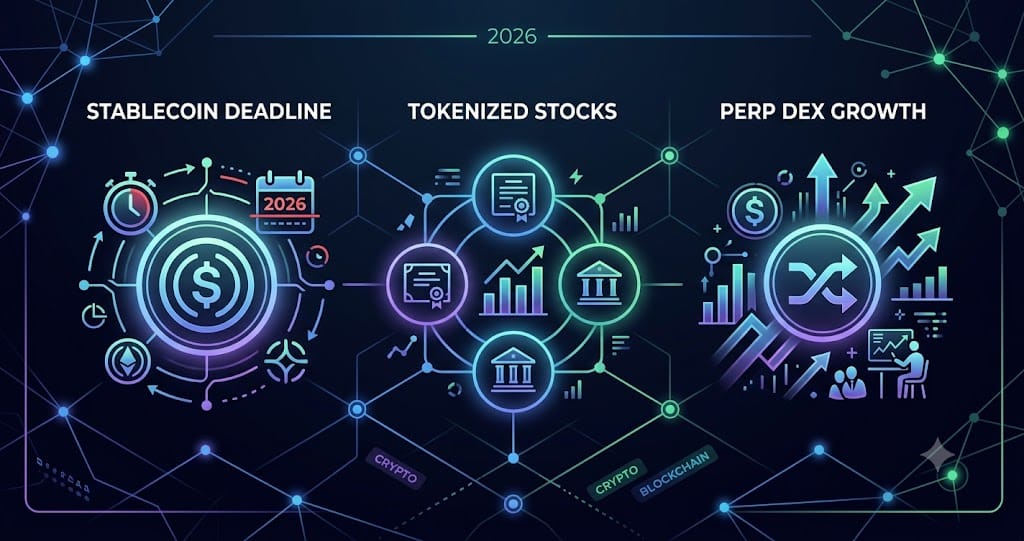
Six US federal regulators have until July 18, 2026, one year after the GENIUS Act was signed, to finalize stablecoin rules that set a $5 million capital floor, require 1:1 reserves in cash or short-term Treasuries, and ban issuers from paying interest to holders. The stablecoin market is already worth roughly $322 billion, led by USDT with USDC near $77 billion, and 21Shares projects the sector could cross $1 trillion by the end of 2026.
Elsewhere, capital is rotating into narratives with measurable revenue or hard regulatory catalysts. Lighter (LIT) jumped 48% over seven days to about $2.54 after Robinhood Wallet integrated its perpetual contracts on July 2, tokenized stocks reached a $5.5 billion market cap on data through June 8, and Render onboarded roughly 60,000 consumer GPUs through the Salad Network under proposal RNP-023.
The GENIUS Act Deadline: What Changes on July 19
The Office of the Comptroller of the Currency, the FDIC, and four other federal agencies must finalize GENIUS Act implementation rules by July 18, 2026, with no extension available since the law itself turns one year old that day. The OCC has set a $5 million minimum capital requirement for stablecoin issuers, the FDIC has confirmed that token holders receive no deposit insurance, and issuers must back tokens 1:1 with cash, insured bank deposits, or short-term US Treasuries.
The rule barring issuers from paying interest to stablecoin holders is the clause most likely to reshape flows. Compliant dollar stablecoins cannot offer yield, which may push yield-seeking capital toward unregulated platforms or DeFi protocols that can legally hold reserves on-chain. Six asset managers, including BlackRock, Goldman Sachs, State Street, Fidelity, BNY, and Invesco, have already launched or filed for GENIUS-compliant reserve money market funds, alongside at least three other firms.
Perp DEX Distribution Goes Retail: Lighter and Robinhood
Perpetual DEX activity, previously concentrated around Hyperliquid, spread this week to Lighter (LIT), which rose 48% to roughly $2.54 and now ranks third in the sector by trading volume. The catalyst was Robinhood Wallet's July 2, 2026 integration of Lighter perpetual contracts, which sent LIT up 24% in a single day and marked the first time a mainstream retail brokerage has plugged directly into a decentralized perpetuals venue.
Robinhood paired the integration with its own Ethereum layer-2, Robinhood Chain, and is covering gas fees for new users for the first 90 days. Broader altcoin rotation stayed narrow and selective this week: Lighter gained 48%, DeXe (DEXE) rose 30% to $28.39, and Cardano (ADA) climbed 26%, with roughly 40% of top-100 tokens outperforming Bitcoin, which held in the $60,000 to $62,000 range.
New RWA Subsectors: Tokenized Stocks and On-Chain Reinsurance
Tokenized equities reached a $5.5 billion market cap as of June 8, 2026, up 147% from $2.23 billion at the start of the year, with monthly on-chain transfer volume near $2.14 billion, an 81% month-over-month increase. Backed Finance's xStocks has processed over $25 billion in cumulative volume in under eight months and accounts for 68% of holders across the top 25 tokenized stock products. Robinhood Chain went live on July 1 and 2, 2026, offering 24/7 self-custody stock token trading in more than 120 countries, though these instruments are debt securities rather than equity and carry no shareholder rights. Kraken's xStocks covers 110-plus countries, and NYSE parent ICE formed a joint venture with OKX in June to compete in the same space.
On-chain reinsurance is a newer, earlier-stage category built around Re Protocol, which underwrote $191.6 million in premiums in 2025 at a 92% combined ratio and held about $465.7 million in TVL as of June 2026. Re's governance token has not yet launched, meaning users currently interact through reUSD and reUSDe while accumulating points ahead of a token generation event. OnRe became the first reinsurer to hold dual licenses in Bermuda, covering both traditional insurance (IIGB) and digital assets (DABA Class F), positioning the sector against a $784 billion global reinsurance market that some project could approach $2 trillion within a decade.
Infrastructure and Warning Signs: Stablechains, DePIN, and the ICM Slowdown
A new class of purpose-built stablecoin blockchains is consolidating in 2026: Tether's Plasma, live on mainnet since March 2026 with fee-free USDT transfers and sub-second, 1,000-plus TPS throughput; Stripe-incubated Tempo, which launched March 18, 2026 with Visa card rail integration and Lightspark Lightning Network support across more than 100 compatible services; and Circle's Arc, still under development. The backdrop includes tokenized Treasuries surpassing $7 billion, an Open USD alliance of more than 140 Fortune 500 companies, and MiCA becoming mandatory across Europe on July 1, 2026.
DePIN compute is also converting from narrative to measurable cash flow: Render's RNP-023 proposal integrated roughly 60,000 consumer GPUs through the Salad Network, and its Dispersed Compute Subnet is expanding to Windows machines globally. The DePIN sector now generates about $150 million in monthly on-chain revenue and has a larger total market cap than the Oracle sector. By contrast, the Internet Capital Markets trend built around Believe, founded by Ben Pasternak, shows signs of topping out. Believe has minted over 9,845 tokens for more than 190,000 traders and $400 million in volume, with LAUNCHCOIN once valued near $4 billion, but weekly trading volume has fallen 80% and new token creation has dropped 77%.
What to Watch
- Whether the six federal agencies finalize GENIUS Act stablecoin rules on schedule by July 18, 2026, and how issuers respond to the no-interest-payment restriction
- Retail adoption trends for Robinhood Wallet's Lighter perpetuals integration and Robinhood Chain's 90-day gas fee subsidy program
- Timing of Re Protocol's governance token generation event as on-chain reinsurance TVL approaches $465.7 million
- Whether Believe and the broader Internet Capital Markets trend stabilize or continue declining after an 80% drop in weekly volume
Ready to start trading?
Trade on Bitget Try CoinTech2uAffiliate links — we may earn a commission at no extra cost to you.
Frequently Asked Questions
What happens to stablecoin issuers after the July 18, 2026 GENIUS Act deadline?
Six US federal agencies, including the OCC and FDIC, must finalize implementation rules by that date with no extension available. Issuers will face a $5 million capital floor, mandatory 1:1 reserves in cash or short-term Treasuries, no deposit insurance for token holders, and a ban on paying interest to holders.
Why did Lighter's LIT token rally 48% this week?
Robinhood Wallet integrated Lighter's perpetual contracts on July 2, 2026, sending LIT up 24% in a single day as part of a broader 48% weekly gain to about $2.54. Robinhood paired the move with the launch of its own layer-2, Robinhood Chain, and a 90-day gas fee subsidy for new users.
What is the key risk with Robinhood's tokenized stock products?
Robinhood Chain's stock tokens, launched July 1 and 2, 2026 across more than 120 countries, are structured as debt securities rather than equity. Holders do not receive shareholder rights such as voting or dividends, even though the tokens track the underlying stock's price.