Bitcoin ETF Inflows End 8-Week, $8.2 Billion Outflow Streak in July 2026
US spot Bitcoin ETFs pulled in $510 million over three days, ending an 8-week, $8.2 billion outflow streak, while ETH ETFs and meme coins saw fresh
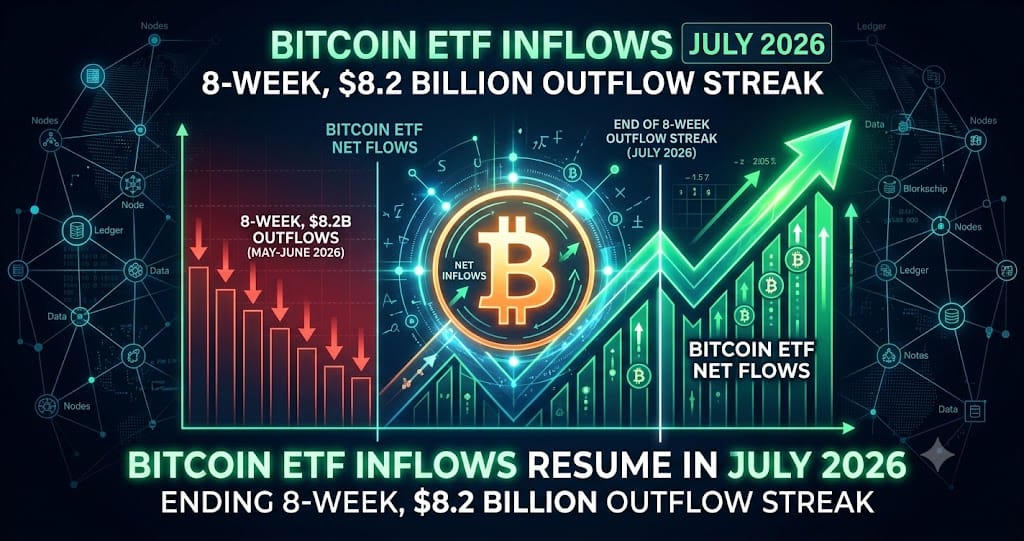
US spot Bitcoin ETFs recorded roughly $510.7 million in combined net inflows over three consecutive trading days through July 9, 2026, ending an 8-week outflow streak that had drained about $8.2 billion from the funds. The reversal follows a single-day $221.7 million inflow on July 3, 2026 that had initially been dismissed as noise rather than a trend change.
The recovery is partial. Bitcoin ETFs remain down roughly $5.4 billion in net outflows for the year, meaning the three-day rebound has offset only about 9% of the year-to-date drain. Fidelity's FBTC led the July 3 inflow day with $166 million, while BlackRock's IBIT posted a $40.43 million outflow the same day, a break from IBIT's usual role as the category's inflow leader.
A Fragile Turn After Eight Weeks of Outflows
The eight-week stretch of outflows through early July 2026 was the worst in the history of US spot Bitcoin ETFs by cumulative dollar volume, according to data compiled by CoinDesk and Bitcoin Foundation. The turnaround began with a $221.7 million single-day inflow on July 3, 2026, which built into the three-day, $510.7 million streak reported by July 9.
The IBIT outflow on July 3 alongside FBTC's $166 million inflow signals that BlackRock's fund is no longer automatically setting the pace for the category. Analysts covering the shift, including reporting from Tech Times, frame this as evidence that institutional allocators are differentiating between issuers rather than moving as a bloc.
Institutions Rotate From Bitcoin Into Ethereum
On July 8, 2026, Bitcoin ETFs posted a same-day net outflow of $84.9 million while Ethereum ETFs took in $70.5 million, with Fidelity's FETH accounting for $69.2 million of that inflow. The ETH figure ended an eight-week streak of net outflows for spot Ethereum ETFs, per data cited by Cryptonomist.
The same-week divergence, Bitcoin outflows paired with Ethereum inflows, is being read as a tactical reallocation within crypto rather than capital leaving the asset class. It marks the first clear rotation signal in the ETF data since Ethereum funds began their extended outflow run earlier in 2026.
Altcoin Season Index Hits a Three-Month High
The Altcoin Season Index climbed from 39 to 46 to 52 over the past several weeks, moving into neutral territory where roughly half of altcoins are outperforming Bitcoin. Bitcoin dominance eased from about 60% to 58% over the same period, according to CoinDesk.
The move comes after sentiment readings as low as 11 on the Fear and Greed scale earlier in the cycle. Analysts still characterize the market as narrow and narrative-driven rather than broadly risk-on, since the July 8 session saw the DeFi sector fall 8.77% even as select altcoin narratives rallied.
MemeCore Leads a Meme 2.0 Rally as DeFi Sells Off
MemeCore (M) gained roughly 89% to 90% over the past week, the top performer among the 100 largest cryptocurrencies by market cap, according to Crypto Daily. The project markets itself as Meme 2.0, running its own blockchain and rewarding both posting activity and on-chain behavior, backed by a pledged $10 million-plus in ecosystem spending from the MemeCore Foundation.
The broader meme sector's market capitalization sits near $34.7 billion, with Solana-based Fartcoin seeing elevated volume and PEPE outperforming Dogecoin, which analysts describe as a shift toward newer meme tokens over legacy names. MemeCore has already fallen about 10% in a single day after its peak, and the same July 8 session that lifted meme tokens saw the DeFi sector drop 8.77% and the token LAB collapse 67.7%, underscoring that the rebound is selective rather than broad-based.
Prediction Markets and AI Agent Payments Emerge as New Categories
Prediction market projects raised about $1.85 billion in the first half of 2026, roughly 26% of the $7.1 billion raised across the top ten funded crypto categories, making it the single largest funding category of H1 2026 according to CoinGecko. Kalshi and Polymarket together processed roughly $44.8 billion in June 2026 trading volume, driven partly by World Cup betting activity, and Kalshi launched a Bitcoin perpetual contract on June 3, 2026, with Ethereum, XRP, and Solana contracts reportedly planned.
A second infrastructure category, AI agent payments built on Coinbase's x402 protocol, has processed more than 169 million payments involving 590,000 buyers and 100,000 sellers, settled mostly in USDC on Base and Solana. The x402 Foundation, backed by Coinbase, Cloudflare, and Stripe, joined the Linux Foundation in April 2026, with Google, Microsoft, AWS, Circle, Visa, and Mastercard listed as supporters, while Forbes reports Visa's tokenized card rails and Coinbase's x402 network are now competing for the same AI agent payment volume, with Visa's stablecoin settlement volume already at $7 billion.
What to Watch
- Whether the $510.7 million three-day Bitcoin ETF inflow streak extends into a fourth and fifth day, or reverts given the year-to-date net outflow of about $5.4 billion
- Ethereum ETF flows following FETH's $69.2 million single-day inflow on July 8, 2026, to see if the BTC-to-ETH rotation continues or was a one-off
- MemeCore's price action after its roughly 90% weekly gain and subsequent 10% single-day drop, a pattern typical of overheated meme rallies
- Kalshi's rollout of additional crypto perpetual contracts beyond Bitcoin, following its June 3, 2026 BTC perpetual launch
- DeFi sector stability after the 8.77% single-day decline on July 8, 2026, and the 67.7% collapse in the LAB token, as a signal of how selective the current rebound remains
Ready to start trading?
Trade on Bitget Try CoinTech2uAffiliate links — we may earn a commission at no extra cost to you.
Related Articles
- Bitcoin's Five Reversals in 25 Days: Inside the July 2026 Liquidation Whipsaw
- Bitcoin Short Squeeze 2026: Inside the $498M Liquidation Event and the $65K-$68K Corridor Ahead
- Bitcoin's June-July 2026 Whipsaw: $4.56B in Liquidations, Then a Short Squeeze
Frequently Asked Questions
Why did Bitcoin ETF outflows end in July 2026?
US spot Bitcoin ETFs recorded three consecutive days of net inflows totaling about $510.7 million through July 9, 2026, ending an 8-week streak that had removed roughly $8.2 billion from the funds. The shift began with a $221.7 million inflow day on July 3, 2026, led by Fidelity's FBTC, while BlackRock's IBIT posted an outflow the same day. Year to date, Bitcoin ETFs are still down about $5.4 billion in net outflows, so the rebound has reversed only a portion of the annual decline.
What does the Bitcoin-to-Ethereum ETF rotation mean?
On July 8, 2026, Bitcoin ETFs saw an $84.9 million net outflow while Ethereum ETFs took in $70.5 million, with Fidelity's FETH contributing $69.2 million and ending an 8-week Ethereum ETF outflow streak. Analysts interpret this as a tactical reallocation between the two largest crypto assets rather than capital exiting crypto altogether.
What is MemeCore and why did it rally in July 2026?
MemeCore (M) is a meme-focused blockchain project that gained roughly 89% to 90% over one week, becoming the top performer among the 100 largest cryptocurrencies. It markets itself under a Meme 2.0 framing that rewards both social posting and on-chain activity, supported by a pledged $10 million-plus ecosystem fund from the MemeCore Foundation. The token has since fallen about 10% in a single day, which analysts flag as a sign the rally is stretched.
Why are prediction markets described as the top-funded crypto category of 2026?
Prediction market startups raised about $1.85 billion in the first half of 2026, representing 26% of the $7.1 billion raised across the ten most-funded categories, according to CoinGecko. Kalshi and Polymarket combined processed roughly $44.8 billion in June 2026 volume, boosted by World Cup betting, and Kalshi added a Bitcoin perpetual contract on June 3, 2026.