Uniswap (UNI) Spotlight — August 5, 2026
In-depth Uniswap spotlight: $4.09 price, +6.5% 24h change, technical analysis, pros/cons, and market outlook.
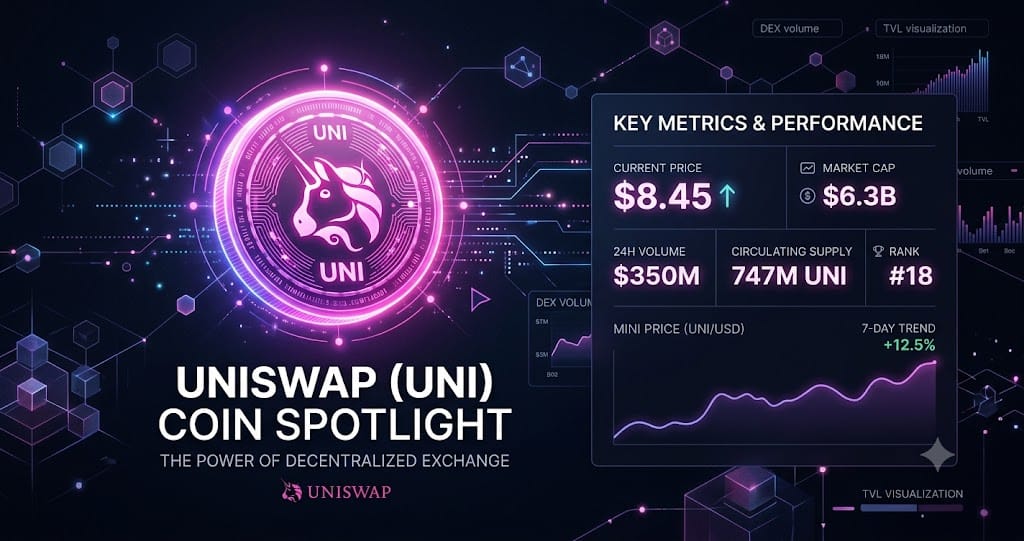
Uniswap (UNI) trades at $4.09 as of August 5, 2026, a 90.9% decline from its all-time high of $44.92 set on May 3, 2021, according to CoinGecko data- . The token holds a $2.6 billion market cap at rank #38, with a 24-hour gain of 6.5%, a 7-day rise of 2.3%, and a 30-day surge of 30.8%- . UNI functions as the governance token for Uniswap, the leading automated market maker DEX on Ethereum, enabling holders to vote on protocol decisions.
The token's recent price action coincides with a fundamental shift in its tokenomics. On July 27, 2026, Uniswap activated protocol fees on v4 pools for the first time, directing all new fees into the existing UNI burn mechanism- . Protocol daily revenue jumped from $114,000 to $325,000 following activation- . Early data implies roughly $26 million in annualized protocol fees- . Uniswap processed $231 billion in Q1 2026 volume — its strongest first quarter ever — and captured 27.4% of global spot DEX trading volume, up from approximately 10% in 2022- . The protocol now controls 84.6% of DEX market share on Arbitrum- . A key metric to watch: daily UNI burn rate, which hit 106,000 tokens on August 1, 2026 — the third-highest burn day ever- .
What Is Uniswap?
Traditional exchanges rely on order books and trusted custodians, making trading slow and illiquid for many assets. Uniswap replaces that with automated pools: anyone deposits equal values of two tokens, traders swap directly against those reserves, and a constant-product formula sets prices instantly without a middleman. Bitcoin is digital gold and Ethereum is a programmable blockchain that uses ETH for transaction fees. Uniswap is neither a base-layer chain nor a currency—it is a decentralized exchange application. UNI does not pay for computation or act as cash; instead, it grants holders voting rights over protocol fees, treasury allocations, and upgrades, making it a governance tool rather than a store of value.
Key Features
- GovernanceVoting: UNI holders passed the UNIfication proposal on December 25, 2025, with 125,342,017 tokens in favor versus only 742 against, according to Bitget News-
- ConcentratedLiquidityAMM: Uniswap V3 pools offer four fee tiers (0.01%, 0.05%, 0.3%, and 1%) per Glassnode data, letting LPs concentrate capital within custom price ranges for higher efficiency-
- FeeSwitchBurn: The protocol captures 17% of swap fees for buybacks and burns, generating about $23.15 million in cumulative revenue since activation on December 28, 2025, per KuCoin-
- MultiChainReach: Uniswap is deployed on over 40 chains as of June 2026, with total value locked at $2.86 billion — $1.96 billion on Ethereum, $416 million on Base, and $198 million on Arbitrum, according to protocol-disclosed data-
- V4Hooks: Uniswap v4 (shipped in late 2024) introduced hooks — programmable smart contracts that execute before or after swaps, liquidity additions, and other pool lifecycle events, with pool creation costs dropping approximately 99% via the new singleton architecture, per Bitget-
Use Cases
- Decentralized Exchange (DEX) applications and use cases
- Exchange-based Tokens applications and use cases
- Decentralized Finance (DeFi) applications and use cases
- Yield Farming applications and use cases
- Automated Market Maker (AMM) applications and use cases
Pros & Cons
✅ Pros
- Strong market position at rank #38 with $2.6B market cap
- Active trading volume of $228.6M suggests healthy liquidity
- Positioned in growing sectors: Decentralized Exchange (DEX), Exchange-based Tokens, Decentralized Finance (DeFi), Yield Farming, Automated Market Maker (AMM)
- Listed on major exchanges ensuring accessibility for traders
❌ Cons
- Currently -90.9% from all-time high of $44.92
- Cryptocurrency markets are highly volatile and unpredictable
- Regulatory uncertainty could impact price and adoption
- Competition from other projects in the same space
Technical Analysis
Our TA engine shows a BULLISH signal with a score of 5/100 (WEAK).
- RSI(14) — Neutral (59.1) (neutral)
- MACD(12,26,9) — Bearish momentum (hist: -0.01) (bearish)
- EMA Trend — Strong uptrend (Price > EMA20 > EMA50) | Above 200d EMA (bullish)
- Bollinger Bands — Near upper band (%B: 77%) (bearish)
- Volume — High volume (1.9x avg) — insufficient base signal for amplification (neutral)
Price Outlook
Ethereum's daily active addresses reached 590,654 on May 22, 2026, up 18% from 500,537 one year earlier- 3 . Yet ETH trades roughly 55% below its August 2025 high of $4,953- 19 . This divergence between usage and price frames the central tension.
Bull Case
Network adoption has never been higher. Daily active addresses climbed toward 2 million in February 2026, surpassing peaks from the 2021 bull market- 19 . Smart contract interactions now exceed 40 million per day- 19 . The Fusaka upgrade in December 2025 cut gas fees by nearly 6x, removing friction for on-chain activity- 1 - 2 . Lower fees appear to have driven a "return to mainnet," with Ethereum's daily active addresses now exceeding those of all major layer-2 networks- 2 .
Supply-side dynamics offer another tailwind. Exchange reserves have dropped to 16 million ETH — the lowest level ever recorded — down 30% from 23 million ETH in 2023- 19 . Roughly 7 million ETH, worth around $13.7 billion, has moved from exchanges to cold storage and staking- 19 . Reduced exchange supply can lower selling pressure over time.
Ethereum dominates tokenized assets. The network hosts approximately $162 billion in stablecoin supply — about 52% of the global market- 19 . Ethereum controls 56% of stablecoins and 66% of tokenized real-world assets when layer-2 networks are included- 2 . Institutional demand appears robust: Ethereum treasuries acquired 1.2 million ETH in Q4 2025- 1 , and BlackRock's staked Ethereum fund pulled in $155 million on its first trading day- 19 .
Bear Case
The price-activity relationship has broken. In prior bull markets (2018, 2021), surging on-chain activity correlated with surging prices- 19 . That pattern no longer holds. Ether dropped roughly 30% over the past six months even as network activity hit record highs- 19 . Capital flows and rising exchange deposits now explain ETH's price better than on-chain usage- 19 .
Not all activity reflects genuine demand. Security researchers attribute a meaningful portion of the active address surge to "address poisoning" attacks — scammers sending tiny "dust" transactions from spoofed addresses- 1 - 2 . This tactic has stolen $740,000 from 116 addresses- 1 . Blockchain security firm Cyvers indicates address poisoning is likely a meaningful contributor to the recent jump, not a minor outlier- 2 . With lower transaction fees, spamming the network has become economically viable- 2 .
Ethereum's fee revenue tells a concerning story. The network generated roughly $10 million in transaction fees over the past 30 days, placing it third behind Tron (~$25 million) and Solana (~$20 million)- 19 . Economic value increasingly flows to layer-2 operators and sequencers rather than to ETH holders directly- 19 . The base layer is losing fee share to rival networks even as total usage climbs.
Tokenomics present an additional headwind. Ethereum's circulating supply stands at approximately 120.69 million ETH- , with roughly 37 million ETH (close to 30% of total supply) locked in staking contracts- 19 . While staking reduces liquid supply, it also creates an overhang: staked ETH can be withdrawn, and the ongoing issuance from staking rewards adds inflationary pressure that may offset some of the supply-side benefits.
Metric to Watch
Monitor the Price-Daily Active Addresses (DAA) divergence- . If DAA remains positive (address growth outpacing price) for an extended period, it may signal a fundamental disconnect. A reversal — price appreciation accompanied by sustained or growing active addresses — would suggest the relationship is re-establishing. Watch for DAA to turn positive and hold above 1.0 on a 30-day moving average.
Uniswap (UNI) Resources
Frequently Asked Questions
Is Uniswap (UNI) a good investment in 2026?
UNI’s investment case depends on Uniswap’s trading activity and governance value. CoinMarketCap data as of August 2026 lists UNI at $4.09 with a market cap of $2.6B, while the token remains 90.9% below its $44.92 all-time high, indicating a large recovery gap but also continued market skepticism.
What is Uniswap (UNI) used for?
UNI is the governance token for the Uniswap protocol, allowing holders to vote on key protocol decisions. According to CoinGecko data, UNI has a circulating market value of about $2.6B at a price of $4.09, while Uniswap operates as an Ethereum-based automated market maker DEX without traditional order books.
Can Uniswap (UNI) reach its previous all-time high?
UNI would need to rise from $4.09 to $44.92 to reclaim its previous peak, requiring an increase of about 998%. CoinMarketCap data shows UNI is currently 90.9% below its ATH, so the key metric to monitor is Uniswap protocol trading volume growth compared with the $2.6B current market capitalization.
How does Uniswap make money and generate value for UNI holders?
Uniswap generates protocol activity through decentralized trading, with value tied to exchange usage, liquidity, and governance decisions. As of August 2026, UNI trades at $4.09 with a $2.6B market cap according to CoinMarketCap data, so the main metric to watch is Uniswap’s monthly trading volume and whether governance decisions create direct value for token holders.
Ready to start trading?
Trade on Bitget Try CoinTech2uAffiliate links — we may earn a commission at no extra cost to you.
Our Verdict
🇧🇩 Bangladesh: Has the political upheaval ended? No — the uprising succeeded in toppling Sheikh Hasina, but violence and instability continue. On August 5, 2026, a massive student-led uprising ended Hasina's nearly 16-year rule, with the prime minister resigning and fleeing the country as hundreds of thousands of protesters marched on Dhaka- - 3 . Army Chief General Waker-Uz-Zaman announced her resignation, and celebrations erupted nationwide- 3 . However, violence persisted after her departure: law enforcement opened fire at multiple locations, protesters continued advancing, and agitated crowds attacked Awami League offices and police stations- 3 . The movement, which began as a quota-reform protest, escalated after a UN estimate of around 1,400 killed and 20,000 injured during the broader unrest- 3 . While the government fell, the country faces an uncertain transition and ongoing unrest. 🌍 Ethiopia landslide: Was anyone killed? Yes — at least 14 people died in a landslide near a monastery in Ethiopia's Amhara region. The disaster struck near the Tsadkane Mariam Monastery in North Shewa zone- - 11 . Heavy rainfall during Ethiopia's main rainy season (June to September) triggered the slide- - 11 . Worshippers had gathered at the monastery for a religious ceremony when the hillside collapsed, burying many under mud and debris- . Seven others were injured, five of them seriously- . Search teams with excavation machinery continue to recover bodies- 11 . 🇵🇭 Philippines earthquake: Was there major damage? No major damage or tsunami threat was reported, despite multiple strong quakes. A 6.4-magnitude earthquake struck off the coast of Mindanao on August 5, 2026- , with the GFZ also recording a 6.3-magnitude jolt at 04:14 GMT- 21 . The Philippine Coast Guard reported no tsunami threat or significant damage- . Several other tremors were recorded throughout the day, including magnitudes 5.0, 4.3, and 3.3- . The strongest quake's epicenter was 29 km southwest of Sarangani at a depth of 13 km- . While the shaking was powerful, it did not cause the widespread destruction that might be expected from a quake of this magnitude. 🇲🇾 Malaysia fishing boat fire: Was anyone killed? Yes — one fisherman died and four others were injured in a boat fire off Mukah. The fishing vessel caught fire about four nautical miles northwest of the Mukah estuary- - 28 . All five crew members jumped into the sea as the fire spread rapidly- 28 . Rescue teams from the Malaysian Maritime Enforcement Agency, Marine Police, Fire and Rescue Department, and other agencies rushed to the scene- 28 . Four victims were rescued with injuries, while one was found unconscious and later pronounced dead- 28 . The cause of the fire remains under investigation- 28 . Maritime authorities have reminded fishermen to prioritize vessel safety and conduct regular inspections- 28 . ⚔️ Strait of Hormuz: Is a deal actually happening? Possibly — but conflicting statements from the U.S. and Iran leave the outcome uncertain. U.S. Treasury Secretary Scott Bessent said on August 5 that a deal could come "today or tomorrow" to reopen the strait- 38 , and President Trump described talks as "very good"- 38 . Axios reported the U.S. was preparing to announce temporary agreements with Iran and Oman as early as Wednesday- . However, Iran's Foreign Ministry spokesman rejected any direct U.S. negotiations, insisting talks were solely with Oman- 38 . Iranian media also cautioned that even if an Iran-Oman agreement is reached, the strait will remain closed as long as the U.S. continues its "violations"- . Qatar confirmed mediation efforts are at "very progressive stages"- 38 . A 60-day temporary arrangement is reportedly under discussion- — but until both sides agree, the strait's reopening remains in doubt. 🚢 Red Sea ship attack: Were the crew rescued? Yes — all 14 seafarers were rescued safely after their Indian-flagged vessel sank. The MSV Faize Noore Oliya, carrying oil from Saudi Arabia, was struck by a projectile off Yemen's coast on August 4, causing it to capsize and sink- - 48 . The crew included 13 Indian nationals and one Yemeni- . India's Ministry of External Affairs condemned the attack, calling the continuing incidents against commercial shipping "deeply worrisome"- 48 . Yemen's government blamed the Houthis for the attack- . India's embassy in Riyadh is coordinating with Yemeni authorities for the crew's safety- 48 . While the vessel was lost, all lives were spared. 🇺🇦 Ukraine-Russia drone attack: Was the vendor killed? No — the 52-year-old vegetable vendor survived, though he was injured. Video footage showed a Russian FPV drone chasing a man at a street market in Kherson before detonating its explosive charge- 59 . The victim, identified as Yuriy, sustained blast trauma, shrapnel wounds, and concussion but his life is not in danger- 59 . Ukrainian President Volodymyr Zelensky shared the footage, calling it a deliberate "drone safari" and a war crime- 59 . The incident occurred in Kherson, which Russian forces regularly strike from across the Dnieper River- 59 . Ukraine's foreign minister labeled it a "barbaric Russian war crime"- 59 . The UN has reported an uptick in civilian deaths in the conflict throughout 2026- 59 . 🇲🇾 Malaysia's Rohingya policy: Will refugees be sent back? No — Malaysia will not proceed with repatriation if their lives are at risk. Communications Minister Fahmi Fadzil confirmed on August 5 that the initial group of 5,000 Rohingya refugees will not be returned to Myanmar if they face persecution or threats to their lives- - 68 . "Malaysia, as a responsible country, will not send the 5,000 Myanmar refugees back if they are likely to be persecuted or if their lives would be at risk," he said- 68 . Prime Minister Anwar Ibrahim had announced on July 29 that Myanmar's junta agreed to take back the refugees, but Malaysia is now examining the criteria to ensure repatriation is safe- 68 . Malaysia hosts one of the region's largest Rohingya populations, many of whom fled persecution in Rakhine State- 68 . Each case will be assessed individually before any repatriation proceeds- .
Related Articles
- Crypto Week June 2026: Proof-of-Humanity Leads as Tokenized Stocks Arrive
- BTC Crashes to USD 78,600: The May 2026 Liquidation Cascade Explained
- Crypto Market Sentiment Breakdown 2026: Fear, Funding Rates, and Macro Risk Signals Explained