2026 Crypto Narratives: Equity Perps, AI Agents, and BTCFi Surge
Equity perps hit USD 30.7B weekly volume in Q1 2026, AI agents reach USD 15.3B market cap, and Babylon locks 56,853 BTC. Key narratives for May 2026.
Three structural shifts defined crypto in the week ending May 24, 2026: equity perpetual weekly volume reached USD 30.7 billion in Q1 2026, up 58x from December 2025; India enacted ISP-level blocks on Polymarket on May 21 under new gaming laws; and Bitcoin ETFs recorded nine consecutive days of net inflows totaling USD 2.7 billion after a prior-week outflow of USD 1 billion.
These are not isolated price events. They represent a convergence of TradFi asset migration onto on-chain rails, regulatory fragmentation across emerging markets, and a maturing institutional demand curve that together define where capital is likely to flow in the second half of 2026.
Equity Perpetuals: TradFi Assets Move On-Chain
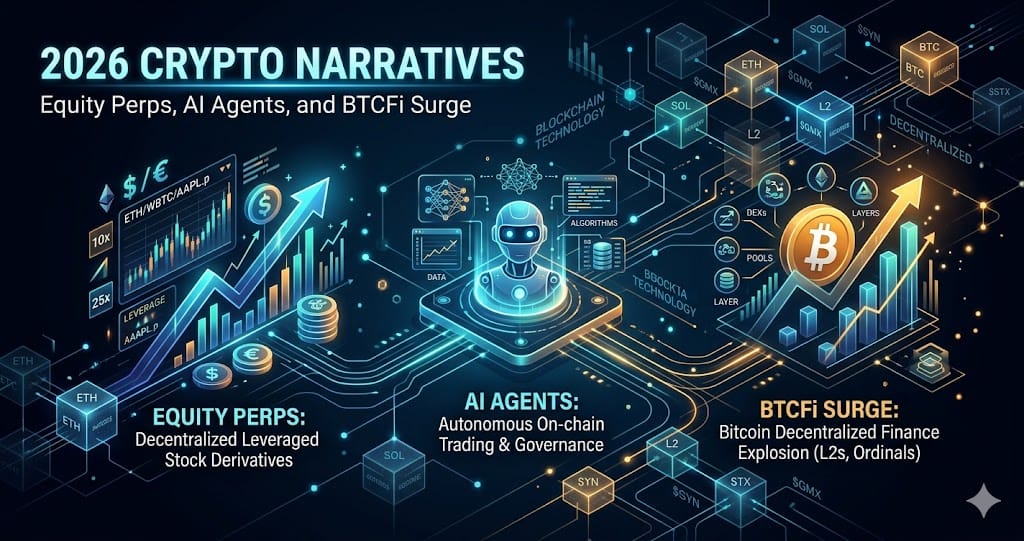
Equity perpetual contracts have emerged as a distinct crypto sub-sector. Weekly volume in TradFi-linked perpetuals rose from USD 525.8 million in December 2025 to USD 30.7 billion in Q1 2026, a 58x increase. The single-week peak of USD 54.5 billion was recorded on February 8, 2026.
Trade[XYZ] deployed the first 24/7 S&P 500 perpetual contract on Hyperliquid after securing an official license from S&P Dow Jones Indices. Kraken followed in February 2026 with crypto-style perpetuals for tokenized U.S. stocks, and Coinbase International has since listed xStocks equity perpetuals. RWA-linked perpetual weekly volume on Hyperliquid jumped from USD 11.8 billion in December to USD 31 billion in January 2026, a 162% month-over-month gain.
Industry analysts project that offshore equity perpetual volume will surpass crypto perpetual volume within two to three years. Hyperliquid, which holds approximately 70% of on-chain perpetual market share and returns 97% of fees to HYPE token buybacks, is the primary infrastructure beneficiary of this migration.
Prediction Markets Under Regulatory Pressure
India's Promotion and Regulation of Online Gaming Rules, effective May 1, 2026, reclassified prediction markets as money games, making them illegal under Indian gambling law. ISP-level blocks on Polymarket took effect May 21, with Kalshi expected to face the same action by May 23.
Polymarket and Kalshi together reached USD 150 billion in lifetime trading volume by April 2026. Kalshi recorded annualized volume of USD 178 billion, a threefold increase over six months, and is simultaneously preparing to enter the crypto perpetuals market, meaning the prediction market and perp DEX categories are beginning to converge.
Polymarket settles in USDC on Polygon, making it a concrete use case for stablecoins as settlement assets. The India action could be followed by similar regulatory moves across Southeast Asia and the Middle East, adding jurisdictional risk to the prediction market growth thesis.
Bitcoin ETF Flows: Two Reversals Inside One Month
Bitcoin ETFs recorded nine consecutive trading days of net inflows beginning May 1, 2026, accumulating USD 2.7 billion. The largest single-day figure was USD 629 million in net inflows. This followed a prior week running from May 11 to 15 that recorded net outflows of USD 1 billion.
Bitcoin spot price fell to the USD 76,000 to 77,000 range during the same inflow period, putting it down approximately 11% year-to-date. Concurrent inflows suggest institutional buyers were accumulating near those levels even as spot price declined. Yet year-to-date cumulative ETF net inflows for 2026 remain below the same-period figures for both 2024 and 2025.
Total assets under management across spot Bitcoin ETF products stand at approximately USD 145.9 billion. The pace of new inflows in 2026 indicates a slower accumulation rate relative to the two prior years, despite continued institutional participation in the ETF structure.
AI Agents, Crypto Cards, and BTCFi: New Sectors Formalize
The AI agents sector reached a combined market capitalization of USD 15.3 billion in Q1 2026. Virtuals Protocol leads the agent launchpad category with a USD 5.01 billion market cap and approximately 14,000 AI agent tokens incubated. AI agent wallets now account for 8 to 12 percent of EVM DeFi transaction volume. FET, Virtuals, and NEAR are identified as the three primary agent execution tokens, sitting downstream of Bittensor as base infrastructure. Coinbase launched Agent.market in April 2026 with seven service categories and USDC settlement on Base.
BTCFi has consolidated around a clear leader. Babylon has locked 56,853 BTC, approximately USD 5.64 billion, in its native Bitcoin staking vaults, making it the largest BTC staking protocol by total value locked. BABY token gained 30% over seven days in mid-May 2026, moving from USD 0.0107 to above USD 0.02. a16z crypto led a USD 15 million funding round for Babylon in January 2026 to advance Trustless Bitcoin Vaults.
Crypto Cards has entered CoinGecko's official 2026 Top 9 Narratives list as a new classification. Mastercard's Crypto Partner Program launched with over 85 institutions including Binance and Ripple, and introduced SoFiUSD as a network settlement option. Visa partnered with Stripe's Bridge subsidiary to deploy stablecoin-settled cards across 100 or more countries, with over 130 active stablecoin-linked card projects live in 40 or more countries.
What to Watch
- Hyperliquid equity perp volume: the weekly TradFi perp peak of USD 54.5 billion on February 8, 2026 is the benchmark to watch as S&P 500 perpetuals gain broader retail access throughout Q2 2026
- India prediction market ban follow-on: Polymarket blocked May 21 and Kalshi expected May 23 — whether Southeast Asia or Middle Eastern regulators adopt similar frameworks in the next 60 days will determine if this is regional or systemic risk
- Bitcoin ETF year-to-date underperformance: the nine-day USD 2.7 billion inflow streak has not yet closed the gap versus 2024 and 2025 same-period baselines — a sustained weekly inflow rate above USD 500 million would be a structural reversal signal
- Babylon BTCFi TVL and BABY token: with 56,853 BTC locked and a16z backing, any announcement of expanded vault capacity or a new staking phase from Babylon is a near-term catalyst for the broader BTCFi narrative
Ready to start trading?
Trade on Bitget Try CoinTech2uAffiliate links — we may earn a commission at no extra cost to you.
Frequently Asked Questions
What are equity perpetuals and why did volume grow 58x between December 2025 and Q1 2026?
Equity perpetuals are crypto-native derivative contracts that track traditional stock prices, such as the S&P 500, and trade 24 hours a day, seven days a week with no expiry date. Volume surged from USD 525.8 million per week in December 2025 to USD 30.7 billion per week in Q1 2026 as platforms like Hyperliquid began hosting officially licensed products, giving non-U.S. investors leveraged exposure to U.S. equities outside traditional exchange hours and jurisdictions.
Why did India ban Polymarket and what does it mean for prediction markets globally?
India's Promotion and Regulation of Online Gaming Rules, effective May 1, 2026, reclassified prediction markets as money games, which are illegal under Indian gambling law. ISP-level blocks on Polymarket took effect May 21, 2026. The broader concern is that similar regulatory frameworks in Southeast Asia or the Middle East could follow, given that Polymarket and Kalshi combined for USD 150 billion in lifetime volume by April 2026, making jurisdictional fragmentation a material risk to the sector's growth.
What is Babylon and why is it relevant to Bitcoin holders in 2026?
Babylon is a Bitcoin staking protocol that allows BTC holders to lock coins in trustless vaults and earn yield without bridging to another chain or relying on a custodian. As of May 2026, Babylon holds 56,853 BTC, approximately USD 5.64 billion, making it the largest Bitcoin staking protocol by total value locked. a16z crypto invested USD 15 million in January 2026. For holders, it represents a structural shift away from Bitcoin's historically yield-free profile, without the counterparty exposure of wrapped token solutions.