2026 Crypto Narratives: RWA Hits USD 29.2B and Altcoin Index Rebounds
Altcoin Season Index rebounds to 39/100, RWA surpasses USD 29.2B, and crypto cards hit USD 406M monthly volume. Key narratives driving markets in May
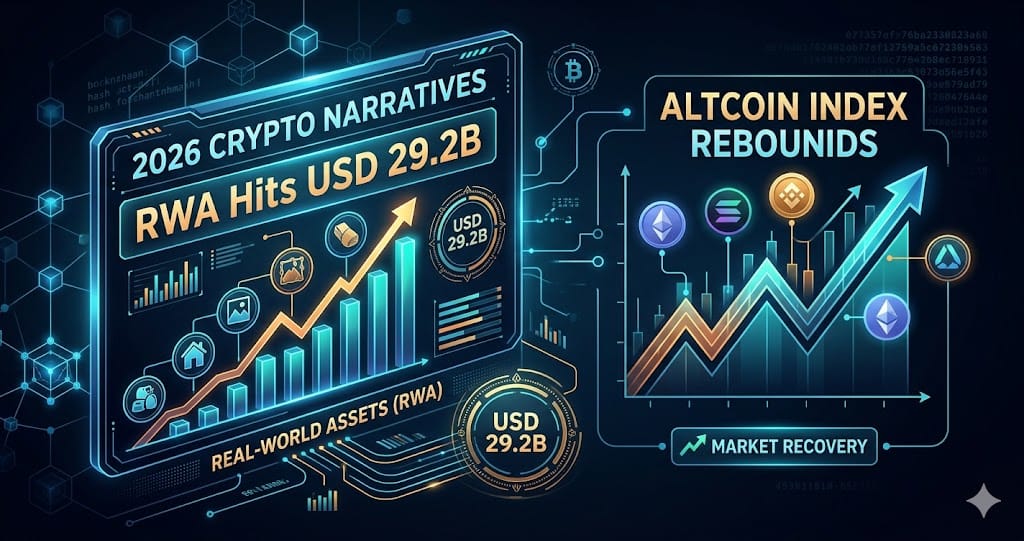
The Altcoin Season Index climbed from 22/100 to 39/100 in the first week of May 2026, a 77% week-over-week jump, while Bitcoin dominance held at 60%. That gap between sentiment recovery and BTC dominance persistence is the defining tension for portfolio positioning right now.
Simultaneously, three structural data points are reshaping where capital is flowing: tokenized real-world assets crossed USD 29.2B on-chain, crypto payment card volume broke USD 406M in a single month, and the Decentralized Perpetuals sector saw Hyperliquid print USD 21.8B in 24-hour volume. This piece maps each narrative with specific figures so readers can calibrate risk before the next rotation leg.
Altcoin Season Index: What 39/100 Actually Signals
The Altcoin Season Index measures how many of the top 100 altcoins outperformed Bitcoin over a rolling 90-day window. A reading of 39/100 in early May 2026, up from a one-year low of 22/100 the prior week, indicates that retail sentiment has shifted from capitulation to tentative speculation. Analysts set 50 as the threshold that would confirm structural rotation out of Bitcoin; until that level breaks, the current move reads as a bounce inside a Bitcoin Season rather than the start of a broad altcoin cycle.
BTC dominance at 60% reinforces that interpretation. Historically, sustained altcoin seasons require dominance to drop toward 55% or below. Traders watching this setup should treat the 50 index level as the trigger for increasing altcoin exposure rather than the current 39, which can reverse quickly if macro sentiment deteriorates.
AI and Meme Convergence: SkyAI, AKT, and the Dual-Layer Narrative
The AI narrative in crypto now operates on two distinct layers. At the infrastructure layer, Akash Network (AKT) is up 72% year-to-date as of early May 2026, trading near USD 0.60, and reported a record USD 5 million in compute revenue for Q1 2026. Its price chart has formed a cup-and-handle pattern, a technical setup that chartists flag as a potential continuation signal. Bittensor (TAO) developer activity is simultaneously at all-time highs, reinforcing the "decentralized compute" sub-narrative.
At the retail speculative layer, SkyAI posted a 290% gain in April 2026 alone, driven by the combination of AI branding and meme coin mechanics. Pudgy Penguins (PENGU) added 53% on community and IP momentum, while Dogecoin (DOGE) rose 13.5% as a liquidity bellwether. The SkyAI move signals that AI infrastructure narratives are now generating consumer-grade meme derivatives, similar to how DeFi blue-chips spawned food tokens in 2020.
RWA Tokenization: USD 29.2B and the Institutional Stack
Tokenized real-world assets reached USD 29.2B in April 2026, compared to USD 5.5B in early 2025. That 5.3x increase in 16 months, including a 38% quarter-over-quarter gain in Q1 2026, makes RWA the fastest-growing DeFi sub-sector by institutional capital inflow. Asset classes on-chain now span US Treasuries, private credit, commodities, and equities.
The broader capital stack is becoming legible: stablecoins at USD 311B provide the cash layer, RWA tokens represent the asset layer, and yield-bearing stablecoins like Coinbase's CUSHY fund connect the two. Analysts tracking institutional on-ramps should monitor RWA monthly growth rates as a leading indicator of the next DeFi total-value-locked cycle, since this sub-sector is explicitly driven by regulated entities rather than retail speculation.
Crypto Cards, DATcos, and Fairer Launches: Three New Categories
Crypto payment cards generated USD 406M in monthly volume in November 2025, the first time a single month crossed USD 400M, with Rain holding 59% share at USD 240M, RedotPay at USD 91M, and ether.fi Cash at USD 36M. CoinGecko's 2026 Top 9 narratives list has formally included Crypto Cards as a standalone category, signaling that analyst frameworks now treat this as a distinct sector rather than a feature of exchanges. The underlying driver is stablecoin mass adoption: with Tether alone holding USD 184B in circulation, the retail payment frontend is the missing link.
Digital Asset Treasury Companies (DATcos) is a new classification term appearing in 2026 research, describing publicly listed firms that hold crypto as a primary reserve asset, extending the MicroStrategy model. CoinGecko groups ETFs and DATcos together in one Top 9 narrative slot, creating a dual-track institutional absorption story alongside spot ETFs. Separately, Fairer Launches, defined as Meme Launchpad designs that resist bot front-running and MEV extraction, have emerged as the competitive differentiator in the Pump.fun successor ecosystem, representing a mechanics upgrade rather than a purely new narrative.
Perp DEXs and Privacy: Volume Data and Regulatory Alignment
Hyperliquid recorded USD 21.8B in 24-hour trading volume and USD 7.3B in open interest in the first week of May 2026. A new competitor named Aster has captured meaningful market share, changing the competitive landscape from a near-monopoly to a contested duopoly. Traders routing large orders should monitor spread and liquidity depth across both venues rather than defaulting to a single platform.
Compliance-friendly privacy, defined as DeFi interactions where user identity is verifiable to regulators but transaction data remains confidential, is being positioned as the 2026 resolution to the tension between KYC obligations and privacy preferences. Projects in the Aztec, Nightfall, and COTI ecosystem are the named implementations to watch. This framing matters because it gives privacy protocols a regulatory argument rather than a confrontational posture, which historically expands the addressable institutional market.
What to Watch
- Altcoin Season Index crossing 50: this is the quantitative threshold analysts define as confirmation of structural rotation out of Bitcoin, currently at 39/100 as of early May 2026
- AKT cup-and-handle resolution: Akash Network is up 72% year-to-date with Q1 2026 compute revenue at a record USD 5M; the technical pattern resolution will indicate whether AI infrastructure tokens can extend beyond YTD gains
- Hyperliquid versus Aster market share: with Hyperliquid printing USD 21.8B in daily volume and Aster gaining ground, this perp DEX duopoly is the clearest data series for measuring DeFi derivatives adoption speed
- RWA monthly tokenization data: the USD 29.2B figure grew 38% in a single quarter; month-over-month growth rate changes are the most reliable signal for institutional on-chain capital flows
Ready to start trading?
Trade on Bitget Try CoinTech2uAffiliate links — we may earn a commission at no extra cost to you.
Frequently Asked Questions
What does an Altcoin Season Index reading of 39 mean for my portfolio?
The Altcoin Season Index measures how many of the top 100 altcoins outperformed Bitcoin over the past 90 days. A reading of 39 out of 100 in May 2026 means the market is still technically in Bitcoin Season, where BTC tends to outperform the majority of altcoins. Analysts use 50 as the cutoff: below that, Bitcoin historically generates better risk-adjusted returns than most altcoins. The jump from 22 to 39 in one week shows sentiment is recovering, but it is not yet a confirmed rotation signal.
What are real-world assets (RWAs) in crypto and why does USD 29.2B matter?
Real-world assets in crypto refer to traditional financial instruments, such as US Treasuries, private credit, commodities, and equities, that have been tokenized and issued on a blockchain. The USD 29.2B figure represents the total on-chain value of these tokens as of April 2026, up from USD 5.5B in early 2025. The scale matters because it reflects regulated institutional capital entering DeFi through a compliant channel rather than speculative retail inflows, which makes the growth more structurally durable than typical altcoin cycles.
What is a DATco and how is it different from a Bitcoin ETF?
A DATco, or Digital Asset Treasury Company, is a publicly listed company that holds cryptocurrency as a primary reserve asset on its balance sheet, using the model pioneered by MicroStrategy. A Bitcoin ETF is a regulated investment product that tracks BTC price and is held by investors in a brokerage account. The key difference is leverage and corporate strategy: DATcos can issue equity or debt to acquire more crypto, creating amplified exposure, whereas an ETF passively tracks price. CoinGecko listed ETFs and DATcos together as a single Top 9 narrative for 2026, reflecting that both serve institutional demand but through different legal and financial structures.