AI Agents Are Driving Crypto's Biggest Narratives in 2026
Three live AI agent payment systems launched in one week in May 2026. Here is what the data says about TAO, VIRTUAL, DePIN, and the selective
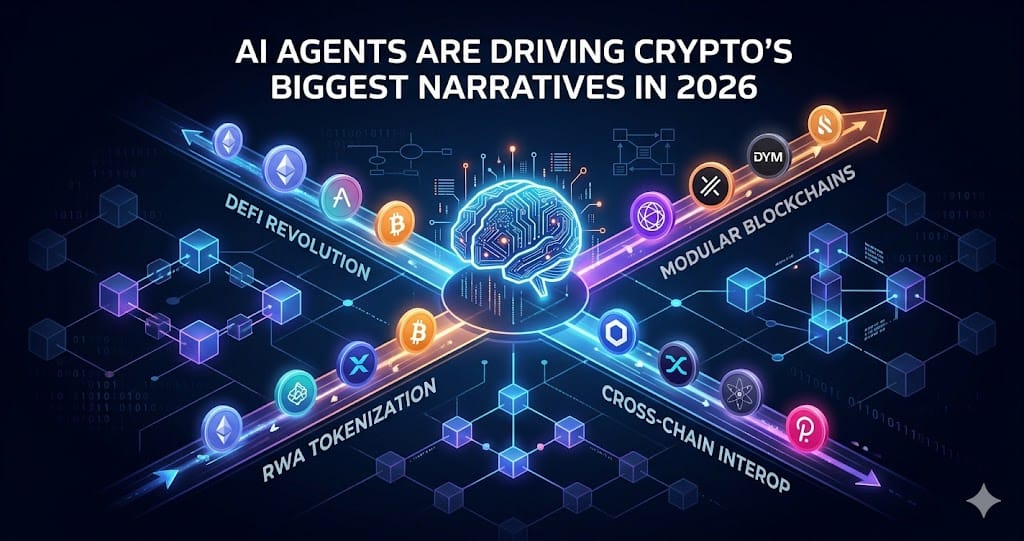
The week of May 12, 2026 confirmed that AI agents needing on-chain payments is no longer a theoretical narrative. Circle, Amazon Web Services, and the Solana Foundation each shipped working infrastructure within seven days, with transactions settling in USDC at under USD 0.01 per call.
At the same time, the Altcoin Season Index sat at 35, placing the market in Bitcoin Season territory, while Bitcoin dominance held at 60.3%. The AI crypto sector reached a combined market cap of USD 22.6 billion with a 17.88% gain, and DePIN hit USD 9.42 billion with a 24.95% gain — both well ahead of the broader market. Capital is not rotating broadly; it is concentrating in a narrow set of sectors.
AI Agents and On-Chain Payments: Three Catalysts in One Week
Circle's Agent Stack introduced Agent Wallets that allow AI agents to hold USDC and execute permissioned financial actions, alongside an Agent Marketplace where agents can buy and sell services from each other. Amazon Web Services announced Bedrock AgentCore Payments in partnership with Coinbase and Stripe, enabling agents to pay for web content, API calls, Model Context Protocol server access, and inter-agent transactions.
Solana Foundation and Google Cloud jointly launched Pay.sh, giving AI agents access to over 75 Google Cloud APIs paid in USDC on Solana, with each call priced below USD 0.01, no subscription required and no billing account needed. Google and PayPal executives offered the same public rationale during this period: AI agents cannot satisfy bank KYC requirements and therefore have no path to traditional payment rails.
The significance of this week is that three independent infrastructure layers converged on the same architecture — stablecoin wallets for software agents — simultaneously. Near 1,000 developers at the Consensus Miami EasyA hackathon were building AI agent projects during the same days, giving the narrative both institutional and developer-side confirmation at once.
Token Performance: TAO and VIRTUAL Define the AI Agent Benchmark
Virtuals Protocol's VIRTUAL token posted a 220% gain over the 30 days ending mid-May 2026, making it the most widely cited example of AI agent token recovery in the current cycle. Bittensor's TAO reached a market cap of USD 3.49 billion with year-to-date gains of 47%. Bittensor operates 128 active subnets and has a Grayscale ETF application currently under review.
The market is beginning to price a clear distinction between projects that have shipped working products and those that remain conceptual. TAO and VIRTUAL are being categorized as the former. The AI crypto sector's USD 22.6 billion aggregate market cap and 17.88% gain during the period reflect this selective rather than uniform repricing across the category.
DePIN Plus AI: The Supply Chain Reframe That Attracted USD 2 Billion in VC
DePIN's 24.95% sector gain reflects a fundamental reframing of the category. The prior narrative positioned DePIN as generalized decentralized physical infrastructure. The version gaining institutional traction in May 2026 positions DePIN projects specifically as the hardware, bandwidth, and data supply chain for AI model training and inference.
Grass aggregates user bandwidth and sells scraping capacity to AI companies. Render pools GPUs for AI model inference. Bittensor's 128 subnets form a decentralized compute market. Venture capital funds totaling over USD 2 billion specifically designated for DePIN infrastructure announced closings this period. That is the clearest signal that institutional capital has adopted the AI supply chain framing rather than the older crypto infrastructure framing.
Selective Altseason: What an Index of 35 and BTC Dominance of 60.3% Tell You
The Altcoin Season Index measures what share of the top 100 altcoins outperformed Bitcoin over 90 days. A reading of 35 on May 12, 2026 places the market in Bitcoin Season. Bitcoin dominance at 60.3% confirms that new inflows are going predominantly to BTC rather than rotating broadly into altcoins. ALGO and TON each posted single-day moves of 9% in early May, but these were isolated events, not a market-wide rotation.
The correct framing for this environment is selective altseason. Only sectors with identifiable demand drivers — AI, DePIN, and Real World Assets — are generating consistent outperformance. Describing the current environment as a general altcoin rally is inconsistent with an index reading of 35 and dominance above 60%.
Prediction market dynamics reinforced the divergence theme. Kalshi recorded USD 4.13 billion in single-week notional volume versus Polymarket's USD 1.60 billion, pushing Kalshi's market share from roughly 53% to 72.1% in one week. Prediction markets as a category captured 18% of all crypto venture funding in Q1 2026, split between Kalshi at USD 1 billion and Polymarket at USD 600 million. Kalshi's CFTC-regulated structure and conventional USD deposit rails are currently outcompeting Polymarket's crypto-native, globally-accessible model at the volume level.
What to Watch
- TAO (Bittensor): USD 3.49 billion market cap, 47% year-to-date, 128 active AI subnets, Grayscale ETF application pending — the largest decentralized AI compute marketplace by subnet count with a track record of shipped infrastructure
- VIRTUAL (Virtuals Protocol): 220% gain over 30 days ending mid-May 2026, the most cited benchmark for AI agent launchpad tokens in media coverage this cycle
- GRASS: DePIN bandwidth token that monetizes user bandwidth sold to AI training pipelines; up 37% as network activity reached new milestones in the same period
- RENDER: GPU-sharing DePIN token positioned as decentralized inference infrastructure; benefits from the AI-DePIN convergence thesis backed by over USD 2 billion in newly closed VC funds
Ready to start trading?
Trade on Bitget Try CoinTech2uAffiliate links — we may earn a commission at no extra cost to you.
Frequently Asked Questions
Why do AI agents need crypto wallets instead of traditional bank accounts?
AI agents are software processes without legal personhood and cannot satisfy the know-your-customer requirements that banks use to open accounts. Stablecoin wallets on public blockchains have no equivalent requirement. Circle's Agent Wallets, AWS Bedrock AgentCore Payments via Coinbase and Stripe, and Solana's Pay.sh all use this property to let agents hold and spend USDC programmatically. The Pay.sh implementation prices each Google Cloud API call below USD 0.01, which is also impractical with traditional payment infrastructure due to transaction minimums and interchange fees.
What does an Altcoin Season Index reading of 35 mean for altcoin investors?
The Altcoin Season Index measures the percentage of the top 100 altcoins that outperformed Bitcoin over the prior 90 days. Readings below 25 are classified as Bitcoin Season, readings above 75 as Altcoin Season. At 35 on May 12, 2026, the index confirms that most altcoins are underperforming Bitcoin. The implication is that position selection matters more than sector-wide exposure. Sectors such as AI and DePIN have shown isolated outperformance within this Bitcoin-dominant structure, but a generalized altcoin rally is not supported by the current data.
Why is Kalshi's weekly volume so much larger than Polymarket's in May 2026?
Kalshi is a CFTC-regulated US prediction market that accepts USD deposits through conventional payment rails, removing the crypto onboarding step for US retail participants. Polymarket requires crypto deposits and restricts US users, limiting its accessible audience. In the week of May 12, 2026, Kalshi processed USD 4.13 billion in notional volume versus Polymarket's USD 1.60 billion, shifting Kalshi's share from approximately 53% to 72.1%. The gap reflects the regulatory-compliant path attracting more capital at the current stage of the cycle, consistent with the broader trend of US-regulated crypto products outperforming their unregulated equivalents in volume metrics.