7 Crypto Narratives Driving the 2026 Bull Market
AI Agents surpassed $15.3B market cap, DATCOs hit 142 companies, and Stablecoin Cards crossed $1.5B/month. The 7 crypto narratives defining 2026.
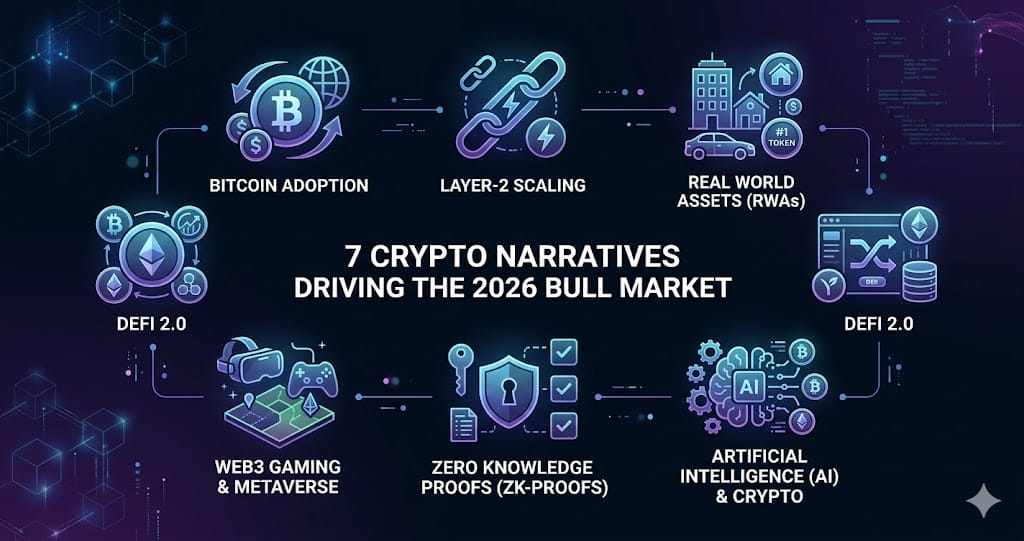
Seven narratives are structurally reshaping crypto capital flows in 2026: AI Agents, DATCOs, Stablecoin Cards, DePIN, Prediction Markets, Meme Launchpads, and institutional staking. The Altcoin Season Index touched 45 out of 100 in early May 2026, with ALGO and TON each gaining roughly 9% in a single day, signaling the earliest stages of rotation away from Bitcoin dominance.
This is not a speculative cycle built on retail sentiment alone. Visa settled USD 4.6 billion in stablecoin transactions in Q1 2026, Mastercard acquired BVNK for up to USD 1.8 billion, and 142 companies now operate as Digital Asset Treasury Companies, up from just 4 in 2020. CoinGecko and MEXC have jointly codified nine canonical narratives for 2026, three of which — Crypto Cards, DATCOs, and ICO Launchpads — did not exist in prior-cycle frameworks.
AI Agents: A $15.3 Billion Sub-Sector That Broke Away from AI Infrastructure
AI Agents became a standalone narrative in 2026, distinct from general AI infrastructure investment. At the Consensus Miami EasyA hackathon, nearly 1,000 developers built AI agent applications, with representatives from Microsoft, Google, AWS, Coinbase, and Stripe all present. The total market cap of AI agent tokens reached approximately USD 15.3 billion, with deployable products already live at AWS, Coinbase, and Stripe.
Virtuals, operating on Base chain, surged roughly 4,600% over three months, while ai16z — rebranded as the open-source cross-chain protocol ElizaOS on Solana — gained approximately 2,900% over the same period. The key structural shift is that AI agents are now consumer-facing applications generating real transaction volume through payment integrations, not simply infrastructure bets on compute or training layers.
DATCOs: 142 Companies Managing USD 130 Billion in Digital Assets
Digital Asset Treasury Companies are publicly listed firms whose primary business is holding digital assets on their balance sheet. From 4 companies in 2020, the category expanded to 142 by early 2026, with 76 of those companies founded in 2025 alone. Total assets across the sector reached USD 130 billion, with 113 companies — 79.6% of all DATCOs — holding Bitcoin as their primary asset, followed by Ethereum at 13.2% and Solana at 2.1.
DATCOs offer a regulated exposure channel structurally different from spot ETFs. Rather than passive custody, companies like BTCS SA — Europe's first active DATCO — use validator staking, structured execution, and yield generation to manage their treasuries. CoinGecko's official 2026 narrative framework lists ETFs and DATCOs together as one of nine defining sectors, reflecting how mainstream the category has become as a portfolio allocation vehicle.
Stablecoin Cards: From USD 100 Million to USD 1.5 Billion Per Month in 24 Months
Stablecoin card transaction volume rose from approximately USD 100 million per month in early 2023 to over USD 1.5 billion per month by the end of 2025, an annualized run rate of USD 18 billion. Visa processed USD 4.6 billion in stablecoin settlements in Q1 2026 alone, and Bloomberg Intelligence projects that stablecoin payment flows will reach USD 56.6 trillion by 2030, growing at roughly 81% per year. Dragonfly and a16z both characterize Stablecoin Cards as the defining narrative of 2026.
Both Mastercard and Visa are moving aggressively. Mastercard acquired BVNK for up to USD 1.8 billion; Visa extended its Bridge partnership — following Stripe's USD 1.1 billion acquisition of Bridge in February 2025 — to over 100 countries. Rain, a card issuance infrastructure provider, raised USD 250 million in a Series C at a USD 1.95 billion valuation in January 2026, backed by ICONIQ Capital and operating under a Mastercard card agreement. Latin America's persistent inflation is the primary demand driver, with consumers substituting USDC and USDT for local currency in everyday purchases.
DePIN and Prediction Markets: Functional Infrastructure With Quantified Growth Paths
DePIN posted a sector market cap of USD 9.423 billion in March 2026 with month-over-month growth of 24.95%, the second-best sector performance after Meme coins. The structural tailwind is Nvidia's constrained GPU supply across multiple quarters of fiscal year 2026, which is redirecting institutional demand toward decentralized compute networks. The AI-DePIN convergence — combining hardware, data, and autonomous agent layers — is tracking as a primary theme for H2 2026, with Robotics-linked tokens beginning to form a hardware-data-agent narrative triangle alongside it.
Prediction Markets are on a quantified growth path: USD 51 billion in 2025 projecting to USD 240 billion in 2026, with a USD 1 trillion target by 2030 implying roughly 4.7x annual growth. Polymarket and Kalshi, the latter valued at approximately USD 22 billion, are the benchmark platforms for the sector. A four-way fusion narrative — Meme coins integrating with AI, Prediction Markets, and PolitiFi — is also consolidating, positioning Meme coins as composite-fundamental assets rather than pure sentiment plays for the first time.
What to Watch
- Altcoin Season Index at 45 in early May 2026, with ALGO and TON each up roughly 9% in one session — the confirmation threshold is ASI at 50 or above for two consecutive weeks, which has not yet been reached
- DATCOs accelerating from passive Bitcoin accumulation to active treasury management via staking and structured products — 76 new companies entered the category in 2025 alone, and the pace continues in 2026
- Stablecoin Cards issuance infrastructure: Rain at USD 1.95 billion valuation and BVNK acquired by Mastercard for up to USD 1.8 billion define who controls card-issuing rails as the USD 56.6 trillion 2030 payment opportunity takes shape
- AI Agents commercial revenue signals: Coinbase and Stripe payment integrations are the first live monetization benchmarks; ElizaOS on Solana is the open-source reference for cross-chain agent protocol development
Ready to start trading?
Trade on Bitget Try CoinTech2uAffiliate links — we may earn a commission at no extra cost to you.
Frequently Asked Questions
What are DATCOs and how are they different from Bitcoin ETFs?
DATCOs, or Digital Asset Treasury Companies, are publicly listed firms that hold digital assets as their core business. By early 2026, 142 companies operated in this category with combined assets of USD 130 billion. Unlike spot ETFs, which passively custody assets, DATCOs can generate yield through validator staking, participate in governance, and deploy structured products — giving investors regulated exposure combined with operational upside that ETFs cannot offer.
Has altcoin season started in May 2026?
Not yet confirmed. The Altcoin Season Index briefly touched 45 out of 100 in early May 2026, with ALGO and TON each gaining roughly 9% in one day and mid-cap tokens including ONDO showing coordinated moves. The conventional confirmation threshold is an ASI reading of 50 or above sustained for two consecutive weeks. Bitcoin dominance remains near 60%, and analysts characterize current conditions as an early beta-testing phase rather than a confirmed rotation cycle.
Which narratives are new to the 2026 crypto framework versus prior cycles?
CoinGecko's official 2026 framework identifies nine canonical narratives, with three considered new entrants compared to prior-cycle thinking: Crypto Cards (stablecoin-powered consumer payment cards), DATCOs (Digital Asset Treasury Companies as a distinct asset class), and ICO Launchpads as a revived category. Robotics-linked tokens are also emerging as a convergence play sitting at the intersection of DePIN hardware, AI data infrastructure, and autonomous agent systems — a combination that did not have a defined sector label before 2026.