5 Crypto Narratives Gaining Traction in May 2026
DePAI splits from DePIN, Hyperliquid hits USD 21.8B daily volume, and stablecoins breach USD 311B. Five narratives driving crypto in May 2026.
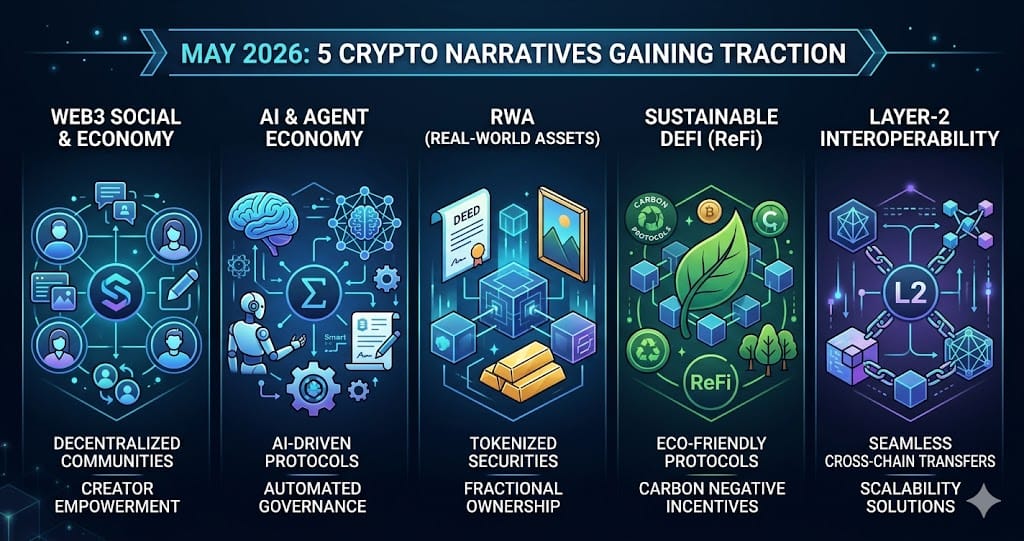
Five narratives are driving capital rotation in crypto as of May 2026: DePAI (Decentralized Physical AI), perpetual DEXs, yield-bearing stablecoins, selective altcoin momentum, and a structural shift from narrative trading to institutional portfolio allocation. Each has moved beyond speculative framing and is now supported by measurable on-chain data.
The Altcoin Season Index held between 35 and 45 through early May 2026 according to CoinMarketCap, confirming a transitional zone rather than a broad altseason. That reading validates a selective rotation pattern where AI tokens, DePIN derivatives, and RWA protocols are outperforming, while most altcoins continue to lag behind Bitcoin.
DePAI Emerges as a Standalone Narrative Separate from DePIN
DePAI, short for Decentralized Physical AI, formally split from the broader DePIN sector around May 6, 2026, when the DePIN segment logged a single-day gain of +20.67%. Messari, Natix, and Aethir all published dedicated DePAI research that week, defining it as a three-layer stack: DePIN hardware at the base, AI agent decision-making in the middle, and on-chain settlement on top.
The defining feature of DePAI versus earlier DePIN framing is its focus on autonomous embodied AI systems, meaning robots, autonomous vehicles, and IoT devices performing verifiable work on-chain. Bittensor, Fetch.ai, and Virtuals Protocol are identified as the leading protocols already generating quantifiable on-chain protocol revenue rather than relying on narrative premium alone. This revenue-based valuation anchor is what separates DePAI from GPU-sharing DePIN projects in the current pricing environment.
Perpetual DEXs Are Now Priced as an Independent Narrative
Hyperliquid recorded USD 21.8 billion in 24-hour trading volume and USD 7.3 billion in open interest as of late April 2026, with those figures continuing to accelerate into May. CoinGecko's 2026 Top 9 Narratives list formally decoupled perpetual DEXs from the broader DeFi category, placing them alongside stablecoins, RWA, and prediction markets as a standalone rotation direction for the first time.
CoinGecko, MEXC, and several institutional analysts have converged on three primary capital rotation axes for 2026: perpetual DEXs, stablecoins and stablechains, and RWA. Hyperliquid's volume dominance gives it a reference-point role in Perp DEX pricing similar to the role Uniswap V3 plays in the spot DEX market. Injective, which was repriced +38.4% after implementing a 60% fee-burn mechanism, represents a second data point confirming that real protocol cash flows are now the primary valuation driver in this segment.
Stablecoin Market Cap Crosses USD 311 Billion
Total stablecoin market capitalization surpassed USD 311 billion in May 2026, up approximately 50% from USD 205 billion at the start of 2025. A new sub-category called Stablechains, which refers to Layer 1 and Layer 2 networks designed specifically for stablecoin settlement, has emerged alongside this growth as a separately investable sector.
Interactive Brokers' 2026 crypto outlook, published this week, characterizes the current environment as the transition point from narrative trading to institutional portfolio allocation. Confirmed infrastructure integrations between Ondo Finance, JPMorgan, Mastercard, and Ripple in the RWA settlement stack are cited as structural evidence of that shift. The USD 311 billion stablecoin base and the RWA sector together form what analysts are describing as a dual on-chain dollar infrastructure.
Meme Coins Shift Toward Fairer Launch Mechanisms
The dominant meme coin narrative shifted in May 2026 from price momentum chasing toward launch mechanism design. KuCoin Alpha and MEXC Innovation Zone introduced anti-bot launch structures, and KuCoin Alpha tokens produced a median 30-day return of approximately 92% under the new mechanism. SKYAI gained +290% in a single month, reaching USD 0.78 per token and a market cap near USD 783 million, entering the top five meme coins by market capitalization.
Pudgy Penguins rose +53% and Dogecoin gained +13.5% during the same period, reinforcing broad meme cycle participation. However, blockchain analyst ZachXBT issued a public warning about SKYAI citing evidence of insider-driven price manipulation, marking the first formal on-chain scrutiny of a major AI-meme hybrid token. Maxi Doge attracted concentrated retail media coverage from outlets including 99Bitcoins as the most-watched new entry point in the current meme recovery cycle.
What to Watch
- Hyperliquid: USD 21.8 billion in 24-hour volume and USD 7.3 billion in open interest make it the reference-point protocol for the Perp DEX narrative, now formally listed as a standalone category in CoinGecko's 2026 Top 9 Narratives
- DePAI leaders Bittensor (TAO), Fetch.ai (FET), and Virtuals Protocol (VIRTUAL): these three are generating measurable on-chain protocol revenue as DePAI prices away from standard DePIN valuation anchors following the May 6 sector breakout
- DeFAI sub-sector: 150+ tracked projects with a combined market cap of USD 685 to 730 million; AIXBT, Velvet (VELVET +12.7% in a single session), aPriori (+11.3%), and Derive (DRV, approximately USD 88 million market cap) are current sector leaders
- EigenLayer restaking ecosystem: approximately USD 19 billion in TVL across 1,900 active operators, but the April 2026 Kelp exploit of USD 300 million and resulting USD 5.4 billion in withdrawals signal active smart contract and systemic counterparty risk across liquid restaking tokens
Ready to start trading?
Trade on Bitget Try CoinTech2uAffiliate links — we may earn a commission at no extra cost to you.
Frequently Asked Questions
What is DePAI and how does it differ from DePIN?
DePAI stands for Decentralized Physical AI. DePIN broadly covers decentralized physical infrastructure including GPU sharing and wireless networks. DePAI specifically refers to autonomous embodied AI systems, such as robots, autonomous vehicles, and IoT devices, that perform verifiable work and settle that work on-chain. Messari and Aethir define it as a three-layer stack covering hardware, AI agent decision-making, and on-chain settlement. The DePIN sector logged a single-day gain of +20.67% on May 6, 2026, partly driven by market recognition of this narrative split.
Why is the Altcoin Season Index at 35 to 45 significant for traders?
CoinMarketCap's Altcoin Season Index uses a scale where readings above 75 indicate broad altseason conditions and readings below 25 indicate Bitcoin dominance. A reading of 35 to 45, as observed in early May 2026, falls in what CoinMarketCap defines as a transitional zone. In practice this confirms the selective altseason thesis: AI tokens, DePAI projects, and RWA protocols are rotating upward, while most smaller altcoins remain flat. Traders using this index as a timing tool should interpret the current reading as directional rotation within specific sectors rather than a signal to add broad altcoin exposure.
What risks should I know about before investing in liquid restaking tokens?
In April 2026, Kelp suffered a USD 300 million exploit that triggered USD 5.4 billion in withdrawals across the EigenLayer restaking ecosystem. EigenLayer currently holds approximately USD 19 billion in TVL with around 4.6 million ETH staked across 1,900 active operators. Ether.fi and Renzo, which holds USD 3.3 billion in TVL, remain the two largest liquid restaking token protocols. The Kelp incident demonstrated that smart contract risk in LRTs is systemic: a vulnerability in one protocol can cause cascading withdrawals across the entire restaking category, not just the exploited platform.