Crypto Narratives June 2026: AI Training, Perp DEX, and RWA Lead
Decentralized AI training, Hyperliquid Perp DEX, RWA tokens, and DATcos are the four themes drawing verifiable capital in June 2026.
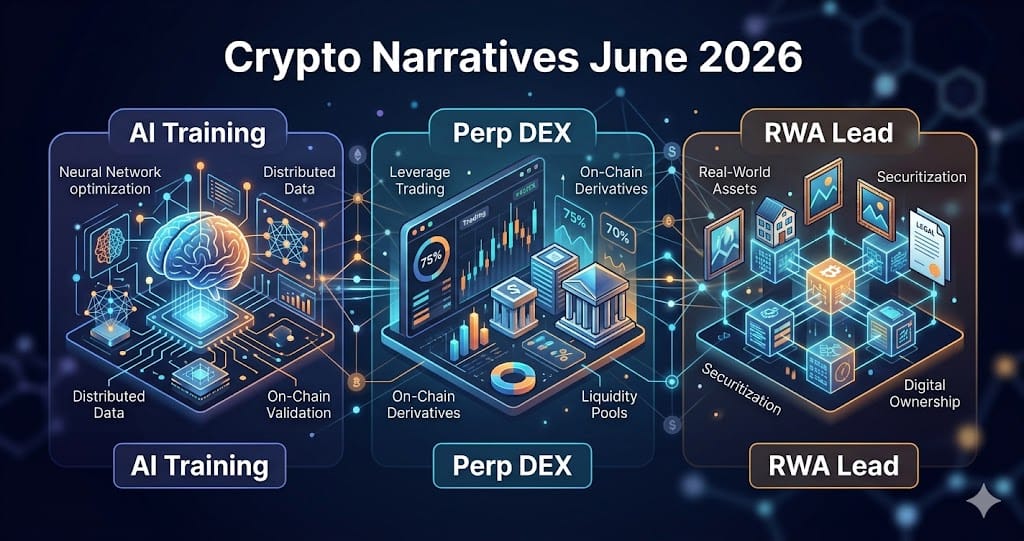
The top four crypto narratives in early June 2026 are decentralized AI model training, on-chain derivatives combining perpetuals and prediction markets, real-world asset tokenization, and digital asset treasury companies. TAO surged roughly 90% in a single move after Bittensor's Templar subnet completed Covenant-72B, a 72-billion-parameter LLM trained by more than 70 contributors across 1.1 trillion tokens, pushing TAO to a 2026 high above USD 305.
Capital is highly selective this week. Protocols with verifiable revenue or real-world output are capturing the bulk of flows: Hyperliquid's HIP-3 permissionless perpetuals already contribute roughly 10% of platform income, ONDO gained 59% over 30 days, and 210 digital asset treasury companies now collectively hold USD 145.9 billion. Broadly speculative plays, including general altseason bets and unfocused memecoins, are lagging every one of these categories.
Decentralized AI Training: From GPU Rental to Model Output
Bittensor's TAO token broke USD 305 this week, its highest level in 2026, driven by the completion of Covenant-72B on the Templar subnet. The model was trained across 1.1 trillion tokens by more than 70 distributed contributors and achieved an MMLU score of 67.1, placing it alongside Llama 2 70B in standard benchmarks. This is the first widely cited example of a frontier-scale LLM completed entirely through decentralized coordination rather than a single data center.
The result reframes Bittensor from an AI-themed speculative asset into a network with auditable model output. Supply dynamics are amplifying the price signal: the December 2025 halving cut daily TAO issuance from 7,200 to 3,600 tokens, creating a supply squeeze at precisely the moment a fundamental milestone landed. Bittensor subnet tokens reached a combined market capitalization of USD 1.5 billion, with nearly every subnet token recording double- or triple-digit 30-day gains as investors priced in the ecosystem upgrade from compute leasing to collaborative model production.
Hyperliquid Merges Perp DEX and Prediction Markets Into One Venue
Hyperliquid's HIP-3 permissionless perpetuals framework, deployed roughly four months ago, now accounts for approximately 10% of total platform revenue. Daily perpetual volume reached a record USD 540 million this week, and the product covers commodities including silver and crude oil alongside crypto pairs, broadening the addressable user base beyond crypto-native traders.
The next catalyst is HIP-4, which would add permissionless prediction markets and zero-day-to-expiry options to the same on-chain engine. That combination effectively collapses two previously separate investment theses, Perp DEX and prediction markets, into a single HYPE narrative. Standalone prediction market Polymarket posted USD 26.2 billion in Q1 2026 volume, a quarter-on-quarter increase exceeding 90%, and a single-day record of USD 425 million on February 28, illustrating the scale of demand Hyperliquid would be absorbing if HIP-4 launches on schedule.
RWA Tokenization Hits USD 25 Billion as Regulatory Clarity Approaches
Total on-chain real-world asset value has surpassed USD 25 billion, with total value locked above USD 19.2 billion as of early 2026. ONDO, which tokenizes US Treasuries, equities, and yield-bearing instruments for institutional access, gained 59% over the past 30 days and is the strongest individual performer in the RWA category this week.
Regulatory momentum is the upstream driver. A May 2026 Senate version of the CLARITY Act is back in focus after prediction markets raised its probability of passing before year-end. Separately, the DTCC is coordinating with more than 50 institutions on a tokenized securities settlement service, with a pilot trade targeted for July 2026 and full rollout by October 2026. Clearer federal asset classification benefits RWA issuers, ETF approval timelines, and institutional on-ramping in parallel, which is why the CLARITY Act text functions as a sector-wide catalyst rather than a single-token event.
DATcos, Crypto Cards, and the Convergence of Real-Use Cases
Digital asset treasury companies, referred to as DATcos, now number 210 entities across 35 countries with a combined holding of USD 145.9 billion, up 140% year-over-year. Strategy, MARA Holdings, and Twenty One Capital are the largest by asset size. The sector is moving past passive accumulation into active portfolio management, custody infrastructure, and potential M&A consolidation, with rating agency scrutiny expected to accelerate that shakeout.
On-chain crypto card spending has reached an annualized USD 18 billion and is projected to reach USD 30 billion by year-end. RedotPay holds 80.7% of current transaction volume, but the fastest-growing challengers including ether.fi, Cypher, MetaMask Card, Gnosis Pay, and Holyheld are all non-custodial, pointing to a structural user preference for spending convenience without surrendering private keys. Mastercard has enabled stablecoin settlement across eight blockchains, supporting USDC, RLUSD, and PYUSD, which removes a significant friction point for mainstream adoption of on-chain card products.
What to Watch
- TAO and Bittensor subnet tokens: monitor whether other subnets release verifiable model outputs, since follow-through depends on Covenant-72B being a repeatable process rather than a one-time event.
- HYPE and Hyperliquid: the HIP-4 launch timeline is the next binary catalyst; track open interest data and whether commodity perpetuals attract non-crypto-native volume.
- ONDO and the CLARITY Act: Senate scheduling is the key political variable; a committee vote would likely trigger a broader re-rating of the RWA sector, not just ONDO.
- Polymarket volume: the USD 26.2 billion Q1 2026 figure sets the baseline; Q2 data will reveal whether prediction markets are a structural category or a cycle driven by high-profile political events.
Ready to start trading?
Trade on Bitget Try CoinTech2uAffiliate links — we may earn a commission at no extra cost to you.
Frequently Asked Questions
What drove the TAO price surge in early June 2026?
TAO rose approximately 90% in a single move after Bittensor's Templar subnet completed Covenant-72B, a large language model trained by more than 70 distributed contributors across 1.1 trillion tokens. The model scored 67.1 on MMLU, comparable to Llama 2 70B, which provided verifiable evidence of real model output rather than infrastructure-layer speculation. The December 2025 halving, which cut daily issuance from 7,200 to 3,600 TAO, added supply-side pressure that amplified the price reaction.
What is HIP-4 on Hyperliquid and why does it matter for HYPE holders?
HIP-4 is a pending Hyperliquid upgrade that would add permissionless prediction markets and zero-day-to-expiry options to the platform's on-chain derivatives engine. If it passes, it expands Hyperliquid's total addressable market by absorbing the prediction market category, which Polymarket alone showed can generate USD 26.2 billion in quarterly volume. HIP-3, the earlier permissionless perpetuals upgrade, already contributes roughly 10% of Hyperliquid platform revenue after just four months, providing a benchmark for how quickly a new product class can become material to the protocol.
How large is the real-world asset tokenization market in 2026?
Total on-chain real-world asset value has exceeded USD 25 billion, with total value locked above USD 19.2 billion as of early 2026. The DTCC, which settles trillions of dollars in traditional securities annually, is coordinating with more than 50 institutions on a tokenized securities service with a pilot scheduled for July 2026 and full deployment by October 2026. ONDO, the leading single-name RWA token, gained 59% over 30 days through early June 2026, and the broader sector is supported by the CLARITY Act moving toward a Senate vote.