Crypto Narratives June 2026: Proof-of-Humanity, NEAR, DeSci, and RWA Catalysts
Proof-of-Humanity, NEAR's 115% 90-day surge, DeSci's 36.8% single-day move, and DTCC tokenization are June 2026's strongest crypto narratives.
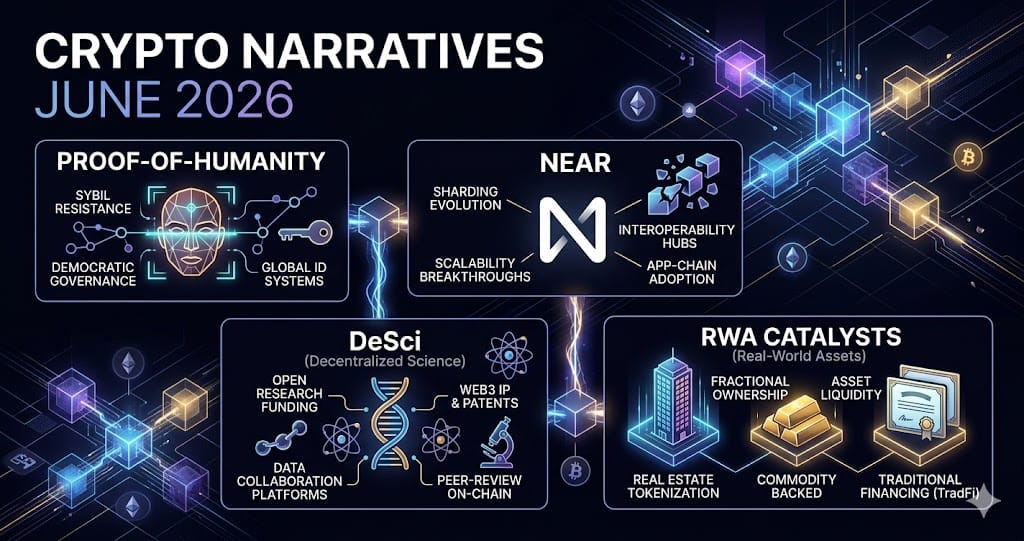
Three narratives posted measurable on-chain evidence in the second week of June 2026: World ID reached nearly 40 million global registrations, NEAR Protocol gained 30% in a single session after its v2.13 upgrade, and the DeSci sector's total market cap rose 36.8% in 24 hours to USD 329 million. These moves share a common feature — each is anchored to a specific protocol event, filing, or verifiable data point rather than general sentiment.
The broader altcoin market has not confirmed a rotation. The Altcoin Season Index sits at 49, and Bitcoin dominance readings conflict across data providers — ranging from 56.0% to 60.66% — with consistent agreement that a sustained break below 55% is required before broad altcoin outperformance can be called. What is working is narrative-specific exposure in identity infrastructure, AI settlement layers, decentralized science, and tokenized real-world assets.
Proof-of-Humanity Emerges as a Standalone AI-Era Narrative
Sam Altman's World project launched a major upgrade to World ID on April 17, 2026, describing it as a "full-stack proof of human" system. By mid-2026 the protocol had accumulated nearly 40 million global registrations, with approximately half verified through its iris-scanning hardware. Consumer integrations with Tinder, Zoom, and DocuSign moved the concept beyond crypto-native audiences and into mainstream user flows.
The investment thesis connects directly to the AI agent narrative: as autonomous agents operate on-chain at scale, protocols require a reliable way to certify that a human counterparty exists behind a transaction. World ID positions itself as that certification layer — sitting beneath training-focused tokens like TAO and application-layer tokens like FET rather than competing with them. WLD is the on-chain representation of that system and has attracted attention as an identity-infrastructure play distinct from other AI tokens.
NEAR Protocol Delivers Concrete Upgrade Catalysts
NEAR Protocol's v2.13 upgrade in June 2026 introduced dynamic resharding, which allows the network to automatically scale shard count based on load without governance votes or extended validator coordination windows. The same release enabled post-quantum cryptographic signatures. The token gained 30% in a single session to USD 2.24 and extended its 90-day cumulative return to approximately 115%.
The protocol has formally branded NEAR as the "currency of agents," targeting AI agent payment flows as a primary use case. NEAR Intents, its cross-chain intent execution layer, has processed over USD 19 billion in volume and generated USD 32 million in fees. Bitwise's NEAR staking ETP reported fresh inflows alongside the upgrade announcement, and daily transaction counts exceeded 5 million at peak during the release window — adding institutional demand signals to the on-chain activity data.
DeSci Posts Real-World Results While Stablechain Infrastructure Scales
BIO Protocol gained 105% between April 13 and April 16, 2026 after its AI system produced a peptide compound targeting ADHD receptors — designated OX2R-004 — within 24 hours of initiation. Traditional early-stage drug discovery timelines for equivalent work run to several months. The event drove broad sector movement: VITA, GROW, VitaRNA, and CryoDAO each gained over 110%, lifting the DeSci category's total market cap 36.8% in a single day. BIO holds approximately 20% of sector market cap and functions as the primary liquidity anchor, with trading volume of roughly USD 720 million against a market cap near USD 68 million on the event day.
A separate infrastructure category called Stablechain is gaining institutional backing. Tempo, launched on mainnet in March 2026 and backed by Stripe and Paradigm, is a stablecoin-native L1 featuring sub-second finality, stablecoin-denominated gas, and a built-in Machine Payments Protocol designed for AI agent transactions. Tempo formalized a settlement partnership with Mesh, opened institutional services via Kraken on June 4, 2026, and stablecoin-focused ventures attracted over USD 1.5 billion in VC funding in 2026. The positioning shifts stablecoins from an asset class to enterprise payment infrastructure running on a dedicated chain.
DTCC Tokenization and the RWA Settlement Layer Upgrade
The Depository Trust and Clearing Corporation announced a tokenized securities platform with a limited production pilot scheduled for July 2026 and full launch in October 2026. Coverage includes Russell 1000 equities, major index ETFs, and US Treasuries. Over 50 institutions joined the working group, including Morgan Stanley, Nasdaq, Robinhood, and Kraken's parent company Payward. Settlement is denominated in stablecoins, connecting this initiative to the stablecoin infrastructure buildout happening in parallel.
Stellar was confirmed on May 27, 2026 as the first public blockchain integrated into the DTCC system, with expansion to additional networks targeted for 2027. This is a structural shift for the real-world asset sector: prior RWA catalysts centered on token issuance platforms such as Ondo Finance, whereas DTCC's involvement moves the conversation to the settlement layer of existing Wall Street clearing infrastructure. The July and October dates represent hard calendar catalysts with institutional counterparties already named and committed.
What to Watch
- WLD (World): Nearly 40 million global registrations with verified consumer integrations on Tinder, Zoom, and DocuSign. The "identity layer for AI agents" framing gives WLD differentiated positioning from training and application-layer AI tokens as the protocol proves consumer-scale traction.
- NEAR: The June 2026 v2.13 upgrade delivered dynamic resharding and post-quantum signatures with no governance delay. NEAR Intents has processed over USD 19 billion in cross-chain volume; the token is up approximately 115% over 90 days with confirmed Bitwise ETP inflows as an institutional demand signal.
- ZEC (Zcash): Grayscale has filed an S-3/A amendment with the SEC to convert its Zcash Trust into a listed ETF on NYSE Arca. Shielded supply grew from 8% of total supply in early 2024 to 30% by May 2026, indicating genuine privacy usage rather than speculative holding, and Multicoin Capital has been a documented accumulator since February 2024.
- BIO Protocol and the DeSci basket: BIO's AI produced a named drug candidate, OX2R-004, in 24 hours — a verifiable milestone that drove a 36.8% sector market cap gain. The narrative has a specific data anchor distinguishing it from prior concept-only DeSci cycles, though analysts have flagged that valuation sustainability warrants scrutiny at current multiples.
Ready to start trading?
Trade on Bitget Try CoinTech2uAffiliate links — we may earn a commission at no extra cost to you.
Frequently Asked Questions
What is driving the Proof-of-Humanity narrative in June 2026?
The primary catalyst was the April 17, 2026 upgrade to World ID by Sam Altman's World project, which introduced what the team described as a full-stack proof of human system. By mid-2026 the protocol had nearly 40 million registrations with roughly 20 million hardware-verified users. Live integrations with Tinder, Zoom, and DocuSign gave it consumer-scale distribution, and the broader thesis — that AI agents operating on-chain require a certified human layer beneath them — connected the token to the existing AI infrastructure narrative in a complementary rather than overlapping way.
Is altcoin season confirmed for June 2026?
Not by the standard thresholds. The Altcoin Season Index was at 49 in the second week of June 2026, and Bitcoin dominance readings ranged from 56.0% to 60.66% depending on the data source. Historical altcoin season conditions have required BTC dominance to fall and hold below approximately 52 to 54 percent. The current environment rewards selective positioning in narratives backed by real metrics — protocol upgrades, institutional filings, or on-chain volume data — rather than delivering broad altcoin outperformance.
What does DTCC's blockchain platform mean for real-world asset tokens?
DTCC, the central clearing and settlement body for US equities, is running a limited production pilot in July 2026 covering Russell 1000 stocks, major ETFs, and US Treasuries, with full production launch in October 2026. Stellar was confirmed as the first integrated public blockchain on May 27, 2026. The significance for RWA tokens is that prior catalysts addressed the issuance side of tokenized assets; DTCC's initiative targets the settlement layer of existing Wall Street clearing infrastructure, with over 50 named institutional participants already in the working group. The July and October dates are concrete milestones rather than open-ended timelines.