Crypto Narratives June 2026: Stablecoin Wars, DATCOs, and XRP's 400% Surge
Circle Arc vs Tether StableChain, DATCOs at USD 100 billion, and XRP up 400% YTD: which narratives are driving crypto capital rotation in June 2026.
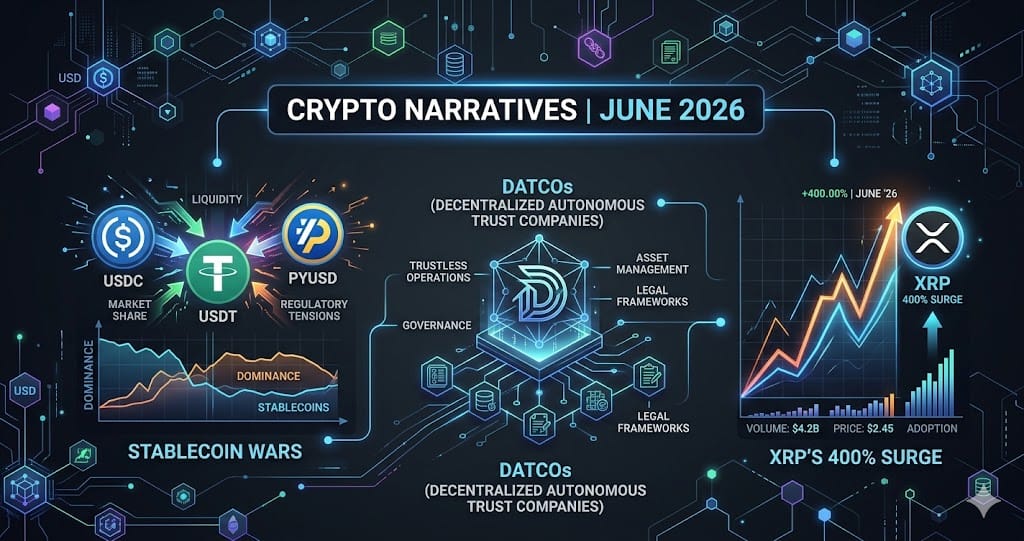
The defining crypto shift in early June 2026 is the emergence of purpose-built stablecoin blockchains as a primary competitive battleground: Circle Arc confirmed a move to proof-of-stake while adding gas-free nanopayment support for AI agents, and Tether StableChain, launched December 2025, processes only USDT with a STABLE governance token. Total stablecoin market cap reached approximately USD 316 billion as of April 2026, up more than 54% from roughly USD 205 billion at the start of 2025.
At the same time, Digital Asset Treasury Companies (DATCOs) have grown into a USD 100 billion sector, XRP has delivered roughly 400% year-to-date gains driven by Ripple's OCC bank license application and USD 22 million in weekly ETF inflows, and the altcoin season index sits at just 39 out of 100. Capital is rotating into specific sectors rather than moving across the market broadly.
The Stablechain War: Circle Arc Versus Tether StableChain
Two dedicated stablecoin blockchains are now in direct competition. Tether StableChain launched in December 2025 as a closed ecosystem that handles only USDT transfers and issues a STABLE governance token. Circle's Arc chain remains in testnet but confirmed a shift to proof-of-stake this week, positioning itself as an open, institution-facing settlement rail. Its headline feature is nanopayments: gas-free USDC transfers as small as one-millionth of a dollar, designed specifically for autonomous AI agent transactions.
The broader stablecoin market provides the scale backdrop for both ambitions. On-chain stablecoin transactions exceeded USD 33 trillion in 2025, and B2B payments now account for roughly 60% of stablecoin payment volume. USDT holds approximately 59% of total stablecoin supply at around USD 184 billion, while USDC sits near USD 78 billion. Venture capital investment in stablecoin-related companies has surpassed USD 1.5 billion, and McKinsey published a dedicated analysis this week titled "Beyond Stablecoins," framing the category as an emerging on-chain monetary settlement layer rather than a trading instrument.
DATCOs and Stablecoin-as-a-Service: Two New Institutional Entry Channels
Digital Asset Treasury Companies (DATCOs) have reached an estimated USD 100 billion in aggregate valuation and now appear as a standalone narrative category in CoinGecko's 2026 taxonomy alongside ETFs. The model traces to the 2020 blueprint of holding digital assets as a primary balance-sheet reserve, and it has spread broadly enough to define a third institutional on-ramp: capital enters crypto through publicly listed company balance sheets rather than ETF flows or direct on-chain purchases.
Stablecoin-as-a-Service is forming as a parallel infrastructure category. Real World Asset (RWA) tokenization is tightly linked: active RWA market cap reached USD 25.895 billion, with total value locked starting 2026 at USD 19.2 billion and analysts projecting the figure could exceed USD 50 billion by year-end. Both DATCOs and Stablecoin-as-a-Service represent low-speculation, high-certainty narratives, making them more relevant to institutional and B2B audiences than retail-driven meme cycles.
XRP at 400% YTD, DePIN's Second Spring, and How Sector Rotation Works Now
XRP is the clearest example of the current pricing logic: verifiable protocol revenue combined with a specific regulatory catalyst and measurable institutional inflows. Ripple's application for an OCC bank license and USD 22 million in weekly ETF inflows drove XRP to approximately 400% year-to-date gains by early June 2026. DeXe reached 363.67% YTD on similar dynamics, and Solana is up roughly 180% YTD. The consistent pattern is that assets with real revenue, a regulatory event, or confirmed institutional participation are outperforming the broader market.
DePIN (Decentralized Physical Infrastructure Networks) shows analogous fundamentals. The sector reached a market cap of USD 9.423 billion with a recent gain of approximately 24.95%, according to DefiLlama narrative data. Protocols including Akash and io.net have shifted node economics from token-subsidy incentives toward actual compute revenue by absorbing AI workload demand. This extends the broader AI infrastructure narrative from the application layer, where Bittensor and NEAR sit, down to physical hardware supply.
Memecoin Cooldown, Launchpad Tokens, and the Crypto Cards Category
Memecoin total market cap contracted to approximately USD 34.7 billion as of May 2026, down from earlier readings closer to USD 47 billion. Weekly charts for DOGE, BONK, WIF, and POPCAT all show volume contraction, and market participants describe the sector as consolidating rather than advancing. Retail behavior has shifted from price-chasing toward earlier-stage discovery, with newer speculative targets such as BinanceLife and BUILDon drawing attention based on narrative positioning rather than existing price momentum.
CoinGecko's updated 2026 narrative taxonomy introduces two categories absent from earlier frameworks: Meme Launchpads and Crypto Cards. Pump.fun, Four.Meme, and Moon are the primary meme launchpad platforms active on Solana and other chains, and they now trade as investable assets distinct from the meme tokens they generate. Crypto Cards, listed as the ninth major narrative, targets everyday consumer spending as an on-ramp product. With the altcoin season index at 39 out of 100 and Bitcoin dominance near 60%, the structure continues to reward specific protocols over the market as a whole.
What to Watch
- Circle Arc's proof-of-stake transition and nanopayment feature, which enables gas-free USDC transfers as small as one-millionth of a dollar for AI agent use cases
- XRP's OCC bank license application and the Crypto Clarity Act timeline, which combined to drive USD 22 million in weekly ETF inflows and a roughly 400% YTD price gain by early June 2026
- DePIN sector market cap at USD 9.42 billion with Akash and io.net shifting from token-subsidy to real compute revenue as AI workloads migrate on-chain
- Prediction market volume projections tracking from USD 51 billion in 2025 toward an estimated USD 240 billion in 2026, with new verticals including weather outcomes, corporate earnings, and on-chain metrics
Ready to start trading?
Trade on Bitget Try CoinTech2uAffiliate links — we may earn a commission at no extra cost to you.
Frequently Asked Questions
What is a stablechain and how is it different from a general-purpose blockchain?
A stablechain is a blockchain built specifically to settle stablecoin transactions rather than support general smart contract activity. Tether StableChain, launched December 2025, only processes USDT transfers and issues a STABLE governance token. Circle's Arc chain, currently in testnet, is optimized for USDC settlement with gas-free nanopayments as small as one-millionth of a dollar, targeting institutional DeFi and autonomous AI agent payments rather than retail trading.
What is a DATCO and why does it matter for crypto markets in 2026?
A DATCO, or Digital Asset Treasury Company, is a publicly listed company that holds digital assets as a primary balance-sheet reserve. The sector reached an estimated USD 100 billion in aggregate valuation in 2026. DATCOs matter because they represent a third channel through which institutional capital enters crypto, alongside spot ETF flows and direct on-chain purchases, without depending on retail participation or speculative trading activity.
Is altcoin season happening in June 2026?
No. The altcoin season index sat at approximately 39 out of 100 as of early June 2026, placing the market firmly in Bitcoin-dominant territory, with Bitcoin dominance near 60%. Rather than a broad-based rally, what is occurring is sector-specific rotation into categories with verifiable revenue or regulatory catalysts, including RWA at USD 25.895 billion active market cap, Perp DEXs, AI infrastructure, and stablecoin chains. Assets without clear fundamentals are largely underperforming.