Crypto Narratives Dominating May 2026: OSMO, DeSci, and BTCFi
OSMO surged 220% on May 11, BIO gained 96%, and Babylon BTCFi TVL hit $3.39B. The five narratives driving crypto in May 2026.
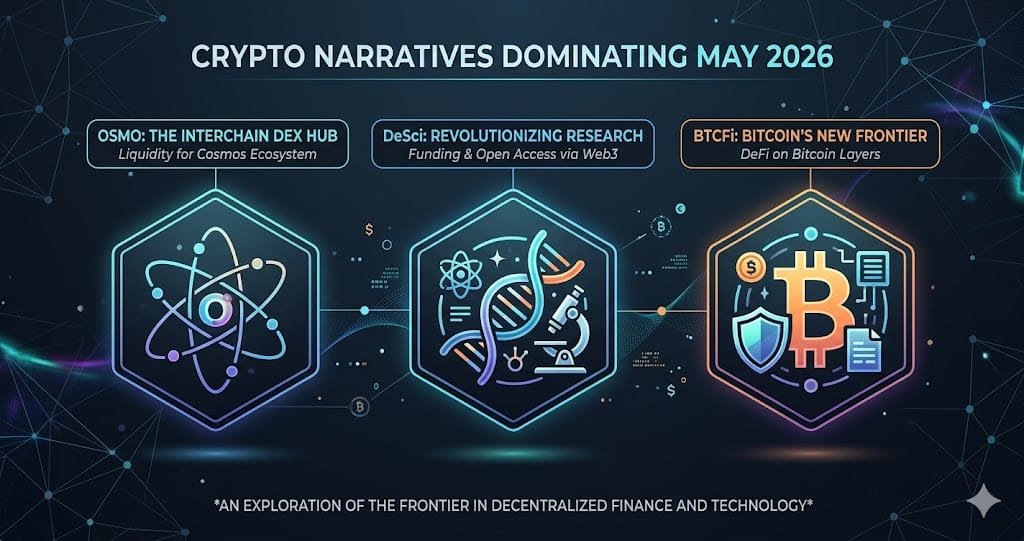
Five narratives moved the most capital in crypto during the week of May 11, 2026: a Cosmos Hub merger proposal sent OSMO up 220% in a single day, BIO token jumped 96% on a DeSci AI breakthrough, and Babylon Protocol crossed USD 3.39 billion in TVL to become the second-largest restaking network globally behind EigenLayer.
The broader market context is a BTC dominance rate of 60% and a CMC Altcoin Season Index of 39 out of 100 as of May 12, 2026. Analysts describe the current structure as a narrow-narrative, high-rotation market — distinct from the broad altseason of 2021 — meaning capital is cycling quickly between specific thesis plays rather than lifting the entire altcoin market uniformly.
Cosmos Ecosystem: OSMO Gains 220% on Merger Proposal
On May 11, 2026, Osmosis (OSMO) recorded a single-day price increase of approximately 220%, driven by a Cosmos Hub governance proposal to merge the two ecosystems. The proposed terms offer holders roughly 1.998 OSMO for every 0.0355 ATOM, with a six-month conversion window. It is the first time the Cosmos ecosystem has received independent narrative pricing in the current market cycle.
Prior to this event, Cosmos-family assets had been grouped by analysts under long-dormant Layer 1s with no imminent catalysts. The merger proposal reframes them under a governance-driven consolidation thesis — a category that historically attracts longer-horizon capital alongside event-driven traders. ATOM also posted double-digit gains in sympathy, suggesting the market is pricing the combined entity rather than just the mechanical swap rate.
DeSci Arrives: BIO Token Surges 96% After AI Peptide Discovery
BIO, the governance token for BIO Protocol, rose approximately 96% in a single session on KuCoin following a high-profile April 30, 2026 event: an AI agent called peptAI reportedly designed and validated a novel ADHD-treatment peptide, OX2R-004, in 24 hours at a total cost of USD 1,500. That announcement triggered USD 202.5 million in 24-hour trading volume on BIO, a 185% volume spike, and introduced decentralized science as an independent sector to a market that had not previously tracked it this cycle.
BIO Protocol uses a bioTokens mechanism to fractionalize and tokenize biopharmaceutical IP pipelines, positioning the token as both a governance instrument and a liquidity backbone for the sector. A BIO v2 tokenomics governance vote is scheduled for May 2026, with proposals to introduce protocol-owned liquidity and reduce inflationary sell pressure. The April 30 catalyst is the kind of verifiable, real-world proof-of-concept that tends to anchor longer-duration narratives beyond the initial speculative spike.
BTCFi: Babylon Protocol Reaches USD 3.39B TVL Without Wrapping BTC
Babylon Protocol's total value locked reached USD 3.39 billion as of mid-May 2026, placing it second only to EigenLayer among all restaking networks globally. a16z crypto led a USD 15 million funding round in January 2026. The protocol is developing Trustless Bitcoin Vaults, which would allow native BTC locked on the Bitcoin mainchain to serve as collateral for external DeFi protocols without wrapping the asset or relying on a custodian.
BABY token, Babylon's native asset, carries a market cap of approximately USD 60 million against the USD 3.39 billion TVL figure — a 1:65 compression ratio that signals early-stage narrative adoption. BTCFi as a category did not appear in most analyst narrative trackers before this quarter. The combination of a16z backing, a credible path to trustless BTC utility, and compressed token valuations is drawing comparisons to the early EigenLayer restaking window.
Meme Sector Rotation: TROLL, BUILDon, and the Fairer Launch Infrastructure
The meme sector produced distinct sub-narratives this week. TROLL, a Solana-based memecoin, gained 77% on May 10, 2026 and has returned approximately 632% over the prior 30 days, pushing its market cap toward USD 110 million. BUILDon (ticker B) rose 37% on the week to a USD 470 million market cap, driven by Trump-linked stablecoin speculation alongside SAGA and ASTEROID. The meme sector as a whole is recovering from a November 2025 low of USD 47.2 billion in total market cap, down from a December 2024 peak of USD 150.6 billion, and is roughly 16 months into its recovery cycle.
A structural shift in how meme tokens launch is also gaining traction. The Fairer Launches framework, implemented by protocols including OpenClaw on Solana, introduces anti-sniper protections against bot front-running on the first block, bonding curves that delay Raydium migration until a market cap milestone is reached, and on-chain reputation systems that route tokens toward verified community participants. This represents the next iteration beyond the Pump.fun model and is being tracked as a separate infrastructure narrative rather than a speculative token story.
What to Watch
- OSMO and ATOM: the six-month Cosmos Hub merger conversion window creates a defined event timeline; governance vote outcomes are the primary risk variable to monitor
- BIO v2 tokenomics vote in May 2026: a shift to protocol-owned liquidity and reduced inflation would structurally change sell-side pressure and could serve as a second catalyst for the DeSci narrative
- Babylon BABY token: the 1:65 market-cap-to-TVL compression ratio will narrow as the BTCFi narrative broadens; monitor TVL growth rate against BABY price divergence on a weekly basis
- CMC Altcoin Season Index and weekly BTC dominance closes: the index sits at 39 out of 100 with BTC dominance at 60%; the four-to-eight week trend in these two readings will determine whether the narrow-rotation structure transitions into a broader altseason
Ready to start trading?
Trade on Bitget Try CoinTech2uAffiliate links — we may earn a commission at no extra cost to you.
Frequently Asked Questions
Why did OSMO increase 220% in one day on May 11, 2026?
The move was driven by a Cosmos Hub governance proposal to merge with Osmosis. The proposed exchange rate is approximately 1.998 OSMO per 0.0355 ATOM held, with a six-month conversion window. The market interpreted this as the first hard catalyst for the Cosmos ecosystem in the current cycle, triggering a sharp repricing of OSMO out of its long-term accumulation range.
What is DeSci and why is BIO attracting attention in May 2026?
DeSci, or decentralized science, refers to protocols that use blockchain mechanisms to fund, govern, and tokenize scientific research pipelines. BIO Protocol gained attention after its AI agent peptAI reportedly designed a novel ADHD-treatment peptide called OX2R-004 in 24 hours at a cost of USD 1,500 in late April 2026. That event generated USD 202.5 million in 24-hour trading volume on BIO and introduced the sector to a broad audience for the first time this cycle.
Is the crypto market in an altseason as of May 2026?
Not by standard metrics. The CMC Altcoin Season Index stands at 39 out of 100 as of May 12, 2026, with BTC dominance at 60%, both of which classify the market as BTC Season. However, isolated assets with specific catalysts — OSMO at 220%, BIO at 96%, TROLL at 77% in a single session — are outperforming sharply. Analysts characterize the current structure as narrow-narrative, high-rotation rather than a broad altseason lift.