Crypto Narratives in May 2026: RWA, BTCFi, and Selective Altcoin Rotation
RWA on-chain assets hit USD 20B, Babylon stakes 56,853 BTC, Bitcoin ETFs show first reversal signal. What's moving crypto markets in May 2026.
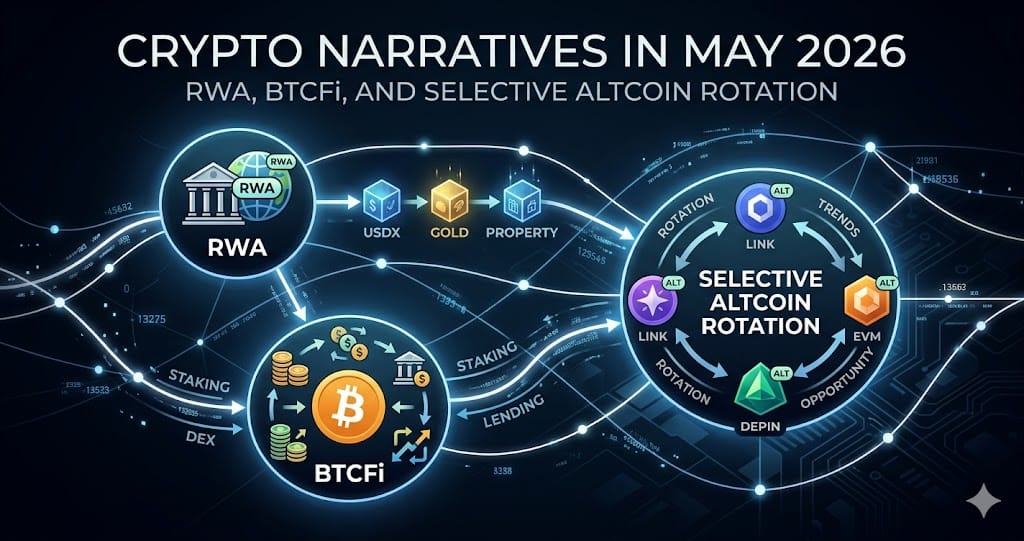
The week of May 10, 2026 delivered a structural shift across crypto markets: on-chain RWA assets crossed USD 20 billion, tokenized U.S. Treasuries hit USD 11 billion, and Babylon's native Bitcoin staking protocol reached USD 5.64 billion TVL with 56,853 BTC committed natively. These are infrastructure events, not speculative milestones.
Bitcoin ETFs recorded seven consecutive weeks of net inflows totaling USD 3.4 billion before a single-day USD 268.5 million outflow on May 7 broke the streak. The Altcoin Season Index sits at 35 and Bitcoin dominance holds above 60.3%. Research firm 10x Research formally invalidated the broad altseason thesis on May 14, 2026. The market is selectively rewarding three categories: structural cash flows, infrastructure-grade catalysts, and ecosystem resets.
RWA Crosses USD 20 Billion: Three Infrastructure Milestones in Five Days
Bullish completed a USD 4.2 billion acquisition of Equiniti on May 10, 2026, securing regulated transfer agent credentials that connect directly to thousands of listed companies. This gives Bullish a licensed pathway to put listed equities on-chain through an existing regulatory relationship, not a sandbox pilot program.
Within the same five-day window, Ondo Finance, JPMorgan Kinexys, Mastercard MTN, and Ripple's XRPL jointly executed the first atomic settlement cross-border redemption of tokenized U.S. Treasuries across four separate infrastructure layers. Total tokenized Treasury supply now stands at USD 11 billion, and tokenized commodities -- led by XAUT and PAXG -- grew 289% year-over-year to USD 5.5 billion. A16z crypto and Standard Chartered both reclassified RWA from a narrative trade to an institutional portfolio allocation category in their 2026 outlooks, with Standard Chartered projecting the broader on-chain RWA market reaching USD 50 billion by year-end.
Babylon Leads BTCFi With USD 5.64 Billion in Native BTC Staking
Babylon topped CoinGecko's trending chart for the week ended May 14, 2026, with its BABY token gaining 30% over seven days. The protocol holds 56,853 BTC staked natively, meaning Bitcoin does not need to be wrapped into WBTC or bridged to an external chain to generate yield. At current prices that represents approximately USD 5.64 billion in TVL.
The broader BTCFi sector expanded from USD 304 million in early 2024 to USD 7 billion as of May 2026, a 22x increase. Babylon's price action gives this category its first clear benchmark asset. EigenLayer, now rebranded as EigenCloud, holds USD 9.4 billion in TVL and generated USD 272,000 in weekly fees while transitioning its tokenomics to a revenue-based model -- a parallel shift in the restaking sector from a points-accumulation dynamic to a cash-flow asset category.
Bitcoin ETF Concentration Risk: IBIT Holds Nearly 7 Percent of Circulating Supply
After seven straight weeks of net inflows totaling USD 3.4 billion, U.S. spot Bitcoin ETFs recorded a single-day outflow of USD 268.5 million on May 7. Fidelity's FBTC led with USD 129 million in redemptions; BlackRock's IBIT followed with USD 98 million. This was the first instance in the streak where both major funds pulled back on the same day.
IBIT now holds 809,870 BTC -- 62% of total Bitcoin ETF AUM and nearly 7% of the entire circulating supply. That concentration means synchronized redemptions at the institutional level could generate systemic downward price pressure independent of spot market dynamics. The simultaneous FBTC and IBIT outflow on May 7 is consistent with correlated institutional positioning rather than isolated fund rebalancing.
Selective Rotation: INJ, TON, VVV, and the Altseason That Did Not Arrive
10x Research confirmed on May 14 that broad altcoin momentum stalled at the 30-day moving average with declining volume. The Altcoin Season Index of 35 reflects Bitcoin Season conditions, and Bitcoin dominance remained above 60.3%. XDC posted a 7.5% single-day gain on May 14 as one of the few tokens to hold ground during the macro-driven sell-off, but it stood as an isolated signal rather than evidence of sector rotation.
The market rewarded three specific protocols this week. Injective's INJ rose 38.4% after its native USDC integration into its derivatives flywheel and a mechanism routing 60% of dApp fees to weekly on-chain burns. Venice Token (VVV) entered the top 20 by market cap at approximately USD 6.1 billion by offering privacy-first multi-model AI prompt routing without centralized storage. TON gained 9% in a single day after Telegram announced it would replace the TON Foundation as the network's governing entity and cut transaction fees by 6x; April 2026 registered 67 million transactions on TON, the strongest single month since the chain launched.
What to Watch
- Babylon (BABY): 56,853 BTC natively staked with USD 5.64 billion TVL; first clear pricing leader in a BTCFi sector that grew 22x since early 2024, sourced from CoinGecko trending and Phemex protocol data
- RWA infrastructure: on-chain RWA market cap excluding stablecoins reached USD 26 billion in May 2026, up 66% year-to-date; Standard Chartered and RWA.io project USD 50 billion by year-end 2026
- Bitcoin ETF concentration: IBIT holds 809,870 BTC (7% of circulating supply); monitor weekly flow data from The Block for correlated outflows following the May 7 USD 268.5 million single-day reversal
- EigenCloud (formerly EigenLayer): USD 9.4 billion TVL with USD 272,000 in weekly fees and a revenue-based tokenomics overhaul -- restaking narrative shifting from points accumulation to a verifiable cash-flow asset class
Ready to start trading?
Trade on Bitget Try CoinTech2uAffiliate links — we may earn a commission at no extra cost to you.
Frequently Asked Questions
What does the RWA market crossing USD 20 billion mean for crypto investors?
It indicates that institutional tokenization has reached infrastructure scale. The four-party atomic settlement between Ondo Finance, JPMorgan Kinexys, Mastercard MTN, and Ripple's XRPL demonstrated live multi-chain interoperability for tokenized Treasuries in production, while Bullish's USD 4.2 billion acquisition of Equiniti creates a licensed channel for on-chain equity issuance. A16z crypto and Standard Chartered both reclassified RWA from a narrative trade to an institutional portfolio allocation category in their 2026 outlook reports.
Is a broad altcoin season starting in May 2026?
No. 10x Research explicitly confirmed on May 14, 2026 that altseason momentum stalled at the 30-day moving average with declining volume. The Altcoin Season Index is at 35, which falls in Bitcoin Season range, and BTC dominance exceeds 60.3%. The market this week rewarded only protocols with verifiable cash flows such as Injective's on-chain burn mechanism, infrastructure catalysts such as Babylon's BTCFi TVL, and ecosystem resets such as TON's Telegram governance takeover -- not broad speculative rotation across altcoins.
Why did the May 7 Bitcoin ETF outflow matter even though the seven-week inflow streak was positive?
Because Fidelity's FBTC (USD 129 million) and BlackRock's IBIT (USD 98 million) both recorded outflows on the same day for the first time, suggesting correlated institutional selling rather than isolated fund rebalancing. With IBIT alone holding 809,870 BTC -- nearly 7% of the circulating supply -- synchronized redemptions from major ETF holders carry systemic price risk that outflows from smaller funds do not. The seven-week inflow streak totaled USD 3.4 billion, making the first joint reversal a meaningful data point for market structure analysis.