Crypto Narratives Gaining Traction in May 2026: RWA, DeFAI, and Tokenized Stocks
RWA, Perpetual DEX, and DeFAI dominate May 2026 crypto capital flows. Raydium crosses USD 1T volume, xStocks tops USD 25B cumulative, DePIN earns USD
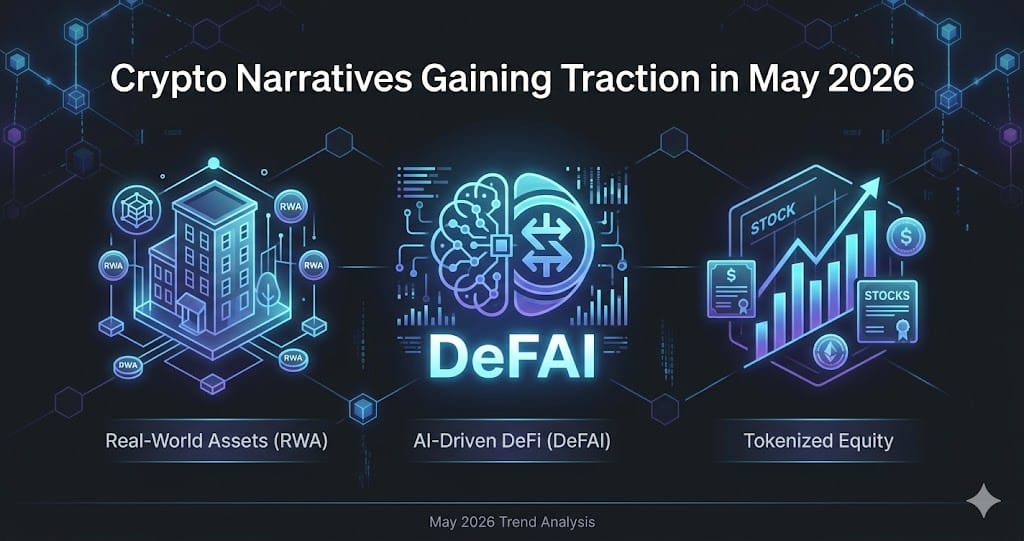
Three narratives are absorbing the majority of on-chain capital in late May 2026: Real World Assets (RWA), stablecoins, and Perpetual DEX protocols. US spot Bitcoin ETFs recorded a net outflow of USD 1.26 billion across six consecutive trading sessions in the week of May 11-17, confirming that broad altcoin rallies are not materializing and that gains remain concentrated in specific, narrative-driven sectors.
Two catalysts arrived this week that are reshaping capital flows more concretely. Raydium surpassed USD 1 trillion in cumulative DEX volume following RAY token listings on Robinhood and Revolut, and the SEC and CFTC formally implemented a new digital commodity taxonomy that excludes governance tokens and gas fees from strict securities oversight. Both events have moved their respective narratives from speculation into observable, on-chain outcomes.
RWA, Stablecoins, and Perpetual DEX: The Three Structural Pillars
Multiple analytics platforms have converged on the same view: RWA, stablecoins, and Perpetual DEX are the cycle's dominant narratives, replacing purely speculative concepts as the primary drivers of liquidity rotation. Total stablecoin market cap has crossed USD 300 billion, and that scale is generating a new infrastructure sub-category called Stablecoin-as-a-Service, where platforms help enterprises issue and manage compliant tokens. Venture investment in this sub-sector exceeded USD 1.5 billion in 2025 alone.
In Perpetual DEX, competition has moved from volume claims to revenue proof. Hyperliquid, GMX v2, and dYdX v4 lead liquidity depth, while Drift, ApeX, and Reya compete on institutional-grade design. Hyperliquid's HIP-4 upgrade adds support for binary options within portfolios, projecting USD 25 million in incremental annual revenue. The protocol's native stablecoin USDH is simultaneously being integrated for internal settlement, tightening the ecosystem loop and reducing reliance on external stablecoin issuers.
Tokenized Equities: xStocks and Raydium Define a New Distribution Channel
Tokenized stocks have separated from the broader RWA category into a standalone sector. Backed Finance's xStocks holds approximately 95% of on-chain tokenized stock market share. As of early 2026, the platform listed over 100 tokenized equities and ETFs with cumulative historical volume exceeding USD 25 billion. By March, total ecosystem market cap crossed USD 1 billion with 185,000 individual holders. Solana has led on-chain tokenized stock trading volume for 50 consecutive weeks, with Raydium serving as the primary liquidity layer.
The week of May 29 brought a specific catalyst: Raydium surpassed USD 1 trillion in cumulative DEX volume, coinciding with RAY token listings on both Robinhood and Revolut. This makes RAY the first Solana DEX token distributed simultaneously through two major consumer finance applications. Tokenized equities including Tesla and Nvidia are now routed through Raydium liquidity pools, with tokenized equity volume on the single protocol exceeding USD 1 billion this month. The Robinhood and Revolut distribution channel represents a structural shift in how retail traders access on-chain equity exposure without using a traditional brokerage.
DeFAI and DePIN: AI Crypto Splits Into Three Measurable Layers
The AI crypto sector is no longer treated as a single category. CoinGecko now lists DeFAI as an independent classification, tracking over 150 actively traded projects with a combined market cap of USD 682 million. DeFAI positions autonomous AI agents at the DeFi execution layer, where they monitor markets, manage risk, rebalance portfolios, and call smart contracts directly without human input. The broader AI crypto sector grew from approximately USD 3.2 billion to a peak near USD 30 billion over the past year, with May 2026 market cap sitting between USD 22.6 billion and USD 27 billion following a 16% drawdown in Q1.
DePIN, the physical infrastructure layer, now counts 265 tokens with a combined market cap of USD 18.92 billion and USD 2.74 billion in 24-hour trading volume as of May 2026. The more significant figure is verified revenue: paid-customer receipts in January 2026 alone reached approximately USD 150 million across storage, GPU compute, wireless data, and mapping APIs. Helium Mobile crossed 120,000 subscribers in 2025, and AT&T and Telefonica are actively offloading real cellular traffic to Helium hotspots. This revenue data is what distinguishes DePIN from earlier speculative infrastructure narratives and explains why the sector's market cap has surpassed that of oracle protocols.
Retail Sentiment: Presale Positioning and Meme Coin Velocity
Retail trader activity in May 2026 is concentrated in two areas: meme coin short-term trading and presale positioning ahead of CEX listings. Total meme coin market cap sits between USD 3.39 billion and USD 3.47 billion, but 24-hour trading volume hit USD 8.22 billion this week, a single-day increase of 87.67%. The capital-to-volume ratio signals that holding periods have compressed significantly, with cultural cycles for specific tokens now measured in days rather than weeks. Tokens like TERMINUS recorded a 66.78% single-day price move as an example of this velocity.
Presale participation has emerged as a distinct retail behavior pattern this cycle. Pepe Dollar (PEPD) raised close to USD 5 million with its first two presale stages sold out and the third nearing its cap. BlockchainFX raised over USD 14.59 million from more than 24,800 participants. Little Pepe (LILPEPE) showed a 120% price increase approaching its 14th presale stage. The common pattern across these projects includes third-party audits from firms such as Coinsult and SolidProof, token burn mechanics, and CEX listing commitments, which serve as credibility signals in a segment where pre-launch risk remains structurally elevated.
What to Watch
- Hyperliquid HIP-4 binary options integration, projecting USD 25 million in incremental annual protocol revenue alongside the USDH stablecoin for internal settlement, both reinforcing the same HYPE ecosystem loop that saw USD 20 million in single-day ETF inflows earlier this month
- SEC and CFTC digital commodity taxonomy effective May 2026, formally excluding governance tokens and gas fees from securities classification, providing a cleaner compliance path for DeFi protocols building under US jurisdiction
- Raydium and the xStocks ecosystem on Solana, where tokenized US equities are now accessible through Robinhood and Revolut following the RAY dual listing, creating a consumer-facing on-ramp to on-chain equity exposure without a traditional brokerage
- DePIN monthly real revenue tracking, currently at approximately USD 150 million per month as of January 2026, offering the most defensible usage-to-market-cap ratio in the AI crypto category and a basis for fundamental valuation that most other crypto sectors lack
Ready to start trading?
Trade on Bitget Try CoinTech2uAffiliate links — we may earn a commission at no extra cost to you.
Frequently Asked Questions
What is driving the RWA and tokenized stock narrative in May 2026?
Real-world asset tokenization is being propelled by two distinct forces: institutional demand for on-chain yield from compliant assets, and the expansion of tokenized equities through platforms like Backed Finance's xStocks. xStocks has accumulated over USD 25 billion in historical cumulative trading volume and reached a USD 1 billion ecosystem market cap with 185,000 holders by March 2026. Solana has led this segment for 50 consecutive weeks, and Raydium's USD 1 trillion volume milestone combined with RAY listings on Robinhood and Revolut has added a consumer distribution channel that did not exist in prior cycles.
What is DeFAI and how does it differ from general AI crypto tokens?
DeFAI refers specifically to autonomous AI agents deployed at the DeFi execution layer. Unlike general AI tokens that may represent a concept or branding association, DeFAI projects operate agents that actively manage portfolios, monitor risk, and execute smart contract calls without human intervention. CoinGecko now tracks over 150 DeFAI projects with a combined market cap of USD 682 million as a standalone category. This contrasts with DePIN, which covers physical infrastructure such as GPU compute and wireless networks, and AI memecoins, which carry no underlying utility claim. Selecting the right sub-category label matters for marketing alignment because each layer attracts a different type of capital.
Why are BTC ETF outflows occurring while specific crypto narratives appear bullish?
The two trends are not contradictory. US spot Bitcoin ETFs recorded USD 1.26 billion in net outflows across six consecutive trading days in the week of May 11-17, driven primarily by the higher-for-longer US Treasury yield environment, which makes risk-free fixed income more competitive relative to ETF-held BTC. At the same time, on-chain capital is rotating into specific narratives including RWA, Perpetual DEX, and tokenized equities. The pattern is narrow narrative rotation, not a broad market rally. Altcoins with clear revenue or adoption stories attract short-duration capital flows, while ETF vehicles serving macro-oriented investors face a separate set of rate-driven pressures.