Crypto Narratives May 2026: THYP ETF, DeSci, and Institutional Rotation
Hyperliquid ETF launches May 12, BIO Protocol surges 120%, Zcash +75%: the five sharpest crypto narratives of May 7-13, 2026 with data and sources.
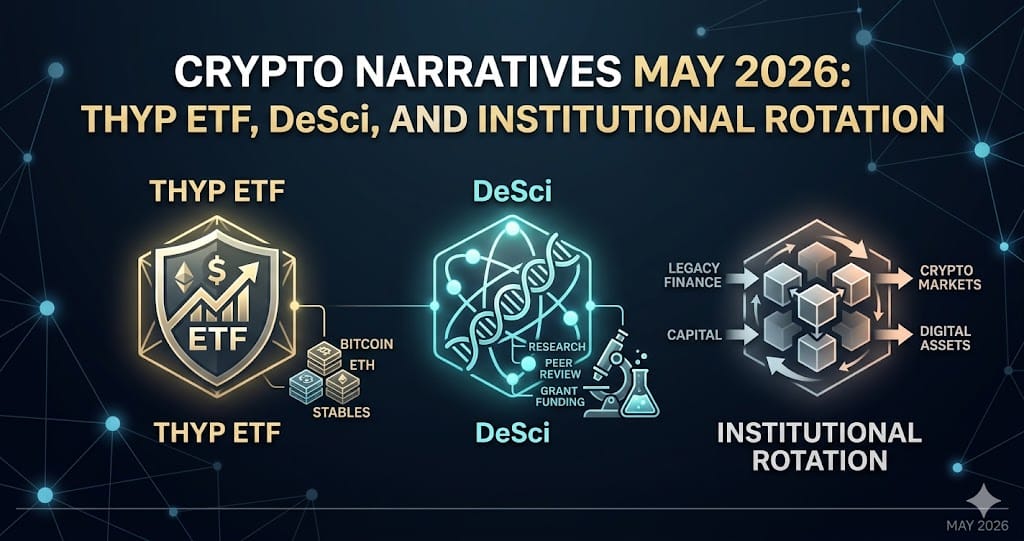
The week of May 7-13, 2026 produced three verifiable institutional milestones: 21Shares launched the Hyperliquid ETF (THYP) on May 12, Kalshi closed a USD 1 billion Series F at a USD 22 billion valuation, and Visa-backed crypto cards processed an annualized USD 18 billion with Visa capturing 97% of total crypto card volume in March 2026.
At the same time, the Altcoin Season Index slid from roughly 45 to approximately 35, Bitcoin reclaimed a three-month high near USD 82,800 on shrinking market-wide volume per Santiment data, and two high-profile meme events — the WLFI collapse and the Roaring Kitty account compromise — confirmed that celebrity- and politically-linked tokens now carry a structural risk premium rather than a speculative upside premium.
Hyperliquid THYP ETF: Perp DEXs Enter the Institutional Asset Class
On May 12, 2026, 21Shares listed the Hyperliquid ETF under the ticker THYP, making Hyperliquid the first perpetual decentralized exchange protocol accessible through standard brokerage accounts. Hyperliquid reported USD 492.7 billion in Q1 2026 trading volume and over USD 180 billion on a rolling 30-day basis, holding more than 70% of the perpetual DEX market compared to dYdX at roughly 10-12%.
The HYPE token is up 68.62% year-to-date as of mid-May 2026, supported by a protocol fee buyback mechanism that ties on-chain revenue directly to token demand. Phantom wallet's builder code on Hyperliquid accumulated USD 20 million in revenue in under a year, adding a second verifiable revenue stream. The THYP listing represents the same category of structural event as the 2024 Bitcoin spot ETF approvals — a TradFi distribution channel opening for a previously DeFi-only asset.
DeSci Goes Institutional: BIO Protocol and Big Pharma Validation
Decentralized science (DeSci) was absent from mainstream crypto narrative trackers entering 2026, but BIO Protocol's move from USD 0.018 to USD 0.038 between April 13-16 — a gain of 96-105% on USD 720 million in 24-hour volume against a USD 68 million market cap, roughly 11x daily turnover — established it as a distinct sector. The DeSci sector total market cap rose 36.8% to USD 329 million in a single session, with VitaRNA and CryoDAO both gaining over 110%.
Pfizer adopted BIO's BixBench suite to run 59 AI agents in parallel, generating over 1,100 hypotheses and identifying a novel ADHD drug candidate within 24 hours at approximately USD 1,500 in compute costs. Eli Lilly's USD 300 million acquisition of a VitaDAO-funded drug project provided the first evidence that DeSci outputs can attract Big Pharma acquisition premiums. BIO Protocol ended the period with a 17-day cumulative gain of approximately 120%, outperforming ETH, SOL, and XRP against Bitcoin over the same window.
Crypto Cards and Prediction Markets: Channel Dominance Meets Regulatory Headwinds
Visa-supported crypto cards processed USD 581.8 million in March 2026, accounting for 97% of total crypto card volume. Annualized, the sector runs at USD 18 billion with a compound annual growth rate of 106% since January 2023, as monthly spend grew from roughly USD 100 million in early 2023 to over USD 1.5 billion by late 2025. OKX's 2026 consumer report documented that card usage has shifted toward groceries, fuel, coffee, and transportation — behavioral categories that suggest stickiness rather than speculative demand.
Prediction markets captured 18% of total crypto funding in the first four months of 2026, more than the entire DeFi sector combined over the same period. Kalshi's USD 1 billion raise and Polymarket's USD 600 million raise produced a combined April 2026 volume of approximately USD 24 billion, with Kalshi holding 62% market share, up from 55% in January. U.S. congressional bipartisan legislation targeting prediction market platforms advanced this week, introducing a regulatory risk variable into what had been the sector's cleanest institutional growth story.
Risk Signals: Zcash Privacy Revival, WLFI Collapse, and Meme Rug Dynamics
Zcash (ZEC) surged approximately 75% in a single week, the sharpest standalone privacy coin move of 2026 and a clear divergence from the broader ZK infrastructure narrative that had previously been treated as a single category. This breakout warrants separate tracking from ZK Layer 2 development because the price driver appears to be retail demand for transaction privacy, not ZK proof adoption by scaling solutions.
The Trump-linked WLFI token collapsed this week, unwinding the political stablecoin hybrid narrative that had attracted attention when the BUILDon token rose 37% in prior weeks, and Binance introduced withdrawal lock mechanisms in response to kidnapping and account hijacking incidents tied to WLFI exposure. Separately, the Roaring Kitty social media account was compromised and over 80 wallets extracted USD 2.86 million from the resulting meme token launch before it collapsed. Both events establish that meme and politically-linked tokens are now priced with a risk discount, not the speculative premium they carried through 2024-2025.
What to Watch
- HYPE token and THYP ETF early AUM data: the 21Shares Hyperliquid ETF listed May 12 — first-week inflow figures will indicate how quickly TradFi allocators absorb exposure to a protocol with 70%+ perpetual DEX market share
- BIO Protocol DeSci sector: monitor whether Pfizer's BixBench adoption and the Eli Lilly USD 300 million acquisition of a VitaDAO project trigger additional Big Pharma partnerships or a broader DeSci token basket rotation
- Kalshi and Polymarket regulatory calendar: bipartisan U.S. congressional ban legislation is advancing — watch CFTC comment periods and Senate Commerce Committee hearing dates for timing signals given Kalshi's USD 22 billion valuation
- Zcash (ZEC) privacy narrative: a 75% weekly gain on what appears to be retail-driven volume — confirm whether ZK L2 teams or institutional privacy desks have established positions before treating this as a sustained sector rotation rather than a one-week spike
Ready to start trading?
Trade on Bitget Try CoinTech2uAffiliate links — we may earn a commission at no extra cost to you.
Frequently Asked Questions
What is the Hyperliquid ETF (THYP) and why does it matter for crypto investors?
THYP is a Hyperliquid protocol ETF listed by 21Shares on May 12, 2026. It matters because it allows investors to access Hyperliquid — which processed USD 492.7 billion in Q1 2026 and holds over 70% of the perpetual DEX market — through standard brokerage accounts without self-custodying HYPE tokens. It is the first perp DEX protocol to receive a TradFi distribution wrapper, comparable in structural significance to the 2024 Bitcoin spot ETF approvals.
Why did BIO Protocol rise over 100% and what is the DeSci sector?
BIO Protocol rose 96-105% between April 13-16, 2026, on approximately 11x daily turnover relative to its market cap. DeSci, or decentralized science, tokenizes biomedical research funding and intellectual property rights. The sector gained institutional credibility this week from Pfizer adopting BIO's BixBench AI agent platform and Eli Lilly paying USD 300 million to acquire a VitaDAO-funded drug candidate, providing verifiable cash flow events that distinguish DeSci from a purely narrative-driven trade.
What does an Altcoin Season Index reading of 35 mean for altcoin traders in May 2026?
An Altcoin Season Index of approximately 35 means only about 35% of the top 50 altcoins have outperformed Bitcoin over the past 90 days. This reading, down from roughly 45 earlier in the week, indicates selective sector rotation rather than a broad altcoin rally. Institutional and on-chain capital is concentrating in AI tokens, DePIN, RWA, and Perp DEXs — sectors with verifiable protocol revenue — while meme coins and politically-linked tokens are underperforming following the WLFI collapse and the Roaring Kitty account compromise.