LayerZero (ZRO) Spotlight — August 25, 2026
In-depth LayerZero spotlight: $1.18 price, +2.0% 24h change, technical analysis, pros/cons, and market outlook.
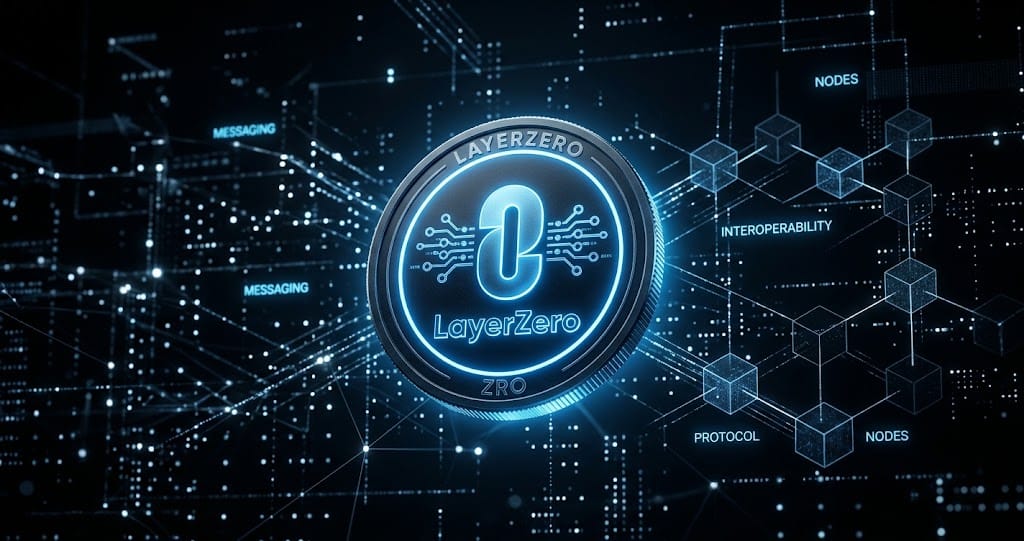
LayerZero's ZRO token is up 50.1% over the past 7 days to $1.18, though it remains 84.3% below its $7.47 all-time high, according to CoinGecko data. Ranked #115 with a $416.7 million market cap, ZRO has gained 39.2% over 30 days and 2.0% over 24 hours. LayerZero operates across Ethereum, BNB Chain, and several other major networks, placing ZRO in the smart contract platform category. The token trades far below its previous peak, leaving room for both recovery and further downside. The metric to watch: whether ZRO holds $1.18 without giving back the 7-day gain.
ZRO's market position shifted sharply this week. Its $416.7 million market cap is still modest next to the $7.47 peak valuation, but the 39.2% 30-day gain shows the move isn't a one-week spike — it's part of a broader monthly climb. The bull case rests on renewed demand for LayerZero's cross-chain infrastructure; the bear case is that an 84.3% drawdown from the all-time high reflects deep, unresolved selling pressure. The number that matters most: can ZRO hold above $1.18 after a 50.1% weekly move.
What Is LayerZero?
LayerZero solves blockchain isolation — the fact that networks like Ethereum, Solana, and Arbitrum can't natively share data or assets. It's a messaging protocol, not a blockchain. When a user initiates a cross-chain transfer, LayerZero uses Ultra Light Nodes (lightweight verifiers) alongside independent relayers and oracles. The relayer transmits a transaction proof; the oracle confirms the source-chain event. Both must agree before the destination chain executes the message, so trust is split across parties rather than resting on one centralized bridge. As of June 2026, LayerZero carries roughly 70% of all cross-chain stablecoin flow and has moved over $260 billion in value across 165 networks.
Bitcoin and Ethereum are base-layer blockchains with their own ledgers and consensus. LayerZero sits between blockchains as an infrastructure layer. Bitcoin processes value transfers on a single chain; Ethereum runs smart contracts on its own virtual machine. LayerZero does neither — it enables arbitrary message passing, so a contract on Ethereum can read from or write to a contract on Solana. Ethereum's native token ETH secures its network and pays for computation; ZRO, by contrast, is a governance token on Ethereum with a total supply of 1 billion and roughly 313.5 million circulating as of mid-2026. Bitcoin has no native messaging layer, and Ethereum's interoperability still relies on third-party bridges. LayerZero standardizes cross-chain communication through immutable smart contracts called Endpoints, which cannot be altered once deployed.
Key Features
- Ultra Light Node (ULN): LayerZero deploys ULNs as minimal smart contract modules on each integrated chain that encode and transmit only critical packet headers rather than full block histories, reducing on-chain overhead while processing messages across networks-
- Immutable Endpoints: Permanent non-upgradeable smart contracts on every supported chain serve as tamper-proof gateways for sending and receiving messages, ensuring that protocol upgrades cannot break existing application integrations-
- Modular Security via DVNs: Applications customize their own security stack by selecting specific Decentralized Verifier Networks (DVNs) for message validation, allowing a DeFi protocol to require stricter verification than a gaming app without forcing either into the same model-
- Omnichain Fungible Token (OFT) Standard: Tokens built with OFT exist as the same asset natively across all chains through atomic burn-and-mint mechanics, eliminating wrapped copies and liquidity pool slippage, with over 750 OFTs overseeing roughly $87 billion in assets as of March 2026-
- Scalable Cross-Chain Volume: The protocol connects 165+ blockchains including Ethereum, Solana, Arbitrum, BNB Chain, and Avalanche, and has facilitated over $200 billion in cross-chain transaction volume since launch-
Use Cases
- Smart Contract Platform applications and use cases
- BNB Chain Ecosystem applications and use cases
- Avalanche Ecosystem applications and use cases
- Polygon Ecosystem applications and use cases
- Arbitrum Ecosystem applications and use cases
Pros & Cons
✅ Pros
- Strong market position at rank #115 with $416.7M market cap
- Active trading volume of $145.3M suggests healthy liquidity
- Positioned in growing sectors: Smart Contract Platform, BNB Chain Ecosystem, Avalanche Ecosystem, Polygon Ecosystem, Arbitrum Ecosystem
- Listed on major exchanges ensuring accessibility for traders
❌ Cons
- Currently -84.3% from all-time high of $7.47
- Cryptocurrency markets are highly volatile and unpredictable
- Regulatory uncertainty could impact price and adoption
- Competition from other projects in the same space
Price Outlook
LayerZero (ZRO) trades at $1.18 as of August 25, 2026, according to CoinGecko data — 84.3% below its $7.47 all-time high. The nearest resistance sits at $1.255, a level ZRO tested on August 23 before pulling back to $1.16. A break above $1.27, the 7-day high per Binance analysis, would open the $1.34-$1.40 zone. Immediate support lies in the $1.07-$1.10 range, with $1.00 as the psychological floor below that. The EMA21 ($0.924) and EMA50 ($0.897) have flipped from resistance to dynamic support, per TradingView data.
Technical indicators are mixed. RSI hit 81.23 on the August 23 rally, signaling overbought conditions and near-term pullback risk. Still, the MACD (12,26) registered a buy signal at 0.003 as of August 19, and moving averages show 11 buys versus 1 sell. A daily close above $1.216 on strong volume would confirm the long-term uptrend; losing the $0.897 EMA50 support on heavy volume would flip the picture bearish. The announced ATLAS trading platform launch in fall 2026 and the expected "Zero L1" mainnet are the catalysts to watch. Not financial advice.
LayerZero (ZRO) Resources
Frequently Asked Questions
What is LayerZero (ZRO) and what is it used for?
LayerZero is an interoperability protocol designed to connect blockchain applications across networks, with ZRO used within the protocol’s ecosystem. As of August 25, 2026, ZRO ranks #115 with a market cap of $416.7M, according to the provided market data. The key metric to watch is LayerZero’s cross-chain message activity as adoption develops.
Is ZRO a good investment?
ZRO has shown strong recent momentum, but its 84.3% decline from the $7.47 all-time high suggests substantial historical downside risk. As of August 25, 2026, CoinGecko-style market data shows ZRO at $1.18, up 50.1% over 7 days and 39.2% over 30 days. The specific metric to watch is whether ZRO can sustain gains above $1.18 while market capitalization remains above $416.7M.
Why is ZRO price rising?
ZRO is up 50.1% over the past 7 days and 39.2% over 30 days, according to the provided August 25, 2026 market data, indicating strong short-term buying momentum. The move could reflect renewed interest in LayerZero and its cross-chain infrastructure, but a 2.0% gain over the past 24 hours suggests momentum has moderated from the broader weekly move. The metric to watch is the 7-day return relative to daily trading volume.
Can ZRO reach its all-time high again?
ZRO would need to rise from $1.18 to $7.47 to revisit its all-time high, representing roughly a 533% increase from the August 25, 2026 price. That outcome cannot be established from recent performance alone, although the 50.1% 7-day gain shows that substantial short-term moves are possible. The key metric to watch is ZRO’s market capitalization relative to its $416.7M level as adoption and token demand develop.
Ready to start trading?
Trade on Bitget Try CoinTech2uAffiliate links — we may earn a commission at no extra cost to you.
Our Verdict
LayerZero (ZRO) looks moderately attractive at $1.18, ranking #115 with a $416.7 million market cap, still 84.3% below its $7.47 all-time high. The strongest bull case is the 50.1% seven-day gain, on top of a 39.2% rise over 30 days — a sign of renewed momentum rather than a single spike. The biggest risk is that 84.3% drawdown from the ATH, and with technical indicators mixed, $1.18 offers no clear directional confirmation yet.
Related Articles
- Crypto Week June 2026: Proof-of-Humanity Leads as Tokenized Stocks Arrive
- BTC Crashes to USD 78,600: The May 2026 Liquidation Cascade Explained
- Crypto Market Sentiment Breakdown 2026: Fear, Funding Rates, and Macro Risk Signals Explained