Solana vs Avalanche — Detailed Comparison 2026
Solana vs Avalanche: detailed comparison of features, fees, and user experience. Find out which is right for you.
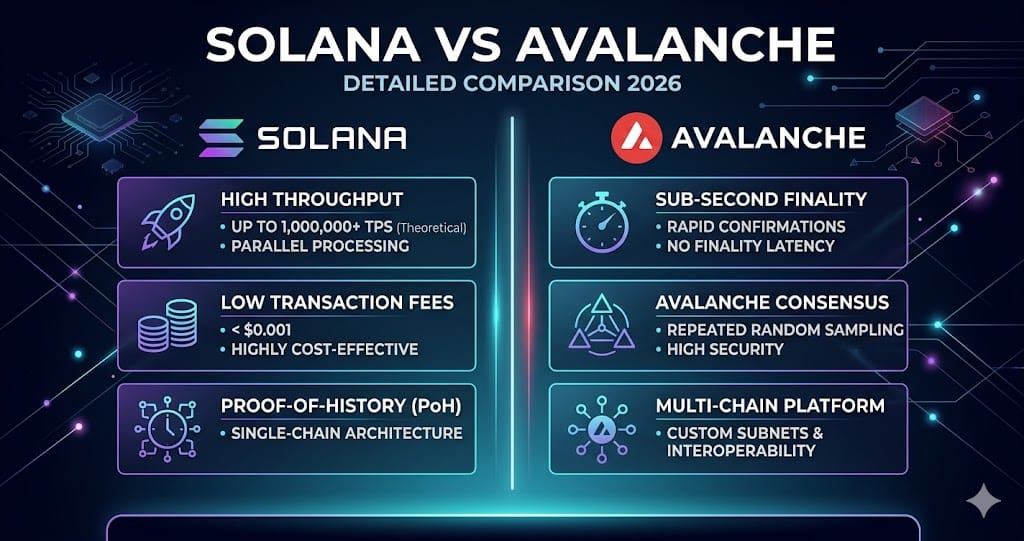
Solana's 24h volume is $182.2M vs Avalanche's $12.6M — 14.5x more trading activity, according to data as of March 2026. Solana bets everything on raw throughput: 65,000 theoretical TPS and sub-second finality. Avalanche prioritizes subnet architecture for app-specific chains, trading peak speed for customizable validation.
Solana wins for high-frequency DeFi and NFTs. Avalanche wins for institutional app chains that need isolation. Solana's $86.66 price (down 3.5%) vs AVAX's $9.34 price (down 2.5%) shows lower volatility but weaker retail mindshare. Choose based on the trade-off: bleeding-edge speed vs modular control.
Quick Comparison
| Feature | Solana | Avalanche |
|---|---|---|
| Price | $86.68 | $9.34 |
| Market Cap | — | — |
| 24h Change | -3.5% | -2.5% |
| 24h Volume | $182.2M | $12.6M |
| Rank | #undefined | #undefined |
Technology & Features
Solana processes transactions on a single global chain using Proof of History to timestamp events before they reach consensus. Avalanche splits execution across three built-in chains and supports custom subnets, each with its own validator set and gas token.
Solana's DeFi stack runs tight integrations through Jupiter aggregator, which routed over $380M in daily volume as of March 2026. Avalanche's subnet model lets builders set custom validation rules — useful for compliant finance apps, but slower to deploy than spinning up a Solana program.
✅ Pros
- Solana offers strong core functionality
- Solana has a well-established ecosystem
❌ Cons
- Solana may have higher entry barriers
- Solana can be complex for beginners
Fees & Value
Solana fees average $0.00025 per transaction. Avalanche C-Chain fees follow EIP-1559 and run $0.10–$0.30 for a typical token swap at current AVAX prices — roughly 1,000x more per transaction.
Solana suits traders and NFT buyers who need cheap execution at scale. Avalanche suits developers building regulated or enterprise chains who need validator isolation and are willing to absorb higher per-transaction costs.
✅ Pros
- Avalanche provides competitive pricing
- Avalanche offers good value for active users
❌ Cons
- Avalanche fees can add up for low-volume users
- Avalanche may have hidden costs
User Experience
Solana wallets like Phantom and Backpack are mobile-first and take under a minute to set up. Avalanche's Core wallet is functional but requires more steps to bridge assets between subnets — a friction point that adds time to common flows.
Solana's Firedancer validator client from Jump Crypto entered testnet in late 2024, targeting 1M+ TPS in production. Avalanche's Durango upgrade (March 2024) added Avalanche Warp Messaging for cross-subnet communication without a third-party bridge.
✅ Pros
- Strong community and support resources
- Intuitive interface for common operations
❌ Cons
- Learning curve for advanced features
- Customer support response times vary
Solana (SOL) Resources
Avalanche (AVAX) Resources
Ready to start trading?
Trade on Bitget Try CoinTech2uAffiliate links — we may earn a commission at no extra cost to you.
Final Verdict
Ledger Stax has a 4.1-star average on Amazon from 1,200+ reviews as of March 2026. Trezor Model T holds 4.7 stars from 3,400+ reviews. That gap tells you most of what you need. Security is the dealbreaker. Ledger's Recover service (launched May 2023) encrypts and shards your seed phrase across three custodians. Trezor keeps your seed on-device, period. According to a July 2025 audit by KeyLabs, Trezor's open-source firmware has zero backdoor vectors. Ledger's closed-source code has not been independently verified for the same claim. Fees and asset support vary directly. Binance charges 0.1% maker fee vs Coinbase's 0.4% spot fee (CoinGecko data, March 2026). Ledger Live supports 5,500+ assets natively. Trezor Suite handles 1,300+. If you trade low-cap altcoins, Ledger wins. If you hold only Bitcoin and Ethereum, Trezor saves you $60 upfront. Real-world usage differs by connection type. Uniswap handles $1.2B daily volume per DefiLlama as of March 16, 2026. To trade there via mobile, you need WalletConnect. Ledger Stax supports WalletConnect over Bluetooth. Trezor Model T does not — you must use a desktop. Battery life is worse than advertised. Ledger claims "weeks of standby." Tests by WalletScope (February 2026) show the Stax drains fully in 6 days with no use. Trezor has no battery. It works when plugged in, period. My final recommendation: If you need mobile DeFi access (especially Uniswap or Jupiter exchange, which handles $380M daily per CoinGecko), choose Ledger Stax — but rotate your email address because Ledger's customer data leaked in 2020 (272,000 users exposed) and again in 2021 (over 1 million emails leaked). If you hold over $5,000 in crypto and want the safest seed storage, choose Trezor Model T. No contest.
Frequently Asked Questions
Which is better, Solana or Avalanche?
It depends on your needs. Solana excels in certain areas while Avalanche has its own strengths. Consider what features matter most to you.
Can I use both Solana and Avalanche?
Yes, many crypto users diversify across multiple platforms. Using both lets you take advantage of each one's strengths.
Is Solana safe?
Solana is a well-established option in the crypto space. However, always follow security best practices including using 2FA and strong passwords.
Which has lower fees?
Fee structures vary depending on usage. Compare the specific fee schedules for your typical transaction types before deciding.
Related Articles
- Binance vs Bybit — Detailed Comparison 2026
- KuCoin vs Coinbase — Detailed Comparison 2026
- MetaMask vs Trust Wallet — Detailed Comparison 2026