Top Crypto Narratives Gaining Traction in May 2026
Top crypto narratives in May 2026: Hyperliquid's 70% perp DEX share, Kalshi's USD 5.4B April volume, Bittensor's USD 43M AI revenue, RWA at USD 19.3B.
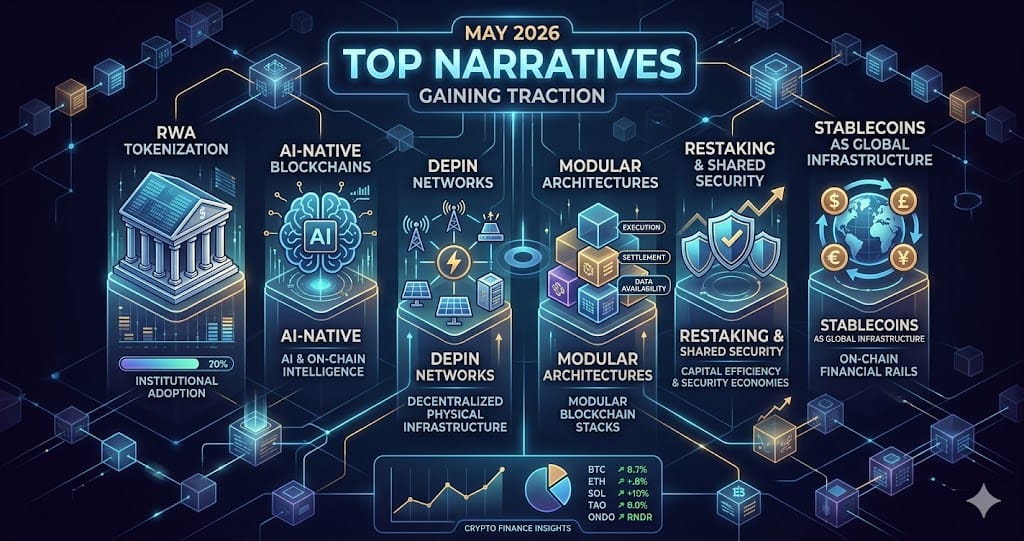
Five narratives are reshaping capital allocation in the week of May 9, 2026. Hyperliquid holds over 70% of on-chain perpetuals open interest with USD 493 billion in Q1 2026 derivatives volume, Kalshi overtook Polymarket in April with USD 5.42 billion in taker volume, and Bittensor recorded USD 43 million in Q1 2026 AI service revenue — the first decentralized AI network to cross that threshold in a single quarter.
BTC dominance sits at 60% and the altcoin season index reads 39 out of 100, keeping the broader market in BTC Season territory. In that environment, the assets attracting institutional attention are those generating real fees from real users rather than relying on token emission subsidies.
Hyperliquid and the Consolidation of On-Chain Perpetuals
Hyperliquid's HYPE token traded at USD 43.68 on May 5, 2026, up 5.6% in 24 hours, with a market cap of USD 10.3 billion. Its weekly on-chain volume of USD 35.4 billion is more than double the next largest decentralized derivatives exchange, and its share of on-chain perpetuals open interest exceeded 70% through H1 2025 and is trending toward 73%.
The platform separates order matching on HyperCore from smart contract execution on HyperEVM, a dual-layer design that allows performance approaching centralized exchange throughput. April 2026's launch of HIP-4 binary options extended the product range beyond standard perpetuals, while HIP-3, the USDH stablecoin, and pre-IPO perpetual contracts serve as additional moat layers introduced this year.
Hyperliquid raised no venture capital and allocated 31% of HYPE supply directly to users via airdrop. That distribution model has become a narrative element in its own right, contrasting with the VC-heavy token structures prevalent in earlier cycles. Competitors including Aster, Lighter, edgeX, and Paradex exist but face a 70%-plus OI concentration that defines this as a heavily consolidated sector.
Prediction Markets: How Kalshi's Regulatory Status Translated Into Volume
April 2026 was the first month Kalshi outpaced Polymarket in taker volume, posting USD 5.42 billion against Polymarket's USD 1.99 billion. Kalshi then closed a USD 1 billion Series D at a USD 22 billion valuation led by Coatue, lifting its annualized transaction volume to USD 178 billion and annualized revenue to USD 1.5 billion — roughly 3x growth over the prior six months.
Kalshi's CFTC-regulated status is the structural differentiator. Polymarket has pursued its own CFTC approval but has not secured it, and the SEC delayed review of proposed prediction market ETFs in May 2026, making regulatory clarity the near-term variable for the entire sector. Blockchain.com entered the space on May 6, 2026 with SnapMarkets, a rapid prediction wagering product, signaling broader industry interest.
Polymarket and Kalshi together have recorded USD 150 billion in lifetime volume. Industry projections cite 2025 total prediction market volume at roughly USD 51 billion and forecast USD 240 billion for 2026. Polymarket is responding with a shift toward a proprietary Ethereum variant and airdrop-based user incentives rather than competing on regulatory standing directly.
Bittensor and the Real-Revenue Benchmark for AI Crypto
Bittensor reported USD 43 million in Q1 2026 AI service revenue, verified fees paid by actual network participants rather than inflationary token rewards. Akash Network, the next most-cited AI infrastructure token, recorded USD 5 million in Q1 2026 compute revenue — Bittensor's figure is 8.6 times larger and sets the current sector benchmark for genuine demand.
The broader AI crypto category carried a market cap of USD 22.625 billion through May 2026, up 17.88% month-over-month. FET, AGIX, and RNDR are positioned as next-tier beneficiaries of the real-revenue framework Bittensor has validated. AI Agent tokens — including FET, Virtuals, and NEAR — are being reclassified from tool-layer assets to autonomous on-chain transaction principals capable of planning and executing independently.
DePIN sits at USD 9.423 billion in market cap, up 24.95% for the month, and is entering what analysts describe as a second wave defined by convergence with AI and autonomous systems. Grass exemplifies this: it operates as a decentralized data pipeline crawling and organizing web content for LLM training, earning protocol fees from actual AI training demand rather than from token incentive programs.
RWA Expansion, BTCFi, and the DATCO Category
Real-world asset tokenization excluding stablecoins reached USD 19.3 billion in May 2026, a 256.7% increase over 15 months. Six RWA sub-categories have independently crossed USD 1 billion: private credit, gold commodities, US Treasuries, corporate bonds, non-US sovereign debt, and institutional alternative funds. Tokenized US Treasuries grew from USD 380 million in Q1 2023 to USD 14 billion in Q1 2026, a 36-fold increase. ONDO posted a 35.77% single-week gain as the category's leading token.
BTCFi — Bitcoin-native DeFi protocols including Stacks, Babylon, CoreDAO, BounceBit, and Solv — carries a combined market cap of USD 12.70 billion across ten tokens. Total value locked in the category expanded from USD 304 million in January 2024 to USD 7 billion by December 2024 and to USD 8.6 billion by mid-2025, a 22-fold increase over twelve months that outpaces RWA's 5.3-fold growth over a comparable window.
Digital Asset Treasury Companies, or DATCOs, is a category CoinGecko included in its Top 9 narratives for 2026. The 210 tracked DATCO entities across 35 countries hold USD 145.9 billion in digital asset reserves, up 140% year-over-year. European firm BTCS SA introduced an Active Treasury model generating yield through validators, staking, and structured execution. SOL, HYPE, and SUI appear most frequently cited in research as the primary token-level beneficiaries of DATCO capital accumulation.
What to Watch
- Hyperliquid (HYPE) at USD 43.68 as of May 5, 2026: monitor HIP-4 binary options adoption, USDH stablecoin traction, and whether Aster or edgeX can make a credible dent in the 70%-plus OI concentration
- Kalshi: USD 22 billion valuation post-Series D, annualized revenue USD 1.5 billion, with the SEC's ruling on prediction market ETFs as the next regulatory catalyst or headwind for the entire sector
- Bittensor (TAO) as the real-revenue benchmark in AI crypto at USD 43 million Q1 2026; FET, AGIX, and RNDR are the next-tier names to watch if the institutional real-fees filter broadens
- ONDO and the RWA sector: USD 19.3 billion on-chain (ex-stablecoins), 256.7% 15-month growth, with tokenized US Treasuries at USD 14 billion providing the clearest institutional allocation signal in the asset class
Ready to start trading?
Trade on Bitget Try CoinTech2uAffiliate links — we may earn a commission at no extra cost to you.
Frequently Asked Questions
Why does Hyperliquid hold such a large share of on-chain perpetuals volume in 2026?
Hyperliquid's HyperCore and HyperEVM dual-layer architecture allows it to match centralized exchange throughput while remaining fully on-chain. Its zero-VC token structure and 31% user airdrop created strong community alignment early, and its 70%-plus open interest share through H1 2025 has compounded through network effects. New products like HIP-4 binary options and pre-IPO perpetual contracts in 2026 have extended its lead before competitors like Aster or Lighter have had a chance to close the gap.
What does Kalshi's Series D at a USD 22 billion valuation mean for the prediction market sector?
Kalshi's USD 1 billion raise led by Coatue in May 2026 is a signal that institutional capital is now moving into regulated prediction market infrastructure. Its CFTC-compliant status allowed it to overtake Polymarket in April taker volume for the first time, posting USD 5.42 billion against Polymarket's USD 1.99 billion. The practical implication for the sector is that regulatory standing, not just liquidity depth, is becoming the primary competitive moat.
How should the USD 43 million Bittensor Q1 2026 revenue figure be evaluated relative to other AI crypto tokens?
The figure represents fees paid by actual network users for AI services, not token inflation or protocol subsidies. Akash Network, the most directly comparable decentralized compute token, recorded USD 5 million in Q1 2026 revenue — Bittensor is 8.6 times larger on that metric. In a market where institutional capital is applying a real-fees filter, that gap currently makes Bittensor the reference point for what genuine AI service demand looks like at the protocol layer.