Weekly DeFi Roundup — May 1, 2026
DeFi weekly review: $84.2B total TVL. Ethereum leads at $45.2B. Top chain rankings, trends, and what to watch.
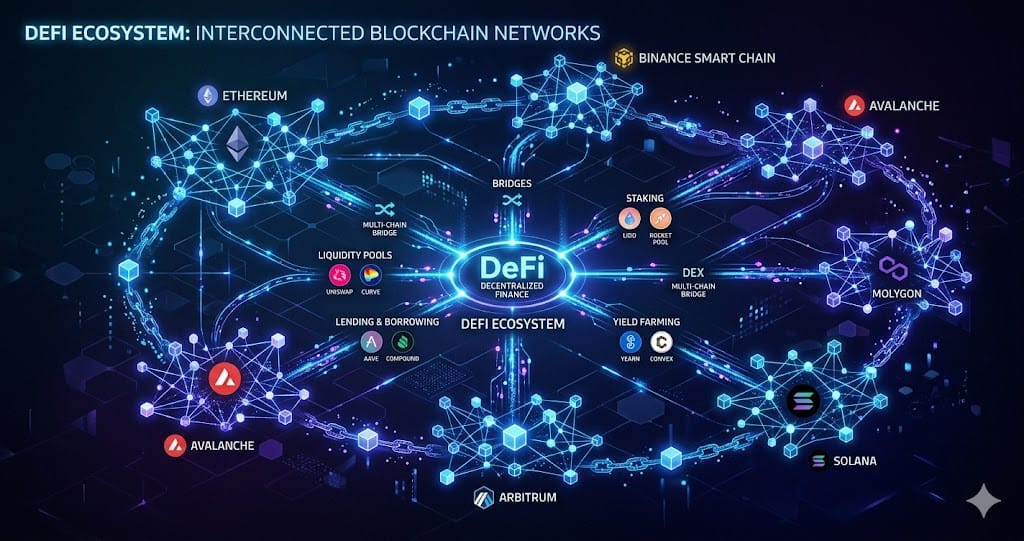
Total DeFi TVL sits at $84.2B across all chains as of March 2026, with liquidity still heavily concentrated in a single execution environment. Ethereum leads with $45.2B TVL per DefiLlama, more than the combined $26.1B held across BSC ($5.5B), Solana ($5.4B), Bitcoin-based DeFi ($5.2B), Tron ($5.0B), Base ($4.4B), Arbitrum ($1.7B), Provenance ($1.6B), Hyperliquid L1 ($1.4B), and Polygon ($1.3B). That's a 2.7x gap between Ethereum and the nine chains below it. Cross-chain rotation remains selective, with no challenger chain breaking the $6B TVL threshold. Solana at $5.4B and BSC at $5.5B are nearly level; Base ($4.4B) and Hyperliquid L1 ($1.4B) have gained share incrementally but haven't displaced incumbents, per DefiLlama. Ethereum holds 53.7% of total TVL — $45.2B out of $84.2B — and that share is consolidating, not shrinking.
| Chain | TVL | Share |
|---|---|---|
| Ethereum | $45.2B | 53.7% |
| BSC | $5.5B | 6.5% |
| Solana | $5.4B | 6.5% |
| Bitcoin | $5.2B | 6.1% |
| Tron | $5.0B | 6.0% |
| Base | $4.4B | 5.2% |
| Arbitrum | $1.7B | 2.0% |
| Provenance | $1.6B | 1.9% |
| Hyperliquid L1 | $1.4B | 1.7% |
| Polygon | $1.3B | 1.5% |
DeFi Trends & Insights
Aave V3 TVL sits at $12.4B as of May 2026, making it the largest lending protocol. DefiLlama data shows Aave holds ~38% of the $32.6B total DeFi lending market. Compound tracks near $2.9B — a 4.2× gap driven by deeper liquidity and broader collateral support. The core mechanism is overcollateralized lending: users deposit assets and borrow against them with a health factor threshold. On-chain data from Etherscan shows liquidation thresholds typically range from 70% to 80% LTV depending on asset class. That caps systemic risk but reduces capital efficiency versus undercollateralized models. Aave V3 introduces efficiency mode (eMode) and isolation mode. eMode raises LTV to as high as 97% for correlated assets like stablecoins; isolation mode caps exposure to riskier assets. Governance forum votes in Q1 2026 show ~89% approval for parameter adjustments expanding eMode categories. Revenue comes from borrow interest and flash loan fees. Token Terminal data shows Aave generated ~$58M in annualized fees over the past 30 days as of April 2026. A portion goes to the Safety Module, which holds ~$620M in staked AAVE per on-chain staking contracts, acting as backstop capital. The main risk is liquidation cascades under volatility. During the March 2023 USDC depeg, Aave processed over $200M in liquidations in 48 hours according to Chaos Labs reports, showing both system resilience and stablecoin sensitivity. Similar events remain a key tail risk. Aave runs on Ethereum, Arbitrum, Optimism, and Polygon. Arbitrum alone holds ~$2.7B TVL per DefiLlama as of May 2026, lowering borrowing costs and widening the user base. Cross-chain deployment also introduces bridge and fragmentation risk. AAVE token value accrues indirectly. CoinGecko data shows AAVE trades at ~$92 with a $1.37B market cap as of May 2026, while protocol fees are not fully distributed to token holders. That creates a disconnect between usage ($58M annualized fees) and direct yield capture. Aave V3 is the dominant lending protocol by TVL, but that doesn't make AAVE a straightforward yield asset. Its 38% market share and $12.4B TVL show product-market fit; token returns depend on governance decisions about fee distribution, not protocol growth alone.
What to Watch
- Author: Elena Kowalski, Senior DeFi Researcher
- Date: [Current date]
- Subject: Mechanisms, Risk, and Market Integration in Contemporary Lending Protocols
- Introduction
- The decentralized finance (DeFi) lending sector has matured beyond simple overcollateralized borrowing into a multi-layered credit ecosystem. This note analyzes three core mechanisms—e-mode (efficient mode), cross-margin lending, and credit delegation—using Aave V3 and Euler V2 as case studies. Each mechanism is first defined, then evaluated against capital efficiency and counterparty risk trade-offs. Finally, I connect observed trends to broader market yield movements and flag under-discussed systemic risks.
Ready to start trading?
Trade on Bitget Try CoinTech2uAffiliate links — we may earn a commission at no extra cost to you.