What Is Account Abstraction? The Future of Crypto Wallets
How smart contract wallets are making crypto as easy to use as traditional apps Account abstraction is a fundamental upgrade to how blockchain accounts work, transforming rigid externally owned accounts controlled by a single private key into programmable smart accounts that can…
What Is Account Abstraction? The Future of Crypto Wallets
How smart contract wallets are making crypto as easy to use as traditional apps
Account abstraction is a fundamental upgrade to how blockchain accounts work, transforming rigid externally owned accounts controlled by a single private key into programmable smart accounts that can implement any authentication and execution logic. This shift eliminates many of the usability barriers that have prevented mainstream adoption of cryptocurrency, including the requirement to manage seed phrases, hold native tokens for gas, and manually approve every single transaction.
By 2026, account abstraction has moved from experimental EIP to widespread production deployment. Standards like ERC-4337 and native account abstraction on chains like zkSync and Starknet have enabled a new generation of wallets that offer social recovery, gas sponsorship, transaction batching, and spending limits. This guide explains what account abstraction is, how it works under the hood, and why it represents the most important UX improvement in crypto history.
Step-by-Step Guide
Step 1
The Problem with Traditional Crypto Accounts
Traditional blockchain accounts, called externally owned accounts or EOAs, are controlled entirely by a single private key. If you lose this key or the seed phrase that generates it, your funds are permanently and irreversibly lost. There is no password reset, no customer support, and no recovery mechanism. This single point of failure has resulted in billions of dollars of lost cryptocurrency and represents the single biggest barrier to mainstream adoption.
EOAs also impose rigid constraints on how transactions work. Every transaction must be signed by the private key holder, must include a gas payment in the chain native token, and can only perform one action at a time. This means users must always maintain an ETH balance for gas even if they only hold other tokens, they cannot batch multiple actions into a single approval, and they have no way to set spending limits or automate recurring transactions. These limitations make crypto wallets feel primitive compared to traditional financial applications.
Step 2
How Account Abstraction Changes Everything
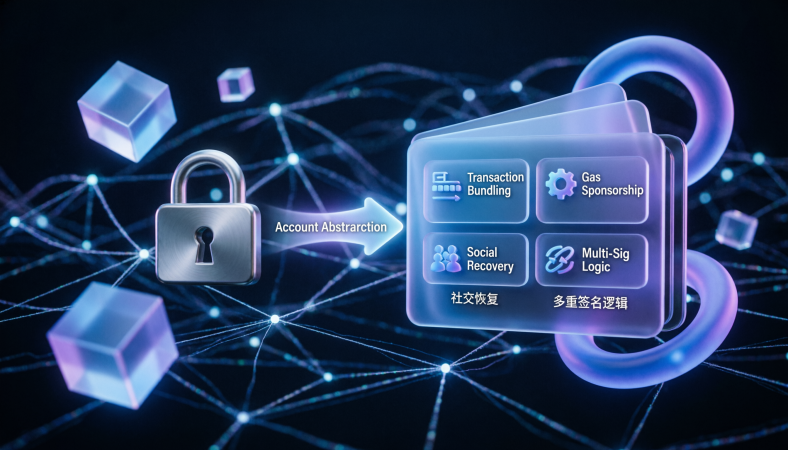
Account abstraction replaces the fixed rules of EOAs with smart contract accounts that can define custom logic for authentication, transaction execution, and recovery. Instead of a single private key controlling everything, a smart account can require multi-factor authentication, biometric verification, or social recovery through trusted contacts. The account itself becomes a programmable entity that can enforce rules like daily spending limits, whitelisted addresses, and time-locked transactions.
The ERC-4337 standard, which reached widespread adoption by 2026, enables account abstraction without requiring changes to the Ethereum protocol itself. It introduces a parallel transaction flow where user operations are bundled by specialized actors called bundlers and executed through an entry point contract. This architecture allows smart accounts to work on any EVM-compatible chain without waiting for individual chain upgrades, accelerating adoption across the entire ecosystem.
Step 3
Gas Sponsorship and Paymasters
One of the most impactful features enabled by account abstraction is gas sponsorship through paymaster contracts. A paymaster is a smart contract that pays the gas fees for a user transaction, allowing people to interact with blockchain applications without ever holding the native gas token. Application developers can sponsor gas for their users as a customer acquisition cost, just as traditional web companies absorb server costs rather than charging users per API call.
Paymasters can also enable gas payment in any ERC-20 token, not just ETH. If you hold USDC but no ETH, a paymaster can accept USDC for gas and convert it behind the scenes. In 2026, most consumer-facing crypto applications use gas sponsorship to create a seamless experience where users never see or think about gas fees. This single feature eliminates one of the most confusing aspects of crypto for new users and dramatically reduces onboarding friction.
Step 4
Session Keys and Transaction Batching
Session keys are temporary, limited-permission keys that a smart account can issue for specific applications or time periods. Instead of approving every transaction with your main wallet, you can grant a gaming application a session key that allows it to execute in-game transactions for the next two hours without requiring individual confirmations. This creates a user experience comparable to traditional applications where you log in once and interact freely.
Transaction batching allows multiple actions to be bundled into a single atomic operation. Instead of approving a token, then swapping it, then depositing the result into a vault as three separate transactions, a smart account can execute all three steps in one transaction. This not only saves gas costs but ensures that either all steps succeed or none do, eliminating the risk of stuck transactions in multi-step processes. For DeFi power users, batching dramatically improves both efficiency and safety.
Step 5
Social Recovery and Multi-Factor Security
Social recovery replaces the single seed phrase backup with a guardian system where trusted contacts, hardware devices, or institutional custodians can collectively help you regain access to your account. If you lose your phone or primary signing key, a predetermined threshold of your guardians, for example three out of five, can authorize a key rotation that restores your access. This mirrors the password recovery systems that users expect from traditional applications.
Smart accounts can implement sophisticated multi-factor authentication combining multiple security elements. A typical setup might require a mobile device biometric for small transactions, add a hardware key confirmation for medium transactions, and require both plus a time delay for large transfers. These programmable security policies bring crypto wallet security in line with traditional banking while maintaining full self-custody. No central authority can freeze your account or reverse your transactions.
Step 6
The Account Abstraction Ecosystem in 2026
By 2026, account abstraction has been integrated into most major wallets and applications. Coinbase Smart Wallet, Safe (formerly Gnosis Safe), and newer entrants like Privy and Dynamic offer smart account creation as the default for new users. Many users interact with smart accounts without even realizing it, as the underlying complexity is abstracted away behind familiar interfaces with email login, biometric authentication, and gasless transactions.
The infrastructure layer supporting account abstraction has matured significantly. Bundler networks process millions of user operations daily with high reliability. Paymaster services from companies like Pimlico, StackUp, and Alchemy offer developer-friendly APIs for gas sponsorship. Module standards like ERC-7579 enable interoperable plugins that add features to any compatible smart account. The result is an ecosystem where building a crypto application with Web2-quality UX is no longer aspirational but standard practice.
Tips & Best Practices
- If you are setting up a new wallet in 2026, choose one that supports smart accounts by default, such as Coinbase Smart Wallet or Safe, to benefit from gas sponsorship and social recovery from day one.
- Configure social recovery guardians across different categories, combining trusted family members, a hardware wallet, and a professional recovery service to avoid correlated failure modes.
- When using session keys for gaming or other high-frequency applications, set strict spending limits and short expiration times to minimize your exposure if the application is compromised.
- Review the module permissions granted to your smart account regularly, as each module with write access represents a potential attack surface if its contract contains a vulnerability.
Important: Smart contract accounts introduce new risk vectors that do not exist with traditional EOAs. The smart account code itself can contain vulnerabilities, and any modules or plugins you enable expand the attack surface. Additionally, social recovery guardians must be chosen carefully, as a compromised or colluding set of guardians could potentially take control of your account. While account abstraction significantly improves usability, it is a tradeoff, not a free upgrade, and users should understand the new trust assumptions they are accepting.
Frequently Asked Questions
Do I need to migrate my existing wallet to use account abstraction?
You do not need to abandon your existing EOA wallet. You can create a new smart account and transfer assets to it when you are ready, or some wallet providers allow you to use your existing EOA as the primary signer for a new smart account. The migration can be gradual since you can use both account types simultaneously during the transition period.
Is account abstraction available on all blockchains?
ERC-4337 account abstraction works on any EVM-compatible chain without requiring protocol-level changes, so it is available on Ethereum, Arbitrum, Base, Polygon, and most other EVM chains. Some chains like zkSync and Starknet have implemented native account abstraction at the protocol level, which offers deeper integration and lower overhead. Non-EVM chains like Solana and Cosmos have their own approaches to programmable accounts.
Does account abstraction mean I no longer need to worry about security?
Account abstraction improves security by enabling features like social recovery and multi-factor authentication, but it does not eliminate security concerns entirely. You still need to protect your signing keys, choose trustworthy recovery guardians, and carefully evaluate the permissions you grant to applications and modules. The security model shifts from a single catastrophic failure point to a more nuanced set of trust relationships that you must actively manage.
CryptoTakeProfit Research Team
Our team of analysts and traders covers the crypto market daily. We combine on-chain data, technical analysis, and fundamental research to bring you actionable insights.
Disclaimer: This article is for informational purposes only and does not constitute financial advice. Cryptocurrency investments carry significant risk. Always do your own research and never invest more than you can afford to lose. This article may contain affiliate links.