What Is MEV? How Validators Extract Value from Your Trades
The hidden tax on every blockchain transaction and what you can do about it Maximal Extractable Value, or MEV, refers to the profit that block producers can capture by strategically ordering, inserting, or censoring transactions within the blocks they create.
What Is MEV? How Validators Extract Value from Your Trades
The hidden tax on every blockchain transaction and what you can do about it
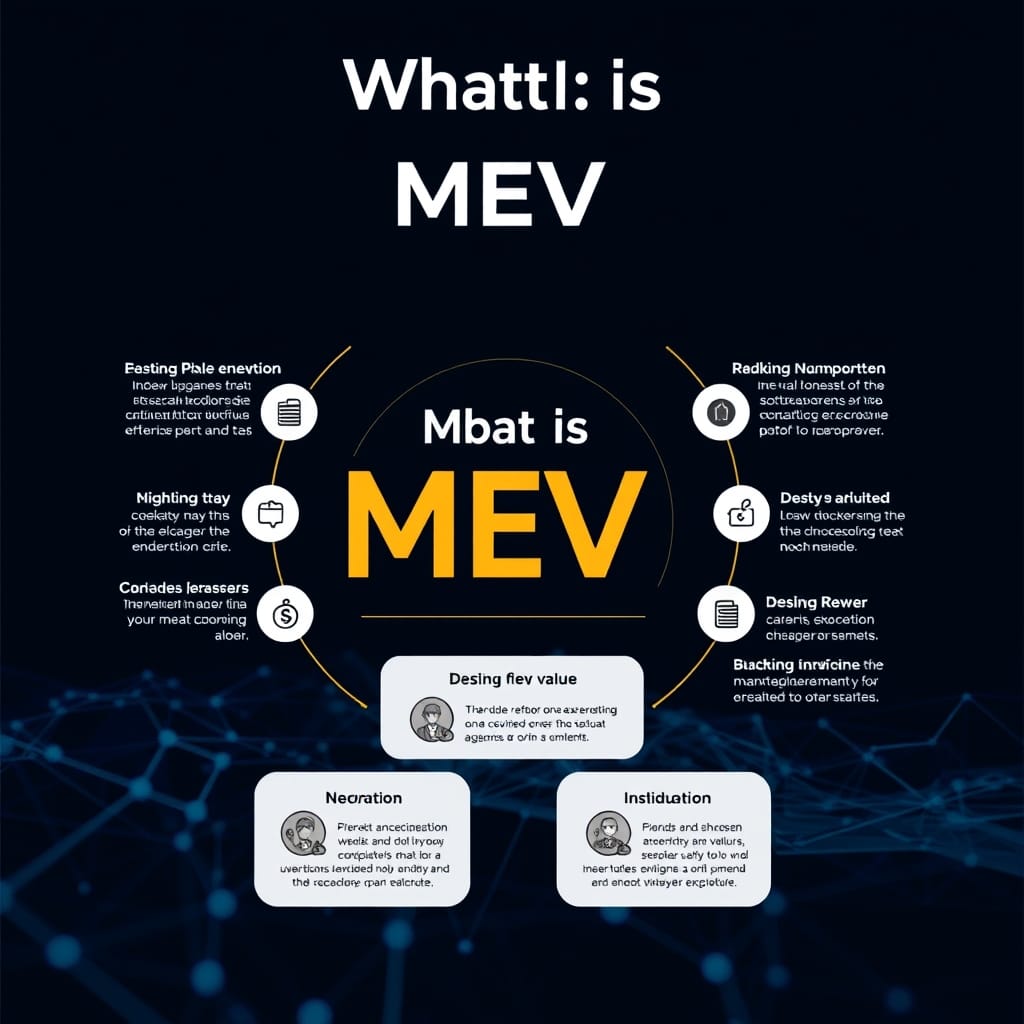
Maximal Extractable Value, or MEV, refers to the profit that block producers can capture by strategically ordering, inserting, or censoring transactions within the blocks they create. It is an invisible cost that affects virtually every on-chain transaction, from simple token swaps to complex DeFi interactions. In 2026, MEV extraction has become a sophisticated multi-billion dollar industry with dedicated infrastructure, specialized searchers, and ongoing debates about its impact on blockchain fairness.
This guide explains how MEV works in practical terms, the common strategies used to extract it, how it directly impacts your trades, and the tools and techniques available to minimize your exposure. Understanding MEV is essential for any DeFi user who wants to stop leaving money on the table with every transaction.
Step-by-Step Guide
Step 1
How MEV Extraction Works
When you submit a transaction on a blockchain, it enters a public waiting area called the mempool before being included in a block. During this brief window, specialized actors called searchers monitor the mempool for profitable opportunities. They analyze pending transactions and submit their own strategically timed transactions to capture value from the ordering. Block builders then assemble the most profitable combination of transactions into blocks, and validators or proposers select the highest-paying block to include in the chain.
The MEV supply chain in 2026 is highly specialized. Searchers identify opportunities and submit bundles to block builders through relay networks like Flashbots. Builders assemble optimal blocks and bid for inclusion through the proposer-builder separation (PBS) mechanism. Proposers select the highest-value block without needing to understand or execute the MEV strategies themselves. This separation has professionalized MEV extraction but has not eliminated its impact on regular users.
Step 2
Common MEV Strategies Explained
Front-running is the simplest MEV strategy, where a searcher detects your pending swap on a decentralized exchange and places an identical trade ahead of yours, profiting from the price impact. Sandwich attacks are more aggressive, placing a buy order before your trade and a sell order after it, effectively inflating the price you pay and capturing the difference. Back-running involves placing a transaction immediately after a large trade to capture the arbitrage opportunity created by the price displacement.
Liquidation MEV occurs when searchers compete to execute liquidations on lending protocols like Aave or Compound, earning the liquidation bonus before anyone else. Cross-domain MEV extends these strategies across multiple blockchains and Layer 2s, exploiting price discrepancies between venues. In 2026, the most sophisticated MEV operations run statistical models to identify profitable opportunities across dozens of protocols and chains simultaneously.
Step 3
How MEV Affects Your Trades
Every time you execute a swap on a decentralized exchange with a public mempool, you are potentially subject to MEV extraction. Sandwich attacks alone cost DeFi users hundreds of millions of dollars annually by worsening execution prices. Even if your specific transaction is not targeted, the general competition for MEV increases gas prices during periods of high activity, raising costs for everyone on the network.
The impact varies significantly depending on the size and visibility of your transaction. A small swap on a liquid pair may lose only a few cents to MEV, while a large swap on a thin pair could lose several percent of its value. Transactions involving multiple steps, such as flash loan-powered strategies or multi-hop swaps, are particularly vulnerable because they create larger and more predictable profit opportunities for searchers.
Step 4
MEV Protection Tools and Private Mempools
The most effective defense against MEV is to bypass the public mempool entirely. Private transaction relays like Flashbots Protect, MEV Blocker, and various RPC endpoints offered by wallets route your transactions directly to block builders without exposing them to searchers. By 2026, most major wallets including MetaMask and Rabby offer built-in MEV protection options that route transactions through private channels by default.
Intent-based trading systems represent another evolution in MEV protection. Platforms like CoW Swap, UniswapX, and 1inch Fusion allow you to sign an intent describing your desired trade, and professional solvers compete to fill your order at the best price. Because the actual execution happens off-chain or through batched settlements, traditional mempool-based MEV extraction becomes significantly harder. These systems often deliver better prices than direct AMM swaps precisely because they internalize MEV that would otherwise go to searchers.
Step 5
The MEV Debate: Harmful Tax or Necessary Mechanism
The crypto community remains divided on whether MEV is a net negative that should be eliminated or an inevitable feature that should be managed and redistributed. Critics argue that MEV represents an unfair tax on regular users, creates centralization pressure among block producers, and undermines the promise of fair and permissionless blockchain access. The concentration of MEV extraction among a small number of sophisticated firms is particularly concerning for network decentralization.
Proponents counter that some forms of MEV, particularly arbitrage, are beneficial because they keep prices consistent across venues and improve market efficiency. They argue that eliminating MEV entirely is impossible and that the focus should be on redistributing MEV value back to users and protocols rather than trying to prevent it. Several protocols in 2026 are experimenting with MEV redistribution mechanisms that share extracted value with the traders whose transactions created the opportunity.
Step 6
Practical Steps to Minimize Your MEV Exposure
Configure your wallet to use a private RPC endpoint that routes transactions through a MEV protection relay. In MetaMask, you can switch to Flashbots Protect RPC in the network settings. For swaps, use aggregators and intent-based protocols like CoW Swap or UniswapX that batch orders and protect against sandwich attacks by design. These platforms typically deliver execution prices that are one to three percent better than direct AMM interactions.
When executing large trades, split them into smaller orders spread across multiple blocks or use limit orders that execute at a specified price. Set tight slippage tolerances to reduce the profitability of sandwich attacks against your transactions. On Layer 2s with centralized sequencers, MEV extraction is partially mitigated by the sequencer ordering policy, though this introduces its own trust assumptions. Always check whether the L2 you are using has a fair ordering policy before executing large trades.
Tips & Best Practices
- Enable private transaction mode in your wallet settings or manually switch to a Flashbots Protect or MEV Blocker RPC to prevent your transactions from being visible in the public mempool.
- Use intent-based swap platforms like CoW Swap or UniswapX for any trade larger than a few hundred dollars, as they consistently deliver better execution than direct AMM swaps.
- Set slippage tolerance as low as possible while still allowing your transaction to succeed, since higher slippage settings directly increase the profit available to sandwich attackers.
- For very large swaps, consider using over-the-counter services or request-for-quote systems that match you directly with market makers rather than routing through public liquidity pools.
Important: MEV protection is not absolute, and new extraction techniques are constantly being developed. Private transaction relays protect against mempool-based MEV but cannot prevent all forms of value extraction, particularly those involving cross-domain arbitrage or validator-level ordering manipulation. Centralized MEV protection services also introduce trust assumptions, as you are relying on the relay operator not to exploit your transactions themselves. Diversify your protection strategies and stay informed about evolving MEV landscape.
Frequently Asked Questions
Does MEV exist on Layer 2 networks?
Yes, MEV exists on Layer 2s, though the dynamics differ from mainnet Ethereum. On L2s with centralized sequencers, the sequencer operator has the power to order transactions and could theoretically extract MEV, though most major sequencers claim to use first-come-first-served ordering. As L2s move toward decentralized sequencing, mempool-based MEV extraction will become more prevalent on these networks as well.
How much does MEV cost the average DeFi user?
Studies estimate that MEV extraction costs DeFi users collectively several billion dollars per year across all chains. The individual impact depends on your trading frequency and size. A casual user making occasional small swaps might lose only a few dollars monthly, while active traders executing large positions without MEV protection can lose hundreds or thousands of dollars to sandwich attacks and front-running.
Can MEV be completely eliminated?
Most researchers believe MEV cannot be entirely eliminated because the ability to order transactions inherently creates opportunities for value extraction. The current approach focuses on mitigating harmful MEV like sandwich attacks while preserving beneficial MEV like arbitrage, and redistributing captured value back to users rather than allowing it to concentrate among searchers and builders.
CryptoTakeProfit Research Team
Our team of analysts and traders covers the crypto market daily. We combine on-chain data, technical analysis, and fundamental research to bring you actionable insights.
Disclaimer: This article is for informational purposes only and does not constitute financial advice. Cryptocurrency investments carry significant risk. Always do your own research and never invest more than you can afford to lose. This article may contain affiliate links.