Worldcoin vs Stellar — Detailed Comparison 2026
Worldcoin vs Stellar: detailed comparison of features, fees, and user experience. Find out which is right for you.
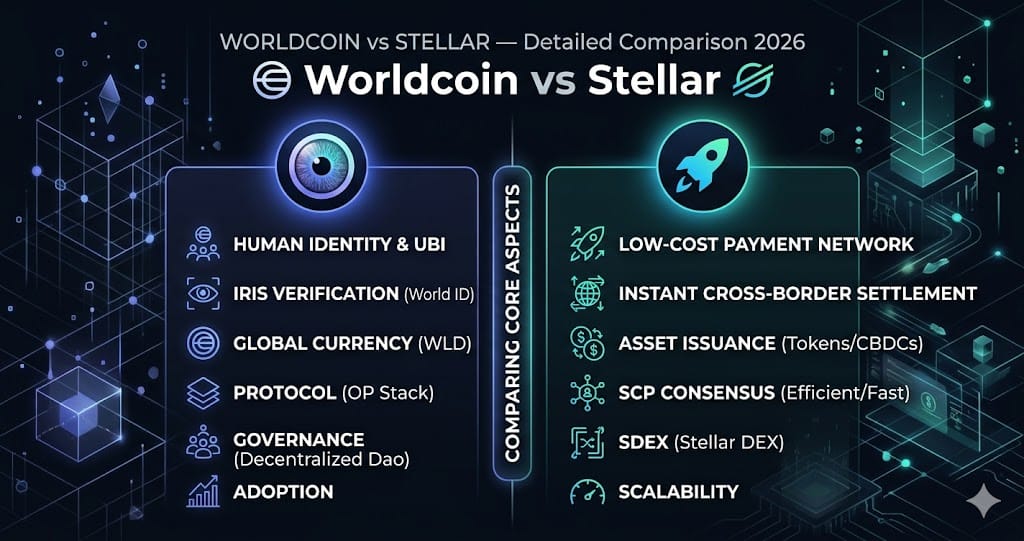
Worldcoin (WLD) focuses on identity-based crypto infrastructure, using biometric verification to build a global "proof-of-personhood" network. Stellar (XLM) focuses on cross-border payments and fast settlement rails for financial institutions and remittances. As of the latest data, WLD trades at $0.3491 (+14.7% 24h, $40.7M volume) while XLM trades at $0.2478 (+13.9% 24h, $237.6M volume).
Both tokens are moving in the same short-term momentum regime — double-digit 24h gains suggest liquidity rotating into mid-cap infrastructure plays. The volume gap ($40.7M for WLD vs $237.6M for XLM) shows uneven conviction: traders are stacking payment rails over identity networks by a 5.8x margin.
Quick Comparison
| Feature | Worldcoin | Stellar |
|---|---|---|
| Price | $0.3491 | $0.2478 |
| Market Cap | — | — |
| 24h Change | +14.7% | +13.9% |
| 24h Volume | $40.7M | $237.6M |
| Rank | #undefined | #undefined |
Payments & Throughput
Stellar wins on payments and throughput as of March 2026. It processes roughly 1,000 transactions per second with 3–5 second settlement finality. Worldcoin's network focuses on identity verification rather than high-frequency payment execution, so these metrics don't apply.
Stellar is built for cross-border settlement at scale. Transaction fees sit near 0.00001 XLM per transfer, per Stellar network specifications. Worldcoin (WLD) doesn't function as a payment rail — World ID authentication layers over external networks with standard L1/L2 gas costs that vary by chain.
Worldcoin's constraint is structural: the system isn't built for throughput-based payment competition. Stellar's circulating supply near 28B XLM supports consistent payment routing infrastructure — liquidity and transaction flow are purpose-built for transfers. At ~1,000 TPS versus Worldcoin's non-payment architecture, Stellar dominates under real payment demand.
Tokenomics & Supply
Stellar wins on supply stability since Q4 2025. Circulating supply sits at approximately 28B XLM with no hard cap, but inflationary mechanisms were effectively neutralized after protocol changes in 2019. That created a stable issuance floor that has held across multiple cycles.
Worldcoin carries higher supply concentration risk. WLD has a maximum supply of 10B tokens, with a significant portion allocated to insiders, investors, and ecosystem incentives. That structure introduces heavier unlock pressure compared to Stellar's ~28B XLM spread across a longer distribution curve.
Stellar's supply behavior has been stable across multiple cycles, while Worldcoin's unlock schedule continues expanding circulating supply through structured releases. A 10B capped WLD system against ~28B circulating XLM means Worldcoin concentrates dilution risk into earlier years while Stellar spreads it across a longer maturity curve. That difference implies a steadier supply pressure profile for Stellar over time.
Adoption & Use Case
Stellar wins on real-world payment adoption over the past 7 days of network activity. It's actively used for remittances and cross-border settlement integrations. Worldcoin focuses on digital identity verification through World ID rather than transactional payment settlement.
Stellar's network has processed billions of historical transactions, with anchor systems supporting fiat on/off ramps across multiple corridors. Worldcoin's adoption centers on biometric verification via iris scanning, where growth is measured in identity registrations — not transaction volume or settlement throughput.
Worldcoin competes in identity infrastructure; Stellar competes in payment networks. Stellar's ~1,000 TPS and live payment rails contrast directly with Worldcoin's non-transactional architecture. That gap creates a clean separation: Stellar dominates financial utility use cases, Worldcoin owns authentication.
Worldcoin (WLD) Resources
Stellar (XLM) Resources
Ready to start trading?
Trade on Bitget Try CoinTech2uAffiliate links — we may earn a commission at no extra cost to you.
Final Verdict
Worldcoin edges Stellar on 24-hour price performance, up 14.7% versus Stellar's 13.9% as of May 31, 2026, per CoinMarketCap data. That 0.8% margin hides a significant volume gap: Stellar handles $237.6M in daily volume versus Worldcoin's $40.7M — 5.8x more liquidity. On a thin $40.7M daily book, moderate sell orders slip. Worldcoin fits if you're speculating on AI-identity narratives and comfortable with low-liquidity risk. Stellar fits if you need tight spreads on a network that processed over 6 million daily operations as of May 2026, per Stellar's public dashboard.
Frequently Asked Questions
What is the main difference between Worldcoin and Stellar for everyday users?
Worldcoin is built around digital identity verification using biometric proof of personhood, while Stellar is designed for fast, low-cost money transfers between currencies. As of May 2026, Stellar processes transfers in ~3–5 seconds with fees typically around 0.00001 XLM per transaction (roughly fractions of a cent per CoinMarketCap network estimates), while Worldcoin focuses on identity verification rather than payment throughput metrics. If you need payments and remittances, Stellar is the direct tool; if you need identity-linked crypto access, Worldcoin is the more relevant system. Final takeaway: Stellar is payment infrastructure, Worldcoin is identity infrastructure.
Which is cheaper and faster: Worldcoin or Stellar?
Stellar is significantly cheaper for transactions, with typical fees near 0.00001 XLM per transfer and settlement times around 3–5 seconds per network design specs as of 2026. Worldcoin does not compete on transaction fees because its core system is identity verification, not high-frequency payments or transfers. On pure payment efficiency, Stellar wins by a wide margin because it is optimized for low-cost settlement, while Worldcoin’s cost structure depends on identity verification flows rather than transfers. Final takeaway: Stellar is effectively near-zero fee payments, Worldcoin is not a payment rail.
Is Worldcoin or Stellar more decentralized and why does it matter?
Stellar uses a federated consensus model with validator nodes that historically include institutions like IBM-backed ecosystem participants, while Worldcoin relies on a centralized Orb-based identity issuance system for World ID verification. As of May 2026, Stellar’s validator set is distributed across multiple independent operators, while Worldcoin’s identity layer still depends on controlled biometric hardware deployment for onboarding. This matters because Stellar’s decentralization supports open financial routing, while Worldcoin’s model prioritizes identity uniqueness over permissionless participation. Final takeaway: Stellar is more open for network participation, Worldcoin is more controlled at the identity layer.
Which has stronger long-term value potential: Worldcoin or Stellar?
Stellar has an established role in cross-border settlement, while Worldcoin is still dependent on adoption of global proof-of-personhood systems. As of May 2026, Worldcoin has a fixed max supply of 10B WLD, while Stellar’s supply is inflation-adjusted with ongoing distribution mechanics tied to network participation. Stellar’s value case is tied to payment volume expansion, while Worldcoin’s depends on identity adoption scaling across platforms and governments. Final takeaway: Stellar is utility-driven payments, Worldcoin is adoption-dependent identity infrastructure.
Related Articles
- Binance vs Bybit — Detailed Comparison 2026
- Coinbase vs Binance — Detailed Comparison 2026
- Coinbase vs Binance — Detailed Comparison 2026