Bitcoin's $600M Liquidation Absorbed With Only 2.2% Drop: May 2026
BTC absorbed a $600M liquidation with just -2.2% price impact on May 18, 2026. Here is what the data on ETF flows, OI, and funding rates tells us.
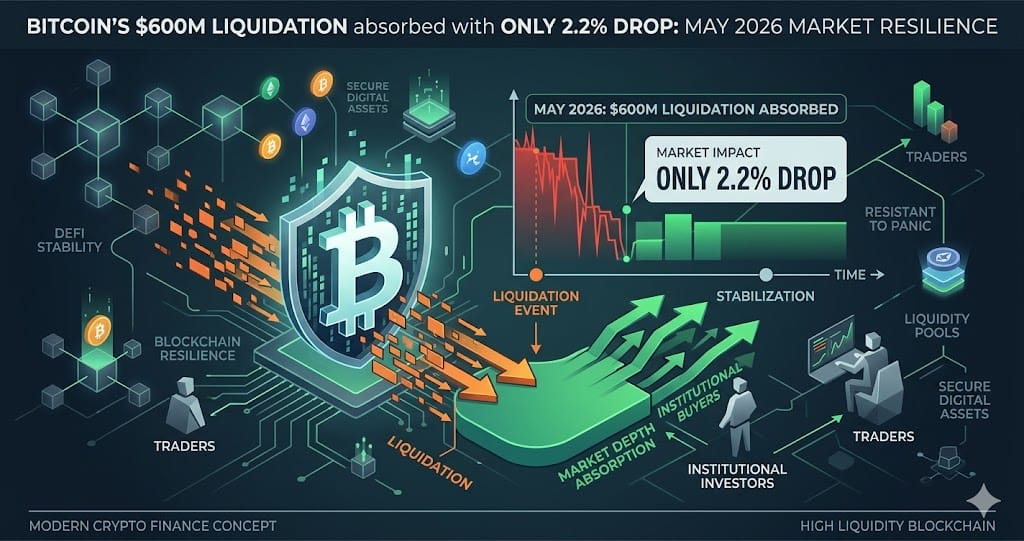
On May 18, 2026, Bitcoin absorbed approximately USD 600 million in forced liquidations and fell only 2.2%, a striking contrast to February 6 when USD 1.26 billion in liquidations sent BTC from USD 70,000 down to USD 63,000, a decline exceeding 10%. That decoupling of liquidation size from price impact is the most important structural signal of the current cycle.
The May 15 through May 18 cascade was not a surprise event. On May 14, CoinGlass publicly flagged that a break below USD 78,000 would trigger roughly USD 1 billion in long liquidations. The actual cumulative forced selling across those four days reached an estimated USD 2 to USD 2.5 billion, yet the price held above USD 76,651 as of May 19. Understanding why requires looking at four converging factors: liquidation map mechanics, institutional ETF positioning, perpetual futures open interest, and 69 days of persistently negative funding rates.
The Cascade Structure: How a $2.5B Unwind Played Out in Stages
The May 15 to May 18 event unfolded in two distinct legs. The first, roughly USD 1 billion in long liquidations on May 15 and May 16, was triggered as BTC broke below the USD 78,000 level that CoinGlass had identified as the critical threshold in its May 14 liquidation map analysis. The second leg, estimated at USD 1.68 to USD 1.75 billion on May 18, represented the tail-clearing phase. CoinGlass data showed Binance alone accounted for approximately one-third of total liquidation volume, consistent with its 34% share of global derivatives market activity and an average monthly volume around USD 2.5 billion entering May.
The high-profile Hyperliquid positions held by traders such as James Wynn and Machi Big Brother attracted significant attention but were small relative to the Binance-dominated aggregate. The more meaningful structural fact is that BTC perpetual open interest had surged to USD 23 billion across major exchanges in early May, the fastest single growth sprint of 2026, before the cascade erased roughly USD 2.5 billion of that leverage within three to five trading days. Against the backdrop of total crypto open interest hitting an all-time high of USD 112 billion on May 10, the perp segment represented approximately 20.5% of the total, with the remainder split between options and futures, the latter having been surpassed by options OI for the first time in this cycle.
Institutional ETF Outflows Were the Hidden Fourth Trigger
Prior analyses of the May cascade focused on macro conditions, geopolitical risk, and the post-CLARITY Act sell-the-news dynamic. A fourth trigger was operating 48 to 72 hours ahead of the retail-visible cascade: during the week of May 11 through May 15, BTC spot ETFs recorded a net outflow of USD 1.039 billion, ending six consecutive weeks of net inflows. ETH spot ETFs saw a USD 255 million net outflow in the same window.
This timing implies an information-asymmetry dynamic. Institutional allocators reduced exposure at prices above USD 80,000 before the cascade was widely visible in price action. The pattern fits what some analysts have labeled anticipatory selling rather than reactive selling. For traders monitoring ETF flow data as a leading indicator, the takeaway is that sustained net inflows are a structural support condition, and their absence in the days before a major technical level break increases cascade severity. Weekly ETF flow figures, available through sources such as the official fund sponsor filings and aggregators like CoinGlass, are now a front-line monitoring tool rather than a lagging confirmation.
Funding Rates and the 69-Day Short-Bias Regime
As of May 19, 2026, the 30-day moving average of BTC perpetual funding rates on Binance had been negative for 69 consecutive days, the longest sustained short-biased regime since the collapse of FTX in November 2022. This means the dominant leveraged position throughout the entire rally from USD 75,000 to the USD 112 billion OI peak was short, not long, a counter-intuitive setup that fueled the three-phase short squeeze cycle observed between April 14 and May 12.
During the May 15 through May 18 cascade, the 8-hour funding rate swung from negative 12 basis points at the peak of long liquidation pressure to positive 7 basis points within 24 hours, a roughly 20 basis point range that represents the largest single-period funding swing since the June 2022 Luna aftermath. Because the 30-day average has not yet turned positive and shorts have continued to accumulate, the setup for a renewed short squeeze remains live. If BTC reclaims and holds above USD 80,000, the same short-position overhang that was squeezed three times between April and May could provide fuel for a fourth leg higher in the USD 80,000 to USD 82,000 band.
Key Price Levels and the Recovery Signal From Shrinking Liquidations
BTC was trading between USD 76,651 and USD 80,000 as of May 19. The most closely watched level is USD 77,331, which corresponds to the 0.786 Fibonacci retracement and functions as the near-term pivot. A sustained close below this level opens the path to the USD 70,000 to USD 72,000 support band, with USD 66,413 as the deeper retracement target. Reclaiming USD 80,000 would convert the prior equilibrium band into resistance but would also likely activate the short-squeeze dynamic described above.
The cleaner recovery signal is the one Seeking Alpha flagged on May 18 under the heading "Shrinking Forced Liquidations Point to Recovery." Historically, the week-over-week decline in forced liquidation volume has been a leading indicator for spot accumulation phases, because it signals that the leveraged overhang is exhausting itself. Solana's USD 34 million in two-day liquidations, combined with a long-to-short ratio of 2.9 entering the cascade period, shows that altcoin deleveraging is following a multi-day decay curve rather than clearing in a single session. Monitoring whether daily liquidation totals continue to shrink through the May 20 through May 25 window will be the most direct read on whether the post-deleverage accumulation thesis is intact.
What to Watch
- BTC holding USD 77,331 (0.786 Fibonacci retracement) on daily closes as the critical near-term support
- BTC spot ETF weekly net flow data for a return of sustained institutional inflows above the six-week inflow streak baseline
- BTC 30-day average perpetual funding rate on Binance and Bybit turning positive and holding, which would confirm the short-bias regime is ending
- Daily forced liquidation totals on CoinGlass shrinking sequentially through May 20 to May 25, the primary leading indicator for a spot accumulation phase
Ready to start trading?
Trade on Bitget Try CoinTech2uAffiliate links — we may earn a commission at no extra cost to you.
Related Articles
- May 18 2026 Crypto Crash: USD 1.75 Billion Liquidated in One Day
- Bitcoin $1B Long Liquidations in May 2026: Funding Rates and OI Collapse Explained
- BTC Crashes to USD 78,600: The May 2026 Liquidation Cascade Explained
Frequently Asked Questions
Why did Bitcoin only fall 2.2% despite $600 million in liquidations on May 18?
The subdued price reaction is consistent with a post-deleverage accumulation phase, where spot buyers are absorbing forced sell orders rather than stepping back. BTC perpetual open interest had already fallen from approximately USD 23 billion to a much lower level after the May 15 cascade, meaning the remaining leveraged long overhang was smaller. When fewer forced sellers remain, each dollar of liquidation causes less price slippage.
What role did the CoinGlass liquidation map play in the May 2026 cascade?
CoinGlass published data on May 14 showing that a break below USD 78,000 would trigger roughly USD 1 billion in long liquidations. That threshold was breached on May 15, and cumulative liquidations over the following four days reached an estimated USD 2 to USD 2.5 billion. The accurate pre-event prediction illustrates that liquidation maps are increasingly useful as forward-looking tools rather than post-hoc explainers, because large clusters of stop levels are visible in real time on platforms like CoinGlass.
What is the short-squeeze risk heading into late May 2026?
BTC perpetual funding rates on Binance have been negative for 69 consecutive days as of May 19, meaning the leveraged market has been net short throughout the rally period. This mirrors the setup that produced three distinct short squeezes between April 14 and May 12. If BTC closes above USD 80,000 and holds, shorts would face mounting unrealized losses and forced covering could accelerate the move. The May 20 to May 25 window is the nearest period where this dynamic could re-activate, though it requires the spot price to first clear and sustain the USD 80,000 resistance level.