Bitcoin Liquidation Cascade May 2026: OI Breaks $112B ATH
BTC fell to $80,389 on May 12 amid $246M in liquidations, $112B BTC futures OI breaking 2025 highs, and Binance leverage ratio hitting a yearly high
BTC dropped over 1% from $82,000 to $80,389 on May 12, 2026, as hotter-than-expected April CPI data and escalating Iran tensions hit simultaneously. ETH fell 3% to $2,259.40 in the same session, declining at three times the rate of BTC.
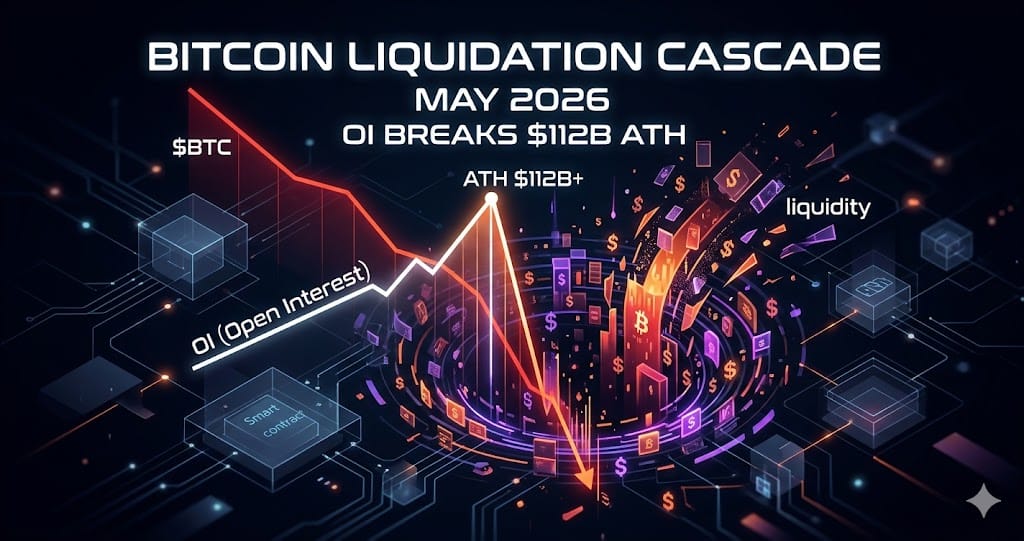
The selloff exposed an unusually fragile derivatives structure. BTC futures open interest had broken $112 billion on May 10, surpassing 2025 all-time highs by an estimated $30 billion, while Binance's estimated leverage ratio reached 0.1976, the highest level of the year. A $246 million cross-exchange liquidation event on May 11 -- 71% of which struck short sellers -- immediately preceded the macro-driven price decline.
Open Interest at $112B: What the Scale Actually Means
BTC futures open interest climbed to $112 billion by May 10, 2026, according to CryptBull data, representing roughly an 84% expansion from the $61 billion level recorded just days prior. This figure is not merely a new record -- it exceeded the 2025 all-time high by an estimated $30 billion in a compressed timeframe, which analyst Markus Thielen characterized as a structural market fragility signal rather than an emotional crowd move.
Adding a second layer of risk, Binance's estimated leverage ratio hit 0.1976 on May 6, the highest reading of the year as tracked by CryptoTimes. This metric captures notional contract value relative to deposited margin. At 0.1976, a BTC price move of just 2% to 3% carries enough force to trigger cascading liquidations across Binance's order book without any change in the absolute OI level.
The Short Gamma Trap at $82,000
Bitfinex analysts identified a critical microstructure condition ahead of the May 12 move: market makers held short gamma positions at the $82,000 level. Short gamma means that as BTC price rises, dealers must buy additional BTC to stay delta-neutral, which mechanically amplifies upward momentum. This created a structural self-reinforcing acceleration zone between $82,000 and $85,000 that prior research had not captured.
On May 12, the combined macro shock from CPI and Iran news was sufficient to overwhelm dealer buying pressure, pushing BTC back below $80,400. The level's significance remains intact going forward: $82,000 to $85,000 is a two-sided institutional battleground. A sustained close below $80,000 could force dealers to reverse their delta hedges and add sell-side pressure, potentially triggering a test of the $75,000 support zone identified in prior on-chain analysis.
$246M in Liquidations: Breakdown by Direction and Venue
The May 11 liquidation event totaled $246 million across all crypto futures markets, with BTC alone accounting for $122.86 million of that figure. Short sellers bore 71.01% of those losses, according to BitcoinWorld data covering all major exchanges. This cross-exchange count is substantially larger than single-venue subsets and corrects earlier reads that suggested May 11 was a near-parity session between long and short liquidations.
Two individual traders illustrated the concentrated human scale of these events. James Wynn accumulated nine liquidations on Hyperliquid totaling over $1 million in losses across those events, and had executed $16.8 billion in cumulative trading volume before his account was fully liquidated in May 2026, per CoinDesk. He was then displaced as Hyperliquid's largest single loser by whale address 247ff, whose one position produced a $40 million loss -- more than double any individual loss Wynn had recorded.
Funding Rate Structure Across Binance, Bybit, OKX, and Hyperliquid
Binance BTC perpetual funding rates spent approximately 67 consecutive days in negative territory, with a 30-day average around -5% compared to a historical norm near +8% annualized. By May 7, Bitfinex confirmed the rate had shifted from deeply negative to neutral. Binance's rate reached +0.0043% per 8-hour interval on May 9 to May 10, marking the end of the extended short-bias funding period without entering an overheated long regime.
The exchange hierarchy shapes how cascades begin. Binance carries the highest retail short concentration, so its funding rate tends to lead directional moves. Bybit typically runs slightly closer to neutral, and OKX tracks with similar directionality during Asia trading hours. Hyperliquid operates on a 1-hour settlement cycle rather than the 8-hour standard on major CEXs, meaning its rates can reverse eight times faster. This structural gap explains why heavily leveraged shorts on Hyperliquid face forced liquidation before traders on Binance, Bybit, or OKX have the chance to reduce exposure within a standard funding window.
What to Watch
- $80,000 near-term support: a sustained close below this level could activate dealer delta-hedging that opens a path to the $75,000 zone
- Binance estimated leverage ratio at 0.1976, the highest since early 2026 -- any further increase raises cascade sensitivity even without OI growth
- BTC futures open interest holding above $112 billion signals continued structural fragility; a de-leveraging drop toward $90 billion or below would be a meaningful reset signal
- ETH relative weakness: ETH fell 3x faster than BTC on May 12, and Binance ETH open interest hit a record 14.17 million contracts -- watch this pair for altcoin contagion signals
Ready to start trading?
Trade on Bitget Try CoinTech2uAffiliate links — we may earn a commission at no extra cost to you.
Related Articles
- Bitcoin's $370M Short Squeeze: Reading the May 2026 Liquidation Cascade
- Bitcoin's 67-Day Funding Rate Flip and Liquidation Storm: May 2026 Analysis
- Crypto Narrative Playbook: May 2026 Market Signals Decoded
Frequently Asked Questions
Why did BTC drop on May 12, 2026?
BTC fell from approximately $82,000 to $80,389 on May 12 due to two simultaneous macro triggers: April CPI data came in hotter than expected, reducing the likelihood of near-term rate cuts, and escalating Iran tensions raised projections for global fuel and food costs. These combined headwinds overrode structural dealer buying that had been supporting price near $82,000 through short gamma hedging.
What does BTC futures open interest breaking $112 billion actually signal?
BTC futures OI at $112 billion exceeds the 2025 all-time high by an estimated $30 billion and reflects roughly 84% growth from the $61 billion level observed just days earlier. When paired with Binance's leverage ratio of 0.1976, the figure means that even a 2% to 3% BTC price move carries enough mechanical force to trigger large cascades of forced liquidations, as each unit of collateral is supporting a much larger notional position than historical norms.
What is short gamma and why was $82,000 a key level in May 2026?
Short gamma is an options position where a dealer must buy the underlying asset as price rises to maintain a balanced exposure -- a process called delta hedging. At $82,000, market makers were net short gamma, so BTC moving toward that level would automatically trigger additional buying and accelerate the move. On May 12, macro headwinds from CPI and Iran news overpowered this mechanical buy pressure, causing price to reverse. The level remains structurally significant because the same dealer hedging dynamic applies in reverse below $80,000.