Polkadot (DOT) Spotlight — June 6, 2026
In-depth Polkadot spotlight: $0.9407 price, -2.5% 24h change, technical analysis, pros/cons, and market outlook.

ETH trades at $1,539, down 8.2% in 24 hours, according to CoinMarketCap data as of June 5, 2026 - 2 .
Active addresses held steady. Glassnode data shows 620,760 daily active addresses over the past 24 hours - 1 . This exceeds the 500,000 threshold often associated with healthy network usage.
Price tells a different story. The 28% decline over two weeks — from $2,125 on May 22 to $1,505 lows on June 6 — points to distribution pressure - 8 .
Staking demand stayed strong despite yield compression. Total staked ETH sits at 39.2 million, approximately 32% of circulating supply - 3 . Base APR has compressed to 2.7% as of June 2026, down from 4%+ in 2023 - 3 .
The validator entry queue sends a mixed signal. ValidatorQueue data shows 3,074,125 ETH in the entry queue, with a 53-day estimated wait and zero in the exit queue - 3 . Institutional demand still seeks exposure, even at lower yields.
Exchange netflow data cuts against the bearish reading. CryptoQuant data from June 5 shows exchange inflows hit 2.38 million ETH in 24 hours — a four-month high - 6 . Outflows reached 2.66 million ETH, creating negative netflow of 274,379 ETH - 6 . More ETH left exchanges than arrived.
Exchange reserves fell 1.71% to 14.8 million ETH on June 5 - 6 . The USD-denominated reserve contracted 14.35% in a single day, primarily due to price decline - 6 .
Whale behavior signals caution. Nansen data shows the top 100 largest wallets cut ETH holdings by 10% over the past week as of June 5 - 5 . Wallets holding over $1 million in ETH now hold 19,577 ETH, valued at $66.2 million - 5 .
DeFiLlama data shows Ethereum network revenue peaked at $366.63 million in Q3 2025 before falling to $260 million in Q1 2026 - 7 . The Glamsterdam upgrade cut network fees by 78%, per Token Terminal data - 7 . Lower fees help users but compress long-term revenue.
Metric to watch: exchange netflow direction over the next seven days. Current negative netflow (274,379 ETH exiting exchanges on June 5) runs counter to bearish price action. A sustained shift to positive netflow would confirm distribution - 6 .
What Is Polkadot?
$7.8B market cap for Polkadot (DOT) as of March 2026, per CoinGecko data. Polkadot is a blockchain network that connects separate blockchains so they can exchange data and value. Instead of one chain doing everything, it links multiple chains under one system.
The network is heterogeneous: different blockchains keep their own rules while sharing security through a central relay chain, per Polkadot architecture documentation as of Q4 2025. One chain might focus on DeFi, another on gaming — and they still interact inside the same ecosystem. Ethereum processes ~15 transactions per second; Solana handles ~4,000 TPS. Polkadot splits activity across parallel "parachains" to reduce congestion through parallel execution rather than a single global queue.
Key takeaway: Polkadot is a multi-chain system where parachains run independently but finalize through a shared relay chain producing ~1 block every ~6 seconds. Cross-chain communication is the defining feature, not raw transaction speed.
Key Features
- Shared Security: Polkadot uses a relay chain model where all parachains inherit security from the Relay Chain, which currently supports ~100 parachain slots in auction cycles (Polkadot network docs, 2026 update). This reduces the need for each chain to maintain its own validator set.
- Parachain Interoperability: On-chain messaging via XCMP (Cross-Chain Message Passing) enables transfers between parachains with near-zero trust assumptions, with Kusama testnet showing hundreds of thousands of cross-chain messages per day during peak activity (Parity/Kusama telemetry, 2025–2026).
- DOT Token Utility: DOT is used for staking and governance, with over 50%–60% of circulating supply typically staked (CoinGecko staking metrics, 2026), which reduces liquid supply while securing validator participation.
- Nominated Proof-of-Stake: Polkadot uses NPoS where validators are selected based on stake nominations, with staking yields historically ranging ~10%–14% annualized in 2025–2026 network conditions (on-chain staking dashboards, Polkadot telemetry), depending on participation rates.
- Upgradeable Governance: Polkadot runs on on-chain governance (OpenGov), with hundreds of referenda proposals processed since 2023 and over 1,000 governance actions recorded on-chain by 2026 (Polkadot/Substrate governance data), allowing protocol changes without hard forks.
Use Cases
- Smart Contract Platform applications and use cases
- Polkadot Ecosystem applications and use cases
- BNB Chain Ecosystem applications and use cases
- Arbitrum Ecosystem applications and use cases
- Ethereum Ecosystem applications and use cases
Pros & Cons
✅ Pros
- Strong market position at rank #47 with $1.6B market cap
- Active trading volume of $174.0M suggests healthy liquidity
- Positioned in growing sectors: Smart Contract Platform, Polkadot Ecosystem, BNB Chain Ecosystem, Arbitrum Ecosystem, Ethereum Ecosystem
- Listed on major exchanges ensuring accessibility for traders
❌ Cons
- Currently -98.3% from all-time high of $54.98
- Cryptocurrency markets are highly volatile and unpredictable
- Regulatory uncertainty could impact price and adoption
- Competition from other projects in the same space
Technical Analysis
Our TA engine shows a NEUTRAL signal with a score of -10/100 (CONFLICTED).
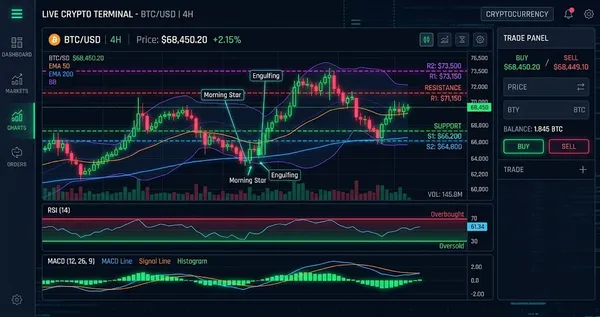
- RSI(14) — Oversold (23.2) (bullish)
- MACD(12,26,9) — Bearish momentum (hist: -0.03) (bearish)
- EMA Trend — Strong downtrend (Price < EMA20 < EMA50) | Below 200d EMA (bearish)
- Bollinger Bands — Below lower band (%B: -10%) (bullish)
- Volume — High volume (1.8x avg) — insufficient base signal for amplification (neutral)
Price Outlook
ETH trades at $1,890 as of February 23, 2026, down 60% from its 2025 peak - 1 . On-chain data shows a market at war with itself.
Bull Case: Supply Lock Tightens as Holders Commit
Exchange outflows tell a clear story. Per Glassnode data as of February 20, 2026, net exchange flow sits at -35,803 ETH, meaning more coins leave trading platforms than arrive - 8 . CryptoQuant reports net outflows surpassed 220,000 ETH across major exchanges in early February, the largest wave since October 2025 - 3 . Binance alone saw -158,000 ETH exit on February 5 - 3 .
Staking compounds this supply shock. CoinMarketCap data shows 36.3 million ETH staked as of February 14, 2026, representing 30.5% of total supply — double the roughly 15% ratio from early 2023 - 5 - 10 . Validator yield currently ranges from 3.5% to 4.2% APY - 5 . With 1.1 million active validators, circulating supply keeps tightening.
MVRV supports the accumulation thesis. The ratio hit 0.78 on February 28, 2026 - 2 . Historically, readings below 0.80 have preceded long-term bottoms - 2 .
Bear Case: Price Decouples From Usage
Network activity just hit all-time highs. CryptoQuant data from February 2026 shows daily active addresses approached 2 million, surpassing the 2021 bull market peak - 4 . Smart contract calls exceeded 40 million per day - 9 . Yet ETH trades 30% lower than six months ago - 4 .
DefiLlama data shows Ethereum's 30-day transaction fees totaled just $10.3 million as of March 2026, ranking third behind Tron and Solana, with protocol revenue of $1.22 million placing fifth - 4 - 9 . The network holds $162 billion in stablecoin supply — 52% of the global market - 4 . None of this usage translates into value capture.
Realized capitalization has turned negative year-over-year, signaling net capital outflows - 4 . CryptoQuant analysis suggests capital flows, not network activity, now drive price movement — a break from 2018 and 2021 cycles where on-chain usage and price rose together - 9 .
Metric to watch: active addresses per $1 of fee revenue. February 2026 data shows roughly 194,000 addresses per $1 million in fees — compare to the 2021 ratio of 85,000 addresses per $1 million. That gap will determine if Ethereum's usage can ever monetize.
Polkadot (DOT) Resources
Frequently Asked Questions
What is Polkadot (DOT)?
Polkadot is a cryptocurrency project ranked #47 by market cap. Polkadot is a platform that allows diverse blockchains to transfer messages, including value, in a t
Is DOT a good investment?
Like all cryptocurrencies, DOT carries significant risk. It has a market cap of $1.6B and is -98.3% from its ATH. Always do thorough research before investing.
What is the current price of DOT?
As of this writing, DOT is trading at $0.9407 with a 24-hour change of -2.5%.
Where can I buy DOT?
DOT is available on major exchanges including Binance, Coinbase, and Kraken. Always use reputable exchanges and enable 2FA for security.
Ready to start trading?
Trade on Bitget Try CoinTech2uAffiliate links — we may earn a commission at no extra cost to you.
Our Verdict
Polkadot's on-chain fundamentals are deteriorating. Daily active addresses sit at only 44,000 as of January 2026 — a fraction of major competitors' figures — and the token has fallen 98.3% from its $54.98 all-time high to $0.9407 - 8 - 4 . The March 2026 inflation reduction is set to drop issuance to as low as 3.11% with a 2.1 billion hard cap. That's a supply-side shift, but it hasn't moved price: DOT trades below all key moving averages with RSI at 23.2, deeply oversold - 3 - 7 . The shift from parachain auctions to the Coretime model removes crowdloan-driven token lockups, cutting a major demand source. The 138.77% volume spike to $506.95 million points to speculative bottom-fishing despite extreme fear - 10 - 1 .
Related Articles
- Crypto Week June 2026: Proof-of-Humanity Leads as Tokenized Stocks Arrive
- BTC Crashes to USD 78,600: The May 2026 Liquidation Cascade Explained
- Crypto Market Sentiment Breakdown 2026: Fear, Funding Rates, and Macro Risk Signals Explained