Bitcoin's June 2026 Crash: Four Triggers, USD 30B Liquidated
Bitcoin crashed from $80K to $62K in June 2026. A hawkish Fed, Iran strikes, $4.4B ETF outflows, and forced liquidations erased $250B in two days.
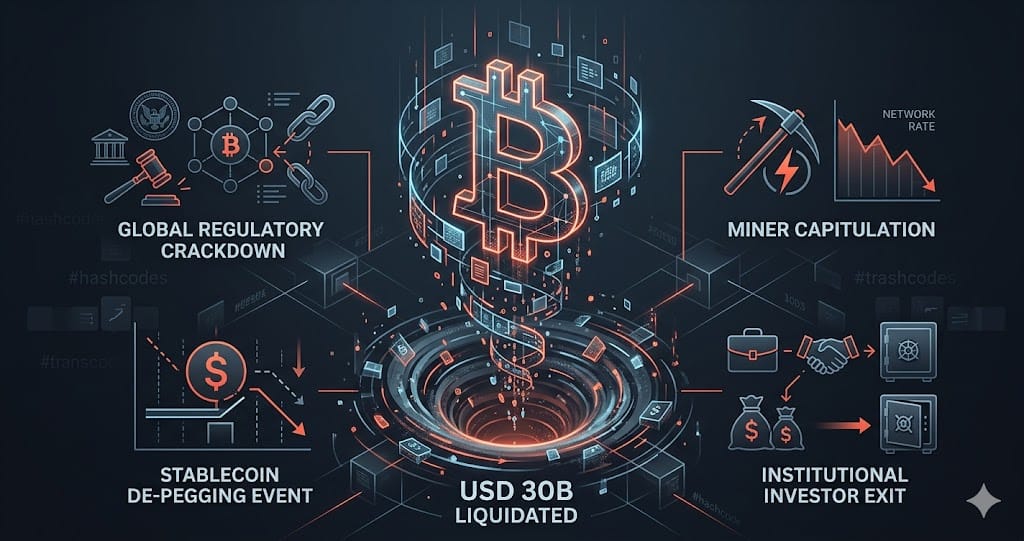
Bitcoin crashed from above USD 80,000 to below USD 62,000 between late May and June 3, 2026, erasing roughly USD 250 billion in total market capitalization in under 72 hours. Four distinct pressures converged simultaneously: a hawkish Federal Reserve effectively ruling out 2026 rate cuts, a US-Iran military exchange on June 2, record Bitcoin ETF outflows totaling USD 4.4 billion over 13 consecutive trading days, and a derivatives cascade that liquidated USD 1.6 billion in a single session.
Long positions absorbed approximately 85 percent of those forced closures. Bitcoin open interest reset from a May peak near USD 42 billion down to a six-month low of USD 25 billion, while funding rates on offshore perpetual contracts collapsed from an annualized 55 to 88 percent down to near zero. The derivatives structure now looks cleaner than it has in months, but the forensic data makes clear that the next directional move will need to be driven by spot demand rather than leveraged speculation.
The Federal Reserve: The Upstream Macro Trigger
The most upstream cause of the crash was a structural shift in Federal Reserve policy expectations. At the April 2026 meeting, the Fed voted 8 to 4 to hold rates at 3.50 to 3.75 percent — the highest dissent count since 1992. New Fed chair Kevin Warsh, sworn in on May 22, quickly signaled a hawkish posture that reinforced the view that rate cuts were off the table for the foreseeable future.
By early June, options markets were pricing a 68.8 percent probability that the Fed would deliver zero rate cuts during all of 2026. For crypto markets, this removed the liquidity tailwind that had underpinned the prior bull run. Risk assets priced for abundant forward liquidity lost their fundamental support before any of the other triggers arrived.
US-Iran Military Escalation: The Match on the Kindling
The geopolitical trigger followed a precise sequence. On June 1, Iran suspended ongoing negotiations. On June 2, Iran launched missile strikes targeting Kuwait and Bahrain. That same night, the United States carried out retaliatory strikes against Iranian military installations on Qeshm Island. Brent crude broke above USD 93 per barrel as global markets absorbed the shock.
June 2 was precisely the day that single-day crypto liquidations peaked, with BTC futures accounting for USD 777 million, ETH USD 398 million, and SOL USD 89 million of the USD 1.6 billion total. The timing was not coincidental: the broad risk-off sentiment triggered by a live US-Iran military exchange accelerated forced liquidations that were already under pressure from the macro backdrop.
Bitcoin ETF Outflows: 13 Days of Institutional Retreat
From May 15 through June 3, Bitcoin spot ETFs recorded net outflows on every single trading day — a 13-session streak that was the longest continuous outflow run since the products launched in January 2024. Total net outflows during this period reached USD 4.4 billion. The single-week figure of USD 3.4 billion set a new all-time record for weekly ETF selling.
BlackRock's IBIT accounted for USD 3.3 billion of those outflows, with its weekly net asset value declining approximately 16 percent. The selling pattern was characterized as coordinated institutional repositioning rather than retail panic, with zero net-positive flow days recorded across the entire 13-session span. This sustained withdrawal functioned as persistent bid removal at a time when leveraged longs had no safety net underneath them.
Derivatives Reset: Funding Rates and Open Interest Breakdown
The derivatives market left a clear forensic trail. Funding rates on offshore perpetual contracts ran at +0.05 to +0.08 percent per 8-hour period from April through early May — annualized rates of roughly 55 to 88 percent, indicating extreme long-side crowding. By late May those rates had collapsed to between -0.005 and +0.005 percent per 8-hour period, oscillating near zero. The cash-and-carry basis on CME Bitcoin futures simultaneously fell from 12 percent annualized down to 4 to 5 percent, prompting neutral carry traders to exit and pulling CME open interest from USD 13 billion to USD 7 billion.
Offshore perpetual markets bore the brunt of the deleveraging, with open interest falling from USD 24 billion to USD 14 billion. On-chain perpetual DEX open interest was largely unaffected, dropping only from USD 5 billion to USD 4 billion, confirming that the cascade was concentrated in centralized exchange leverage on Binance, OKX, and Bybit. Historically, sustained negative funding rates below -0.1 percent per 8-hour period lasting 40 or more days have preceded major reversals — as seen in November 2022 and during March through April 2026. The current structure has not reached that extreme: rates are neutral-to-slightly-negative, not deeply negative, meaning the excess long fuel has been removed but the short-squeeze fuel has not yet accumulated either.
What to Watch
- Federal Reserve guidance: markets currently price a 68.8 percent probability of zero 2026 rate cuts; any dovish pivot or softer-than-expected inflation print would directly remove the primary macro headwind that set this crash in motion
- Bitcoin ETF daily flow data: the 13-session outflow streak ended June 3 — watch for at least 3 to 5 consecutive net-positive days, particularly in BlackRock IBIT, as a signal that institutional demand has genuinely returned rather than merely paused
- Perpetual funding rates: currently oscillating near zero after collapsing from +0.08 percent per 8 hours; a sustained drop below -0.1 percent per 8 hours lasting 40 or more days would qualify as a high-conviction bottom signal based on the November 2022 and early 2026 precedents tracked by Phemex
- US-Iran ceasefire durability: the June 2 military exchange followed a fragile truce breakdown; any re-escalation would likely trigger a fresh risk-off wave and renewed ETF selling, while a durable diplomatic settlement removes a fear premium currently embedded in both crypto and oil prices
Ready to start trading?
Trade on Bitget Try CoinTech2uAffiliate links — we may earn a commission at no extra cost to you.
Related Articles
- Bitcoin's June 2026 Crash: USD 59,100 Low and USD 1.73B Liquidations
- Bitcoin's USD 3 Billion Liquidation Cascade: What Funding Rates Signal in 2026
- Bitcoin's June 2026 Crash: USD 61,300 Low, USD 3B Liquidated, What's Next
Frequently Asked Questions
Why did Bitcoin crash in June 2026?
Four pressures converged at once. The Federal Reserve held rates at 3.50 to 3.75 percent with a hawkish tone from new chair Kevin Warsh, pushing zero-cut probabilities for 2026 to 68.8 percent. US and Iranian forces exchanged military strikes on June 2, triggering broad risk-off selling and pushing Brent crude above USD 93. Bitcoin spot ETFs recorded 13 consecutive days of net outflows totaling USD 4.4 billion, with BlackRock IBIT alone shedding USD 3.3 billion. Those three pressures then combined to liquidate over USD 3 billion in leveraged long positions across the peak two-day window of June 2 and 3.
How large were Bitcoin liquidations on June 2, 2026?
Total crypto liquidations on June 2 reached approximately USD 1.6 billion in a single session, with Bitcoin futures accounting for USD 777 million, Ethereum USD 398 million, and Solana USD 89 million. Long positions represented roughly 85 percent of that total. The two-day cumulative figure for June 2 and 3 exceeded USD 3 billion, making it the most severe liquidation event in several months, with approximately 291,000 individual traders forcibly closed out.
What do Bitcoin funding rates signal about the next price move?
Funding rates on offshore perpetual contracts collapsed from an annualized 55 to 88 percent in April and early May 2026 down to near zero by late May, meaning the crowded long positions that fueled the crash have been largely cleared. However, rates have not yet reached the extreme negative territory — below -0.1 percent per 8-hour period sustained for 40 or more days — that historically preceded major reversals in November 2022 and March 2026. The current structure suggests the next meaningful upward move will need to be driven by spot buyers rather than a short squeeze, as neither excess long nor excess short fuel has accumulated at the extremes.