Bitcoin's May 2026 Cascade: How a PPI Shock Wiped USD 1.22 Billion in Two Days
On May 13, 2026, a PPI print of 6% YoY triggered a six-day Bitcoin cascade that wiped USD 1.22B in liquidations across May 18-19 alone.
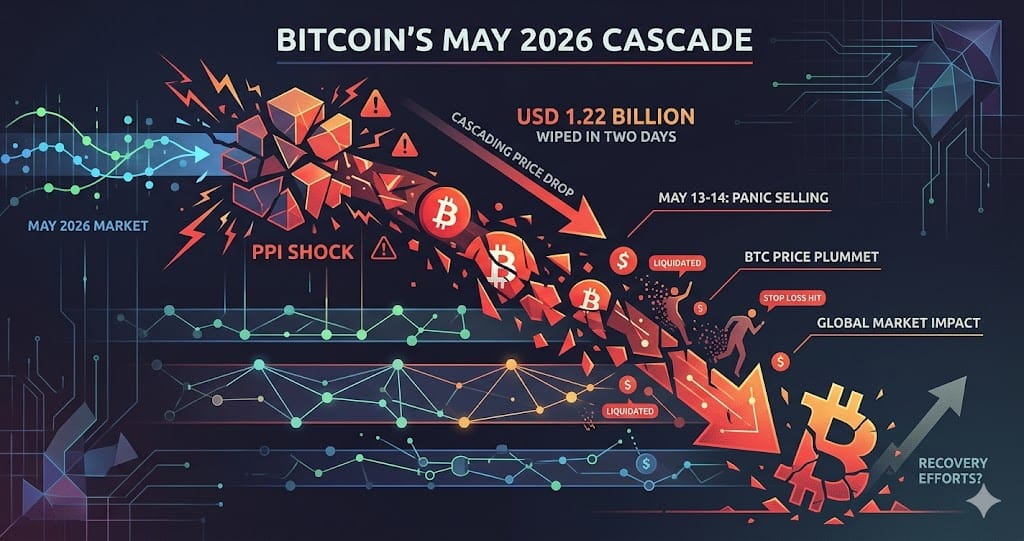
On May 13, 2026, a U.S. Producer Price Index reading of 6% year-over-year — the hottest since December 2022 — sent Bitcoin crashing from above USD 80,000 to an intraday low of USD 78,704, triggering USD 304 million in crypto long liquidations in a single session. What followed was a six-day cascade that became Q2 2026's most destructive derivatives event on record.
By May 19, a second leg down pushed BTC to USD 76,270 and generated USD 657 million in single-session liquidations. Combined with the USD 563 million wiped on May 18, the two-day total reached USD 1.22 billion, with 90.94% of cleared positions being long. This article reconstructs the full chain from the initial macro trigger through the May 21 V-shaped rebound, and explains what the current market structure implies about the next potential squeeze.
The Trigger: May 13 PPI Shock and the Warsh Paradox
The cascade began when the U.S. Bureau of Labor Statistics reported May PPI data showing month-over-month growth of plus 1.4% against a consensus estimate of plus 0.5% — nearly three times the expected figure. The year-over-year print of 6% was the highest since December 2022, and it immediately overrode a market-positive development that had occurred the same week: the Senate confirmation of Kevin Warsh as Federal Reserve Chair. Warsh had known exposure to crypto assets and was considered more constructive on digital assets than the average FOMC member.
That policy tailwind was erased within hours. CoinDesk and Intellectia both documented the minute-level BTC break below USD 80,000 on May 13, with the intraday low of USD 78,704 marking the weakest price since May 4. The episode reset the market's macro priority stack, confirming a structural shift in which inflation data outweighs Fed personnel signals — a return to a purely data-driven regime that has persisted through month-end.
Six Days of Liquidations: The Complete Cascade Timeline
By May 14, CoinGlass had mapped two distinct battleground levels in BTC derivatives: USD 1 billion in long liquidation fuel sitting below USD 78,000, and USD 640 million in short liquidation fuel concentrated at USD 80,458. On that same day Bank of America published a pre-emptive research note warning that equity multiples were about to compress — the first time a major TradFi research desk had explicitly flagged crypto leverage risk ahead of a cascade event. The two-day total for May 18 and May 19 ultimately reached USD 1.22 billion, making it the largest consecutive two-day liquidation event of Q2 2026.
The breakdown of the USD 576 million single-event figure reported by MEXC shows how concentrated the damage was: BTC longs accounted for USD 214 million at a 97.79% long-side share, ETH longs for USD 144 million at 95.96%, and HYPE contributed USD 24.41 million at 78.2% long-side — an altcoin largely absent from earlier cascade analyses. This updates the relative-loss ranking to SOL, BNB, HYPE, XRP, and ETH by long-liquidation proportion. On May 21, BTC staged a V-shaped rebound to USD 80,000, producing only USD 117 million in 24-hour liquidations, but stopping USD 458 below the USD 80,458 short-liquidation trigger that still holds USD 640 million in fuel.
Open Interest Structure: How the Market Was Loaded Before the Shock
Bitcoin perpetual futures open interest grew at its fastest rate of 2026 during the first half of May as BTC pushed toward USD 80,000. This was not organic continuation of existing positioning: data from bitcoin.com shows that mid-April OI declined from 267,480 BTC to 256,000 BTC, indicating that older longs were actively unwinding. The early-May surge represented a second wave of new long entries filling those vacated positions — with aggregate leverage remaining elevated despite the turnover in holders.
That structural fragility explains why the May 13 PPI shock cascaded for six days rather than flushing in a single session. Fresh longs carried no prior loss memory, making them quick to capitulate at each successive support level. After the cascade, Binance's BTC open interest skewed to a long/short ratio of 36.7% to 63.3% — the most bearish skew among major assets at month-end. The direction of leverage has inverted rather than declined, and the short-squeeze setup is now mechanically loaded at the same USD 80,458 level CoinGlass identified in May 14 data.
Funding Rate History and the Three-Stage Institutional Warning Chain
BTC perpetual funding rates turned negative on March 1, 2026, and according to Phemex and CoinGlass remained negative for at least 46 consecutive days through April 15 — only the third streak of that duration in Bitcoin derivatives history. The previous two instances both preceded significant upward price moves. On May 7, CoinDesk published a piece explicitly framing persistent negative funding as a contrarian bullish signal, the first time institutional crypto media formally labeled the setup in advance of a potential move.
The institutional chain for the cascade itself followed a three-stage TradFi sequence: Bank of America's research desk issued a pre-emptive compression warning before the price break, Goldman Sachs executed tactical altcoin ETF sales during the cascade, and Bloomberg provided post-event confirmation coverage. This ordering — research warning, then asset-manager action, then media framing — may mark the first fully formed TradFi information loop around a crypto liquidation event, suggesting that early research-desk signals from traditional finance now carry increased predictive weight for future cycles.
What to Watch
- BTC price versus USD 80,458: this level holds USD 640 million in short liquidation fuel according to May 14 CoinGlass data; a sustained close above it would trigger cascading short covering and potentially a two-layer domino effect given current 63.3% short OI skew on Binance
- Binance BTC long/short OI ratio: currently at 36.7% long versus 63.3% short; any rapid convergence toward parity signals that the short-squeeze setup is beginning to activate
- U.S. PPI and CPI release dates: the May 13 event confirmed inflation data now overrides Fed personnel signals as the primary macro catalyst; each upcoming print carries outsized volatility potential while OI remains elevated
- BTC perpetual funding rates on CoinGlass: the 46-day negative streak through mid-April is historically a pre-rally signal; monitor the point at which funding turns neutral or flips positive as a potential regime-change entry trigger
Ready to start trading?
Trade on Bitget Try CoinTech2uAffiliate links — we may earn a commission at no extra cost to you.
Related Articles
- Bitcoin May 2026 Liquidation Cascade: USD 657M in One Day
- Stablechains, ETF Outflows, and BTC Dominance at 60.88%: May 2026
- Bitcoin's May 2026 Liquidation Cascade: USD 700M and the Treadmill Model
Frequently Asked Questions
What caused the Bitcoin crash in May 2026?
The primary trigger was the U.S. May 2026 Producer Price Index report, released on May 13, showing month-over-month growth of plus 1.4% against a consensus of plus 0.5% and a year-over-year reading of 6% — the hottest since December 2022. This inflation shock overrode a concurrent bullish catalyst, the Senate confirmation of crypto-friendly Fed Chair Kevin Warsh, and initiated a six-day liquidation cascade. The total damage across May 18 and May 19 alone reached USD 1.22 billion, making it Q2 2026's largest two-day derivatives event.
How much was liquidated during the May 2026 crypto crash and which assets were hit hardest?
The two-day combined total for May 18 and May 19 was USD 1.22 billion, with 90.94% of positions being long. The May 19 session alone saw USD 657 million in liquidations with BTC touching USD 76,270. A MEXC-reported single-event figure of USD 576 million broke down as BTC USD 214 million at 97.79% long-side, ETH USD 144 million at 95.96% long-side, and HYPE USD 24.41 million at 78.2% long-side. The updated altcoin ranking by long-liquidation proportion runs SOL, BNB, HYPE, XRP, and ETH.
What does the current negative Bitcoin funding rate mean for the next price move?
Persistently negative perpetual funding rates mean short sellers are paying long holders, reflecting crowded bearish positioning. BTC recorded at least 46 consecutive days of negative funding from March 1 through mid-April 2026 — only the third streak of that length on record, with the previous two both preceding major rallies. After the May cascade, Binance OI sits at 63.3% short, meaning the short side is now the crowded trade. If BTC reclaims and holds above USD 80,458 — where CoinGlass measured USD 640 million in short liquidation fuel — the resulting squeeze could trigger a two-layer domino across both that level and the secondary USD 75,200 to USD 75,800 cluster identified in pre-crash research.