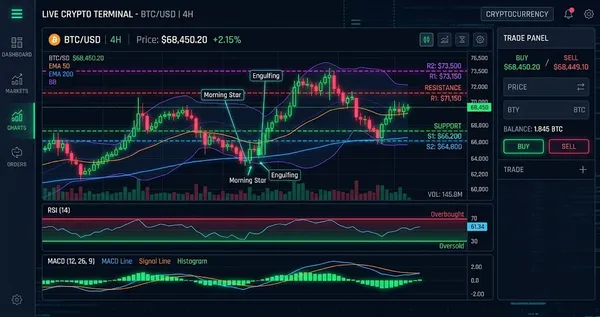
Bitcoin May 2026 Liquidation Cascade: USD 657M in One Day
BTC flash-crashed below USD 77K on May 19, 2026, triggering USD 657M in liquidations. We break down the setup, the whale data, and what comes next.

Bitcoin's May 2026 liquidation cascade reached a single-day peak of USD 657 million on May 19, when BTC flash-crashed below USD 77,000 after BTC perpetual open interest had already surged to USD 23 billion — the fastest OI growth of 2026 — and the asset had touched an all-time high near USD 112 billion market cap on May 10. Phemex's 2026 framework classifies the exact pre-conditions (record OI plus record positive funding at an ATH) as the textbook long liquidation setup, meaning the cascade was structurally predictable, not random.
By May 21, BTC had recovered to the USD 80,000 area with 24,869 BTC absorbed in spot buying, yet USD 117 million in fresh 24-hour liquidations still triggered, confirming leverage had not fully cleared. The Fear and Greed Index told the macro story most clearly: a rare Neutral reading of 50 on May 6 ended 108 consecutive days of negative sentiment dating back to January 17, only to collapse back to 31 (Fear) by May 16 — framing the entire May rally as a brief three-week window inside a longer bearish regime, not a trend reversal.
The May 19 Flash Crash: USD 657M and a Double-Tested Floor
When BTC broke below USD 77,000 on May 19, Bloomberg described the liquidation event as topping half a billion dollars; the precise figure confirmed by bitcoin.com was USD 657 million in a single day. That single-day total accounts for roughly 40% of the two-day May 18-19 cascade, correcting earlier attributions that spread losses evenly across both sessions. The move established USD 76,270 as the intraday low on May 19, and the monthly range locked in at USD 76,845 on the May 20 low to USD 82,845 at the May high — a 7.83% amplitude.
A structural support zone solidified quickly. On May 20, BTC again tested USD 76,845, which banklesstimes described as a crucial support level, meaning the USD 76,000 to USD 77,000 band had been hit in two consecutive sessions. Double-tested support levels carry more technical weight than single-touch lows. Futures open interest continued declining through the bounce, which analysts read as evidence of genuine deleveraging rather than a relief rally built on re-leveraging.
Machi Big Brother: A Documented Case of the Liquidation Treadmill
Trader Machi Big Brother (James Wynn) provides the most detailed individual record of what CryptoSlate calls the Liquidation Treadmill. Over 12 months he lost USD 77.32 million across 335 ETH liquidation events. At one point he held USD 44.8 million in unrealized profit on an ETH long position; when ETH cascaded to USD 1,800, his 25x leveraged long was fully liquidated with losses exceeding USD 29 million. His six-month cumulative loss reached USD 75 million.
The behavior that defines the treadmill pattern is what happened immediately after. Within hours of the May 19 liquidation, Machi reopened a 25x ETH long on 1,825 ETH worth USD 3.87 million, establishing a new liquidation threshold at USD 2,086.69. A 5 to 7 percent decline in ETH from that reopening price would be sufficient to force his position closed and add fresh selling pressure to the market — meaning a single trader was actively contributing fuel for a potential next cascade node in the May 22 to May 28 window.
The Pre-Cascade Framework: Record OI and Funding Rates as Leading Signals
The Phemex 2026 framework names three concurrent conditions that define a textbook long liquidation setup: record open interest, record positive funding rates, and price at an all-time high. All three were present in early May 2026. BTC perpetual OI hit USD 23 billion by early May, marking the fastest OI accumulation of 2026. Funding rates were strongly positive as BTC approached the May 10 ATH. The cascade that followed 5 to 7 trading days later matched the framework's predicted window almost exactly, making this the most efficiently executed leverage unwind of 2026 Q2.
Separately, a longer-term funding regime had been running in the opposite direction for months. Aggregate BTC perpetual funding rates averaged negative 0.13% per 8-hour interval (annualized near negative 47.5%) across Binance, OKX, Bybit, and Bitget during mid-to-late May, per CoinGlass and Coinalyze. This 67-consecutive-day streak of negative daily average funding — which K33 Research flagged as the longest of the decade, exceeding the 2020 COVID crash period — signals that short sellers were paying steep carry costs yet remained committed to their positions, indicating high conviction in continued downside.
Post-Cascade Health Indicators and the Road to Stability
Two signals support the interpretation that the May 15-21 cascade chain represented a genuine leverage flush rather than a temporary price correction. First, futures open interest continued declining through May 21 even as price recovered to USD 80,000. Open interest typically rises when traders re-enter leveraged positions on a bounce, so a declining OI during a recovery suggests that exits were forced rather than voluntary. Second, BTC absorbed 24,869 coins in spot buying on May 21, indicating organic demand at the USD 80,000 area rather than derivative-driven support.
The Fear and Greed Index adds macro context. The May 6 Neutral reading of 50 ended 108 consecutive days of Fear or Extreme Fear dating to January 17, 2026. That three-week neutral window collapsed back to 31 by May 16, showing the market rejected the sentiment improvement rapidly. For traders using this framework, the next Neutral or Greed reading would signal a potential re-accumulation of overleveraged longs. Given the Phemex framework, that moment — not the current recovery — would be the time to watch open interest and funding rates most carefully for signs of a repeating setup.
What to Watch
- ETH price relative to Machi Big Brother's active liquidation threshold at USD 2,086.69 — a 5 to 7 percent ETH decline could trigger the next treadmill node and add fresh forced selling to the market
- BTC futures open interest direction: sustained OI decline from the USD 23 billion early-May peak confirms genuine deleveraging; any OI recovery paired with positive funding rates would recreate the textbook setup Phemex identified before the May cascade
- Fear and Greed Index crossing back above 50 (Neutral) after the current Fear regime — the previous Neutral crossing on May 6 preceded peak overleverage accumulation within roughly two weeks
- BTC structural support integrity at the USD 76,845 to USD 77,000 double-tested zone: a third test of this level carries significant weight and would likely trigger another large liquidation cluster given the concentration of stop orders in that area
Ready to start trading?
Trade on Bitget Try CoinTech2uAffiliate links — we may earn a commission at no extra cost to you.
Related Articles
- Stablechains, ETF Outflows, and BTC Dominance at 60.88%: May 2026
- Bitcoin's May 2026 Liquidation Cascade: USD 700M and the Treadmill Model
- Bitcoin's May 2026 Liquidation Cascade: Five Days, USD 657M, and a Tweet
Frequently Asked Questions
What caused the USD 657 million Bitcoin liquidation on May 19, 2026?
The immediate trigger was a flash crash below USD 77,000, but the structural setup had been building for weeks. BTC perpetual open interest had surged to USD 23 billion by early May — the fastest OI growth of 2026 — while funding rates were strongly positive and price sat near the May 10 all-time high. Phemex describes this exact combination as the textbook long liquidation setup. Any downward catalyst in that condition forces a self-reinforcing cascade of long liquidations, which is precisely what unfolded over May 15-19, producing the largest single-day liquidation event of 2026 to that date.
Who is Machi Big Brother and why do his trades affect the broader market?
Machi Big Brother (James Wynn) is a crypto trader who lost USD 77.32 million over 12 months and experienced 335 ETH liquidation events. His relevance to the broader market is behavioral: after each liquidation he has consistently reopened equivalent or larger leveraged positions, exemplifying the Liquidation Treadmill pattern described by CryptoSlate. After his May 19 liquidation, he reopened a 25x ETH long on 1,825 ETH (USD 3.87 million) with a new liquidation price at USD 2,086.69. When a large leveraged position sits near a predictable price threshold, algorithmic traders and market makers can target that liquidity, amplifying any move that approaches the level.
Does declining open interest after May 21 confirm a genuine market bottom?
Declining OI during a price recovery is one of the stronger signals that a leverage flush is real. When OI falls as price rises, it suggests traders are closing positions rather than opening new longs into the bounce — the opposite of what happens in a temporary relief rally. Combined with the USD 76,845 to USD 77,000 support zone being tested on both May 19 and May 20, the post-May 21 data is consistent with post-deleverage base-building. That said, the 67-day streak of negative aggregate BTC funding rates indicates the short-dominant macro regime has not reversed, and Machi's reopened position at a USD 2,086.69 ETH liquidation threshold remains an active downside risk factor.