Bitcoin's 66-Day Negative Funding Streak and the May 2026 Liquidation Cascade
BTC's 66-day negative funding streak meets USD 415M in daily liquidations in May 2026. CoinGlass, K33, and Bloomberg data maps the risk ahead.
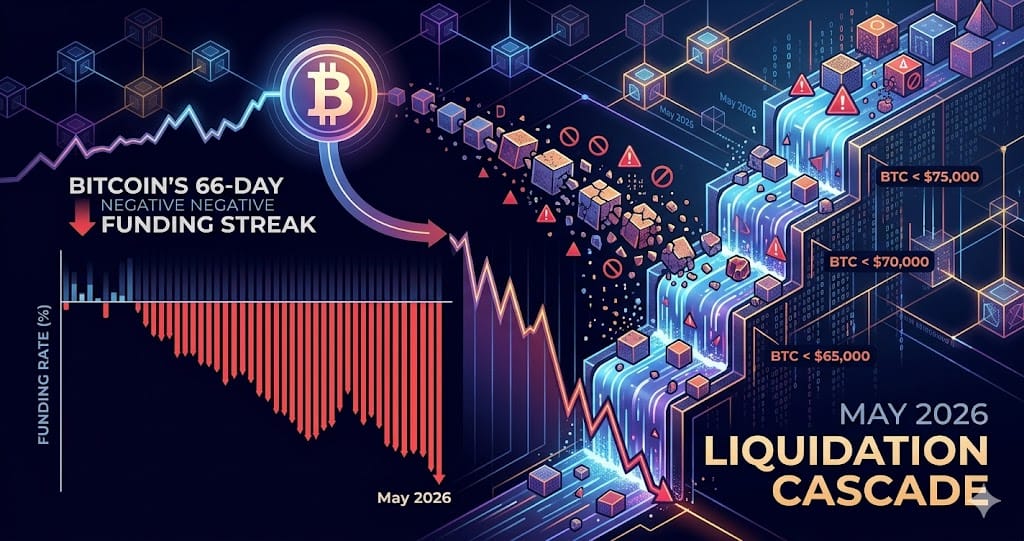
Bitcoin entered May 2026 carrying the longest negative perpetual funding rate streak since the 2010s — 66 consecutive days of net-short bias on Binance, Bybit, and OKX — while simultaneously generating USD 415.57 million in 24-hour liquidations on May 7, with 76.6% of those losses hitting short positions. These two data points describe a market where structural short hedging coexists with episodic short squeezes, not a contradiction.
BTC opened May 7 at USD 81,423.91, its highest opening since January 31, 2026, before a late-session shock — a reported U.S. military strike on Iran that briefly pushed oil above USD 100 per barrel — reversed the rally, pulled price below USD 80,000, and added a separate USD 300 million in futures liquidations to an already record-breaking day. The result: USD 415.57 million total liquidations across 113,153 traders, the single highest daily figure for May 2026 to date.
The 66-Day Negative Funding Rate Streak: What the Data Shows
Since March 3, 2026, Bitcoin's 8-hour funding rate on Binance, Bybit, and OKX has remained continuously negative, reaching a 30-day average of approximately -5% annualized versus the historical norm of +8% annualized — a structural deviation of 13 percentage points. CoinDesk reported on May 8 that this constitutes the longest unbroken negative funding streak on record for the current market cycle. The mechanism matters: short holders on perpetual contracts receive funding payments when rates are negative, but that income erodes as the cost of maintaining conviction through successive squeezes accumulates over weeks.
K33 Research identified the 66-day streak as a contrarian signal grounded in historical precedent. Across 6 comparable negative-rate regimes since 2018 — including the FTX collapse, the March 2020 crash, and the May 2021 sell-off — all 6 produced positive price returns within 90 days, with win rates documented between 83% and 96%. A striking venue-level divergence adds texture: while the three major retail-heavy venues cluster around -0.0020% to -0.0038% per 8-hour period (roughly -2% annualized), Deribit — where institutional traders represent over 70% of volume — showed a rate of +37% annualized as of May 8, 2026. This split suggests institutional desks have rotated toward net-long exposure on Deribit while retail venues bear the structural short load.
The May 2026 Liquidation Cascade: Three Waves in 16 Days
The May 2026 short cascade unfolded in three identifiable events. The April 18 event produced USD 593 million in liquidations with shorts comprising roughly 93% of the total. The May 4 event generated USD 303.88 million with shorts at 81.6%. The May 7 event reached USD 415.57 million across 113,153 traders with shorts at 76.6%, per CoinGlass data. The 16-day cumulative short liquidation total stands at USD 1.215 billion — a figure that still represents only about 24% of the Q1 2026 total, which exceeded USD 5 billion across three landmark events including a USD 1.7 billion single-day long liquidation on January 30 and a USD 2.2 billion Black Sunday event in February.
The declining short-dominance ratio — 93% to 81.6% to 76.6% across successive cascade events — is the structural signal most worth tracking. When long positions begin appearing in the liquidation ledger during what started as a short-squeeze sequence, it typically signals a transition from one-sided price action toward two-way volatility. The May 7 USD 300 million geopolitical reversal reinforced this pattern: the same class of external event that drove shorts into losses on May 5 (Iran de-escalation narrative) drove longs into losses hours later on May 7 (Iran escalation narrative), confirming that BTC is now responding symmetrically to geopolitical triggers.
Supply Tightening: Exchange Reserves and ETF Absorption
Exchange-held Bitcoin declined to 2,693,000 BTC as of May 2026, down 170,000 BTC over the preceding six months. At USD 82,000 per coin, that drawdown represents approximately USD 13.94 billion in Bitcoin that moved off exchanges through ETF creation baskets, OTC block purchases, and cold-custody transfers. Bitcoin ETF assets under management crossed USD 100 billion for the first time in May 2026, with BlackRock and Fidelity together accounting for 80% of cumulative inflows. ETF net inflows over the 9 days ending May 8 totaled USD 2.7 billion, following USD 2.44 billion in net inflows for April alone.
Open interest data from two different methodologies frames the leverage picture. CoinGlass reports total BTC perpetual OI at USD 61 billion, with ETH futures OI at 14.17 million ETH — the highest level since April 18 for both. CME-only OI, tracked separately by CoinDesk, sits at USD 19 billion with a basis of just 1.5% annualized. Elevated aggregate OI alongside a compressed CME basis is consistent with institutions using futures as hedges against spot holdings rather than for directional leverage — structurally different from the retail-driven OI expansion that preceded the February 2026 forced deleveraging event.
Key Price Levels and the Two-Scenario Map
CoinDesk technical analysis identifies USD 83,600 as the convergence point of the 200-day moving average and a long-term descending trendline, placing it 1.55% above the May 7 intraday high of USD 82,320. A sustained close above USD 85,000 is the threshold analysts identify for confirming that the current liquidation-cliff dynamic has converted into a formal trend reversal. Given the 66-day negative funding backdrop and K33's historical data, a breakout above USD 83,600 would accelerate short covering across the major perpetual venues and could move fast within a single session.
Failure to hold USD 80,000 maps to a materially different scenario. CoinGlass liquidation heat maps show a USD 2.048 billion long liquidation cluster below USD 78,000. For reference, the February 5, 2026 forced deleveraging event — characterized as such by Bloomberg — saw BTC break USD 70,000 after margin calls cascaded through leveraged long positions. The May 5 OI-to-market-cap ratio of 1.85% matches the exact threshold level that preceded the Q1 2026 cascade events, meaning the structural preconditions for a comparable downside move are present if the USD 78,000 floor gives way.
What to Watch
- Funding rate direction on Binance and Bybit: a sustained move from the current range of -0.0020% to -0.0038% per 8 hours toward zero or positive values would signal the end of the 66-day streak and a potential shift in the structural short bias that has defined Q2 2026
- Exchange BTC reserve data relative to the 2,693,000 BTC baseline reported in May 2026: continued drawdowns tighten available sell-side float and structurally support any upside price breakout attempt
- The USD 83,600 price level, where the 200-day moving average and the long-term descending trendline converge: a daily close above this level on elevated volume would represent the first technical confirmation of a trend reversal since the Q1 2026 deleveraging cycle
- Daily Bitcoin ETF net flow data following the 9-day, USD 2.7 billion inflow streak: a reversal to net outflows would undercut the supply-tightening narrative that has provided structural buy-side support throughout April and early May 2026
Ready to start trading?
Trade on Bitget Try CoinTech2uAffiliate links — we may earn a commission at no extra cost to you.
Related Articles
- Crypto Market Sentiment Breakdown 2026: Fear, Funding Rates, and Macro Risk Signals Explained
- 2026 Crypto Narratives Explained: BTCFi, DeFAI, AI Restaking, and Capital Rotation Trends
- Crypto Deepfake & TikTok Scam Networks in 2026: How Fake BTC Exchanges Steal Funds
Frequently Asked Questions
What does Bitcoin's 66-day negative funding rate streak actually mean for price direction?
A negative funding rate means short holders on perpetual futures receive periodic payments from longs, which sounds bearish but historically functions as a contrarian signal. K33 Research documented that all 6 comparable negative-rate regimes since 2018 produced positive price returns within 90 days, with win rates between 83% and 96%. The logic is mechanical: sustaining a short position through 66 days of negative rates costs money even when the rate is small, and that cumulative cost compresses the pool of short sellers willing to hold positions through a squeeze event. The current 30-day average of -5% annualized versus the historical norm of +8% represents a 13-percentage-point structural deviation that K33 describes as peak short-squeeze potential for the current cycle.
Why did BTC fall below USD 80,000 on May 7 after reaching an intraday high of USD 82,320?
A late-session news event reversed the earlier rally. Reports of a U.S. military strike on Iran, combined with oil prices briefly breaking above USD 100 per barrel, triggered approximately USD 300 million in futures liquidations within hours. BTC had earlier been supported by an Iran de-escalation narrative that contributed to the short squeeze driving the USD 81,000 breakout on May 5, so the geopolitical reversal on May 7 effectively unwound that catalyst. The episode confirmed that BTC is now acting as a bidirectional geopolitical barometer in 2026: both escalation and de-escalation events in the same conflict can trigger cascade liquidations on opposite sides of the book within days of each other.
How does the May 2026 liquidation total compare to the Q1 2026 events that Bloomberg and CoinDesk covered?
The 16-day cumulative short liquidation total through May 7 reached USD 1.215 billion, which is roughly 24% of the Q1 2026 total that exceeded USD 5 billion. Q1 2026 contained three much larger single-event benchmarks: USD 1.7 billion in long liquidations on January 30 affecting 267,000 traders, a USD 2.2 billion Black Sunday event in February, and the February 5 forced deleveraging episode that Bloomberg reported as Bitcoin breaking below USD 70,000 under sustained margin-call pressure. The May cascade is structurally different in that it has been short-dominated rather than long-dominated, but the OI-to-market-cap ratio of 1.85% recorded on May 5 matches the threshold that preceded the Q1 events, meaning the scale potential exists if price breaks below USD 78,000 and triggers the CoinGlass-mapped USD 2.048 billion long liquidation cluster.