
Crypto Liquidity Crisis: Super-IPO Era Reshapes Bitcoin in 2026
Bitcoin fell below USD 66,000 in June 2026 as super-IPOs from SpaceX, Anthropic, and OpenAI siphon over USD 240B in liquidity from crypto markets.
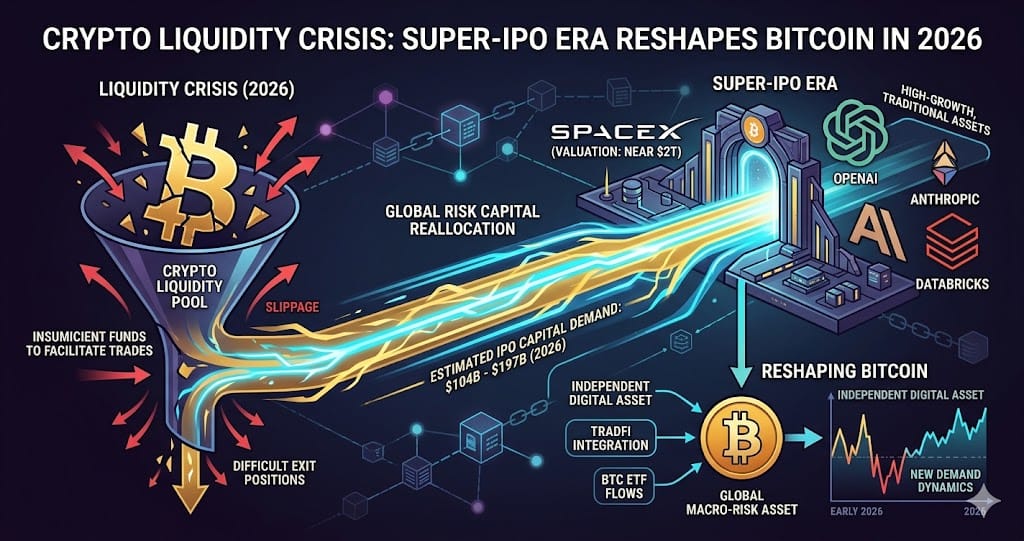
Bitcoin dropped below USD 66,000 in early June 2026, its lowest price since February 2026, closing an 8-week losing streak and a 16% monthly decline. The primary driver is not an on-chain or regulatory event but a structural capital competition: SpaceX, Anthropic, and OpenAI are collectively targeting more than USD 240 billion in IPO fundraising before year-end, drawing from the same institutional and retail pools that allocate to digital assets.
Spot Bitcoin ETFs recorded 10 consecutive days of net outflows totaling USD 2.97 billion, with three-week cumulative outflows reaching approximately USD 4.21 billion. The Altcoin Season Index sits at 49 out of 100, BTC dominance holds at 56%, and the only sectors attracting selective institutional inflows are real-world assets, digital asset treasury companies, and AI-integrated compute networks.
The Super-IPO Era Is Pulling Capital Away From Crypto
SpaceX is targeting a June 2026 pricing of USD 135 per share with roughly USD 75 billion in fundraising at a valuation near USD 1.75 trillion. Anthropic filed confidentially for its IPO on June 1, 2026, carrying an estimated valuation of USD 965 billion. OpenAI is also preparing a large public offering. Together, these three non-crypto listings are projected to absorb more than USD 240 billion in investable capital before the end of 2026.
The effect is already visible in crypto company behavior. Kraken, Ledger, and Grayscale each paused their own 2026 IPO plans citing deteriorating market conditions. This directly signals that the crypto primary market is cooling while AI and big-tech offerings absorb capital that would otherwise support digital asset valuations.
For active traders, the key implication is that this is not a within-crypto rotation from Bitcoin into altcoins. Capital is leaving the asset class entirely. ETF outflows of USD 1.67 billion in the week ending June 3 alone confirm the pace of institutional exit.
Digital Asset Treasury Companies Reach 142 But Face Their First Stress Test
Digital asset treasury companies, or DATcos, have grown from 4 firms in 2020 to 142 as of mid-2026, with 76 of those launched in calendar year 2025. These are publicly traded companies whose primary strategy involves holding cryptocurrency on their balance sheets. Since 2020, DATcos have collectively spent at least USD 42.7 billion acquiring crypto assets, with Bitcoin purchases accounting for at least USD 30 billion, representing 70.3% of total DATco buying.
The concentration is significant. Of 142 DATcos, 113 hold Bitcoin exclusively, 15 hold Ethereum, and 10 hold Solana. By dollar value, Bitcoin represents 82.6% of all DATco holdings, followed by Ethereum at 13.2% and Solana at 2.1%. Bloomberg reported that the crypto price crash on February 5, 2026 triggered a broad rout in DAT stocks, and Nasdaq analysts are now openly debating whether DATcos represent a durable asset class or a cyclical trend.
For intermediate traders, DATcos offer equity-market exposure to crypto without direct token ownership. However, the February 2026 drawdown demonstrated that these stocks tend to amplify crypto downturns rather than dampen them, making them a higher-beta instrument than the underlying assets.
RWA and Tokenized Stocks Grow From Experiment to a USD 29 Billion Sector
The real-world assets sector expanded 256.7% in roughly 15 months, rising from USD 5.42 billion in early 2025 to USD 19.32 billion in Q1 2026 and approximately USD 29.2 billion by April 2026. Tokenized private credit accounts for roughly USD 17 billion of that total. Tokenized Treasuries grew 225.5%, adding USD 9 billion, and tokenized commodities expanded 289% to reach USD 5.5 billion, with gold-backed tokens leading that subcategory.
Tokenized stocks represent a newer but fast-accelerating sub-segment. Market capitalization for tokenized equities jumped from USD 2.09 million on June 30, 2025 to USD 486.7 million by March 31, 2026. Circle is the largest single tokenized holding at USD 171.4 million, followed by Nvidia at USD 42.59 million, Alphabet at USD 36.91 million, and MicroStrategy at USD 26.15 million. Kraken acquired Backed Finance in December 2025, giving it direct control over tokenized stock issuance at the exchange level.
RWA perpetual contracts add a high-velocity trading layer on top of the sector's underlying growth. RWA perps recorded USD 524.79 billion in Q1 2026 alone, putting them on pace to more than double the USD 313.02 billion recorded across all of 2025. This merges what was historically a slow, buy-and-hold RWA narrative with the high-turnover mechanics of perpetual DEX trading.
DePIN Gets an AI Revenue Boost as World Cup Tests Prediction Markets
Decentralized physical infrastructure networks including Akash and io.net are drawing renewed capital attention by absorbing real AI inference and training workloads. Enterprise cloud buyers are using these networks for overflow compute, edge processing, and distributed storage, generating actual revenue for token holders rather than relying solely on emissions-based incentives. This shift from speculative yield to verifiable cash flow aligns with the broader 2026 market preference for sectors with tangible income anchors.
On-chain prediction markets are approaching a significant real-world stress test. The 2026 FIFA World Cup opens June 11 in the United States, Canada, and Mexico. Polymarket and Kalshi combined have recorded roughly USD 416.7 million in total volume across winner markets ahead of the tournament. Whether this event converts non-crypto users into on-chain participants is being tracked as a potential breakout indicator for the prediction market category.
The Altcoin Season Index reading of 49 and BTC dominance at 56% confirm that broad altcoin rotation has not materialized. Historical patterns suggest wider rotation becomes more likely when Bitcoin dominance falls sustainably below 55%. Current conditions favor selective positioning in specific sectors with real revenue such as DePIN, RWA, and prediction markets rather than a generalized altcoin rally.
What to Watch
- BTC dominance at 56% remains the primary rotation trigger to watch: a sustained drop below 55% has historically preceded broader altcoin inflows, and this threshold has not yet been crossed as of early June 2026
- SpaceX IPO expected to price at USD 135 per share in June 2026, targeting USD 75 billion in fundraising from institutional pools that also allocate to spot Bitcoin ETFs, making its timeline a direct headwind for crypto capital
- FIFA World Cup opens June 11, 2026 across North America: Polymarket and Kalshi winner markets have already recorded USD 416.7 million in combined volume, making this the prediction market sector's first large-scale real-world catalyst
- RWA perpetual contracts posted USD 524.79 billion in Q1 2026, on pace to exceed USD 1 trillion annually, creating a high-turnover trading layer that is attracting capital otherwise directed at meme coins and speculative altcoins
Ready to start trading?
Trade on Bitget Try CoinTech2uAffiliate links — we may earn a commission at no extra cost to you.
Related Articles
- Bitcoin's $1.85 Billion Liquidation Cascade Explained: June 2026
- Bitcoin's Record 67-Day Negative Funding Streak and June 2026 Liquidation Risk
- 2026 Crypto Narratives: Capital Is Rotating, Not Retreating
Frequently Asked Questions
Why is Bitcoin falling in June 2026?
Bitcoin fell below USD 66,000 in early June 2026 primarily because institutional capital is being redirected toward major non-crypto IPOs. SpaceX, Anthropic, and OpenAI are collectively targeting over USD 240 billion in fundraising, directly competing with digital assets for the same investor capital. Spot BTC ETFs recorded 10 consecutive days of outflows totaling USD 2.97 billion, with three-week cumulative outflows reaching approximately USD 4.21 billion, confirming that the sell pressure is institutional in nature.
What are digital asset treasury companies and why do they matter to crypto markets?
Digital asset treasury companies, or DATcos, are publicly listed firms that hold cryptocurrency as a primary balance sheet asset. There are now 142 such companies, up from just 4 in 2020, and they have collectively purchased at least USD 42.7 billion in crypto since then. They matter because they create a new channel for traditional equity investors to gain indirect crypto exposure, but the February 5, 2026 crypto sell-off showed that DAT stocks amplify crypto downturns rather than hedge against them, making them a higher-risk instrument than they initially appear.
Is altcoin season coming in 2026?
Based on current data, broad altcoin season has not yet arrived. The Altcoin Season Index stands at 49 out of 100, well below the 75 threshold that has historically signaled confirmed rotation. Bitcoin dominance is at 56%, and rotation has typically accelerated when dominance falls below 55%. The current environment favors selective inflows into specific sectors such as RWA, DePIN, and prediction markets rather than a generalized rally across altcoins.